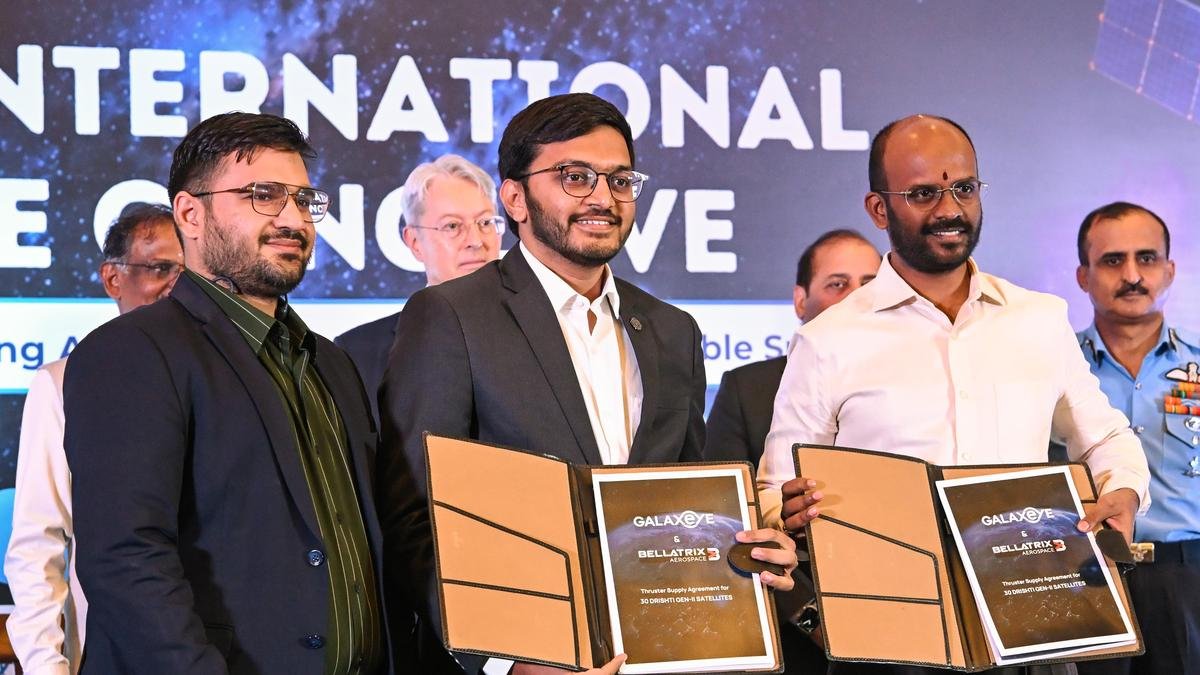


GalaxEye and Bellatrix Aerospace representatives pose with the signed MoU to supply propulsion systems for 30 Drishti Gen-II satellites during the 5th India International Space Conclave, in New Delhi.
| Photo Credit: ANI
Indian space companies GalaxEye and Bellatrix Aerospace on Tuesday (November 24, 2026) signed a multi-year contract in which Bellatrix Aerospace will supply in-space propulsion systems for the next 30 satellites GalaxEye is building.
This made the deal the “largest business-to-business order” one Indian private space company has placed with another since the space sector opened to private players in 2020, a press release noted. While private companies have participated in India’s space sector since inception, it has usually been as suppliers to the Indian Space Research Organisation (ISRO).
The GalaxEye-Bellatrix deal was unveiled at the 5th India International Space Conclave, organised by the Indian Space Association (ISpA). The financial details of the contract were not disclosed.
Both companies are based in Bengaluru.
GalaxEye is building the world’s first OptoSAR satellite constellation. OptoSAR is a proprietary imaging technology that allows customers to see any place on Earth through clouds, smoke, and darkness. Bellatrix builds the thrusters that steer and position satellites once they reach orbit, with hardware already flight-tested on ISRO missions.
“OptoSAR satellites are demanding customers. They need precise, repeatable orbits across a whole constellation, not a single demonstration. Our thrusters have already fired in orbit on ISRO missions, and we have built the production lines to deliver that same performance at constellation scale,” Rohan M. Ganapathy, co-founder and CEO of Bellatrix Aerospace, said in a statement. Bellatrix makes electric and green propulsion systems for satellites and orbital transfer vehicles.
Mission Drishti, launched on a SpaceX Falcon 9 on May 3, 2026, became the world’s first OptoSAR satellite in orbit. It validated GalaxEye’s spacecraft deployment, attitude control, onboard computing and in-house mission operations before contact was lost after a geomagnetic storm, the company stated.
In September, the Department of Science and Technology’s Technology Development Board committed ₹63.84 crore from the Government of India’s Research, Development and Innovation (RDI) Fund for GalaxEye’s next multi-sensor satellite, which targets imagery sharper than 0.5 metres. Sourcing propulsion from a partner in the same city gives GalaxEye closer engineering control and shorter lead times as it builds that satellite.
“Drishti taught us that every critical system on a satellite has to be one we can see, test and improve up close,” Suyash Singh, co-founder and CEO of GalaxEye, said in a statement.
‘Private sector indispensable’
ISRO chairman V. Narayanan said that private industry was now indispensable to India’s space ecosystem. “Today, we are extremely happy that 440 start-up companies are working in the space area. Whenever a launch vehicle lifts off or we place a satellite, 70-80% of the budget is pumped into the Indian industry. Without the support of Indian industry, we would not have reached the present level.”
Other officials, however, pointed out while India was putting in place a system to increase capacity, it had to work towards increasing demand for products from the private space ecosystem. “The first phase of India’s space reforms opened the sector and created an institutional framework for private participation. Now India has to work on generating heavy demand. I have less concern about capacity being created; I see a bigger need for demand to be created. The second is to have enough money coming into the sector, and number three, to have procedures at all levels. Space is not a sector that is going to give you a payback in six months or nine months. Perseverance is required, and the government must continue to have policy stability,” said Pawan Goenka, chairman, InSpace, India’s single-window regulatory and promotional body for the private space sector.
Published – November 24, 2026 09:16 pm IST