


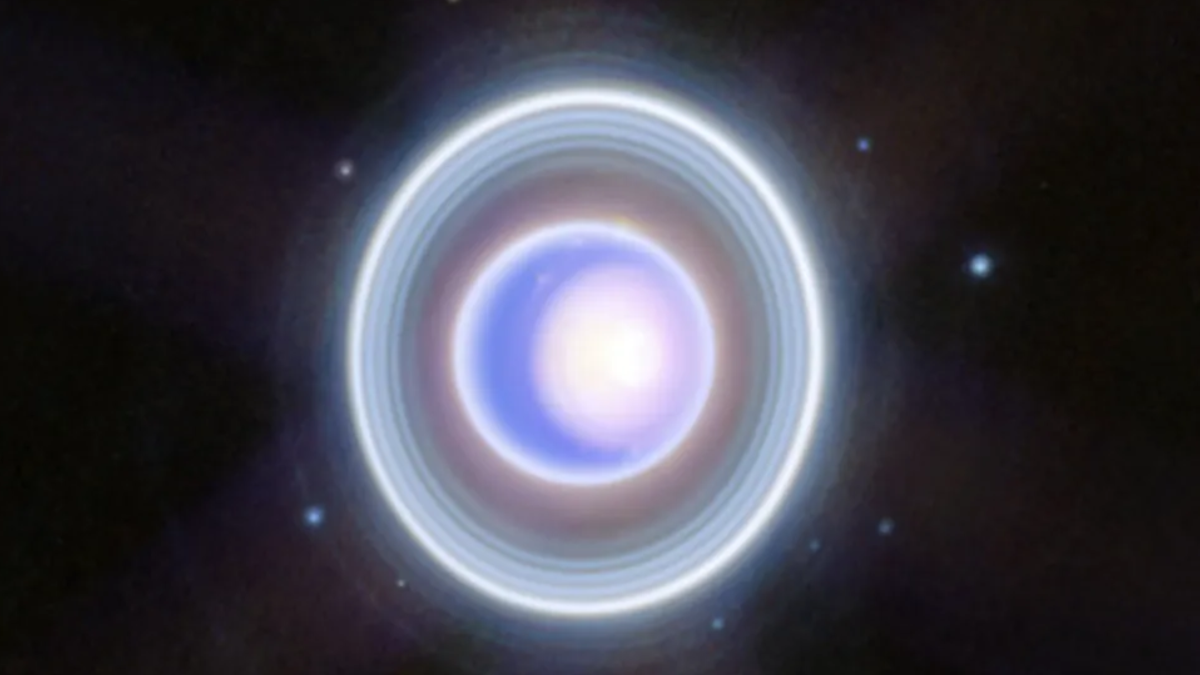
Uranus, which stands as the seventh planet from the sun, exists as a frigid planet that rotates on its side and is an ice giant that possesses an exceptional ring system that differs from all other solar system rings. The thirteen rings of Uranus remained unknown until 1977, while Saturn displays its extensive and luminous ring system. The mu (μ) and nu (ν) rings, which represent the most distant outer rings, have provided new information about moons that scientists have yet to discover.
Two Rings, Two Very Different Stories
Published in the Journal of Geophysical Research: Planets, research conducted by Imke de Pater at the University of California, Berkeley, used observations by the JWST, Hubble and the Keck Observatory to develop the first composite reflectance spectrum for both rings. The results are fascinating. The bluish μ ring is composed of water ice particles knocked off a small moon known as Mab through micrometeoroid impacts. The reddish ν ring, on the other hand, is mineral and includes 10–15% carbon-based organics, resulting from the orbits of unseen moonlets within its vicinity.
The Search for What Lies Hidden
The ν ring’s dust, containing abundant organic matter, suggests that undiscovered satellite bodies, too faint to be discovered by our present-day telescopes, are orbiting within Uranus’s known inner moons. The mystery deepened in 2025 when the James Webb Space Telescope discovered another Uranian moon, S/2025 U1, which was only 10 kilometers wide, according to ScienceDaily, hinting at the existence of even more tiny bodies yet to be discovered. The reasons behind the icy nature of Mab compared to its rocky inner companions have yet to be explained. It has been widely accepted that a mission to Uranus could help solve such perplexing riddles.