


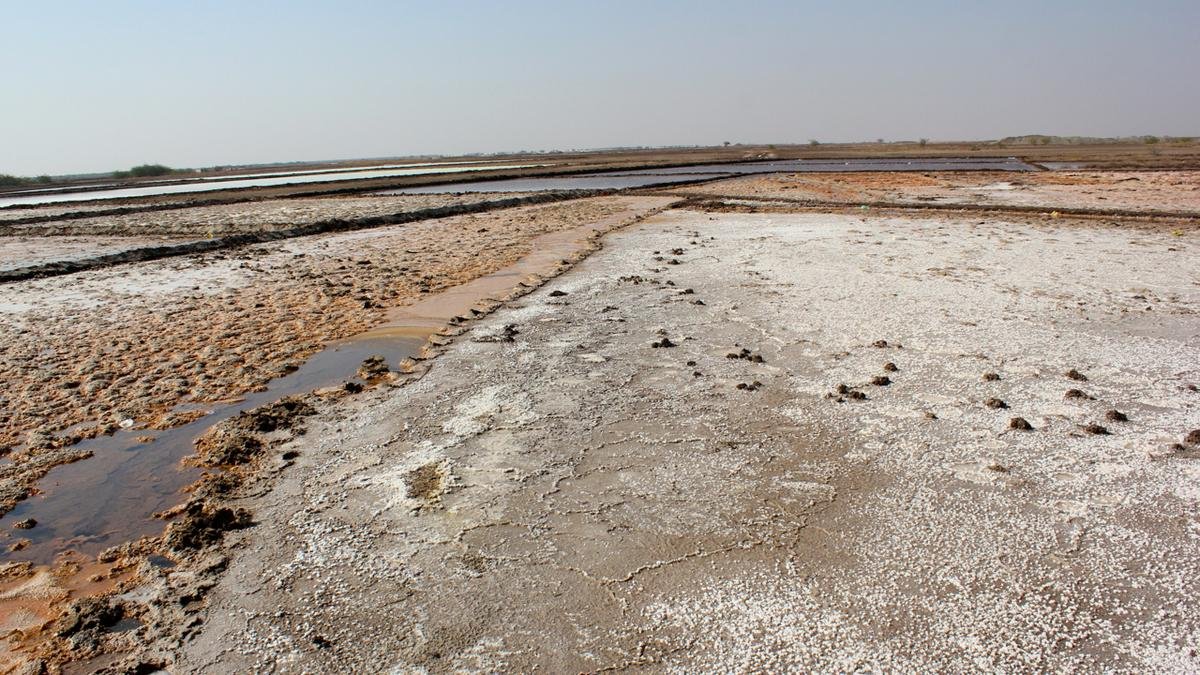
The boundary between land and sea is neither fixed nor clear. The soil does not suddenly stop and give away to a wall of water. Instead, the line is often a salt marsh, where ocean waves break and lose vim as they pass over the marsh’s elevated surface and push against the stems of salt-tolerant plants.
Gujarat is home to India’s largest coastal salt marshes, with smaller areas in Tamil Nadu, Andhra Pradesh, and Maharashtra, among some other places. One 2020 study in Estuarine Coastal and Shelf Science estimated they covered around 290 sq. km in all, and supported wildlife and stabilised coastal sediments. Unfortunately they also face significant threats from expanding aquaculture and coastal development.
As global warming continues, storms become ever stronger and water levels rise, these coastal zones are slowly being acknowledged for the formidable natural buffers they are. But they are being threatened as well, especially their plants, and what might happen if they are gone?
A 2014 study in Nature Geoscience used a wave flume — a long tank filled with water that uses a mechanical paddle to generate waves — to show that the plants of the salt marsh could break waves substantially even when their stems bent or broke.
A new study in Nature by researchers at Wageningen University & Research in the Netherlands took the study a big step further. The team moved 306 sq. metres of a live salt marsh, down to the soil and roots, from the coast of the Dutch Wadden Sea to a 300-metre-long flume at the Deltares Research Institute, capable of creating the world’s largest artificial waves. There, the marsh was tested at different depths against waves measuring 75 cm, 1.25 metres, and 2 metres high over many hours.
The findings were remarkable: the marsh’s elevation fell only 7 mm but at the cost of the flora on the surface losing 75-80% of their biomass and having their stems become shorter by almost half. The researchers concluded the plants’ dense network of roots had helped hold the sediments together. The team also found the plants cut the height of waves 75 cm high by 6-22% but those of waves 2 metres high only by up to 6%.
The team also combined their findings with maps of salt marshes worldwide and modelled the storm surges there. For once in a century storms — the kind climate change is rendering more common these days, like Cyclone Nisarga in 2020 — the team elucidated two kinds of outcomes. Where the incoming waves are at most a metre high, the plants could be expected to cut the height of waves by over 10%, in some instances by as much as 50%. But if the waves got higher, the plants (alone) also became less effective at attenuating them.
Obviously these figures are not a guarantee for every coast everywhere. The study relied on a Dutch marsh dominated by one species of grass (Elymus athericus). A different study published this year, in Communications Sustainability, also found that marsh species with more flexible stems often survived extreme waves better than stiffer ones.
Nonetheless, the findings are important: they reinforce the ecological value of salt marshes, including the roots they still hold on exposed coasts.
From the Science Pages
Question corner
Why is glass transparent?
Flora and Fauna
Published – October 27, 2026 01:14 pm IST