


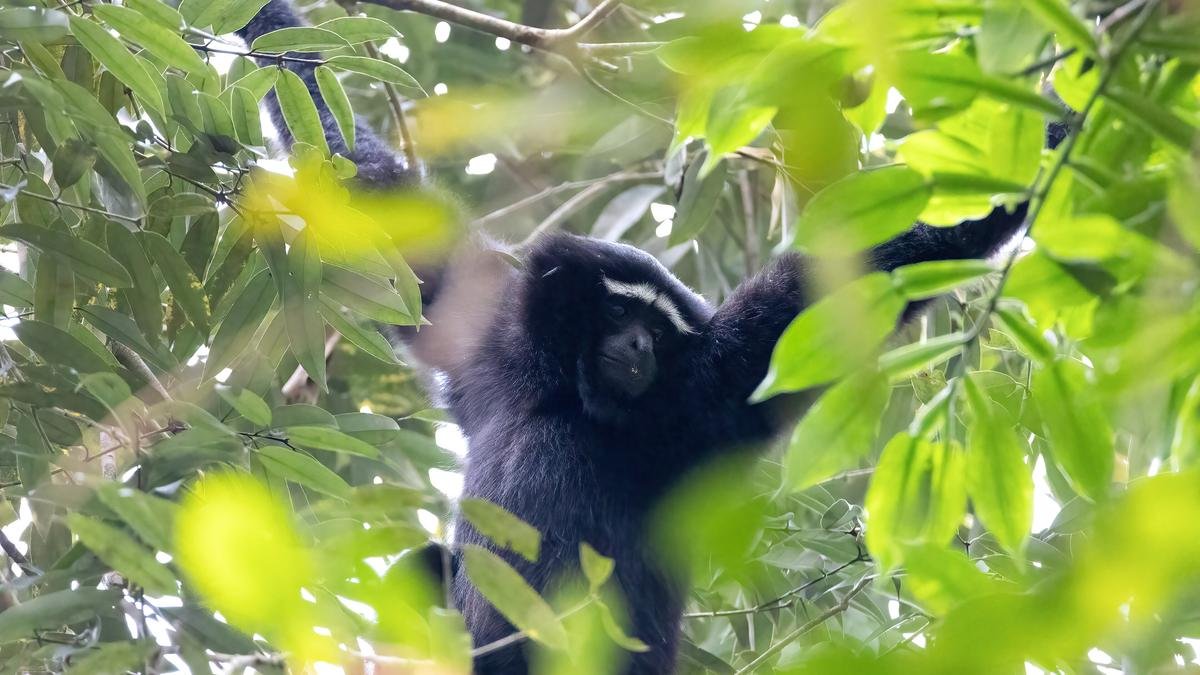

A male western Hoolock gibbon hangs from the lower branches of a tree in the Hoollangapar Gibbon Sanctuary.
| Photo Credit: Krunal Desai (CC BY-SA)
The Hoolock gibbon is India’s only ape other than us humans. Found in Northeast India, mostly to the south of the Brahmaputra river, the western and eastern hoolock gibbon populations have declined by 90% in the last few decades. The main reason for this has been the fragmentation of their habitats — the range that individuals can freely roam over — by roads and railway lines.
The gibbons are particularly vulnerable to such fragmentation because of their unusual body structures. Adults are typically three feet tall but have five-foot long arms. They are very vulnerable when walking on land: their awkward gait makes them easy targets for wild dogs and leopards. The gibbons have adapted to an arboreal lifestyle, using their long arms and the natural spring action of tree branches to move high above the ground with a rapid grace.
Yet this also requires a continuous canopy of trees. A road or a rail line completely cuts off one section of a forest for them. These gibbons mate for life and mated pairs ferociously guard their territory. Linear infrastructure effectively creates isolated pockets of gibbon populations. Smaller territories support fewer gibbons, and over time this leads to genetic isolation, inbreeding, and a decline in numbers.
The problem is not faced by gibbons alone. The lion-tailed macaque’s habitat around the town of Valparai in Tamil Nadu is fragmented by coffee and tea estates, and interconnecting roads lying between stretches of rainforest. Around the world too, the slow loris in Indonesia and the three-toed sloth in Central America have faced fragmentation catastrophes. Both these animals are notoriously slow movers, preferring to move while hanging upside down on branches.
Hoolock gibbon populations began to be fragmented when railway networks were expanded into Eastern Assam in 1887. One such fragment eventually became the Hoollangapar Gibbon Sanctuary, which has a woefully small population of about 130 western hoolock gibbons, out of a total of only 3,000-5,000 in Northeast India. Conservation efforts began in earnest long after the railway lines were operational, led by local organisations such as Aranyak.
To create a natural bridge over the railway line, a careful and dense planting of trees on either side of the track was undertaken. About 15 years later, the canopies of trees on either side of the track came together to form a bridge that the apes could swing over. And even before the canopy bridge was established, gantry bridges were put up.

Efforts to help arboreal creatures find their kin and supplies of food have been successful at other locations, too. The giant Indian squirrel is more frequently seen as roadkill than in the wild. This magnificent creature, which has a body that is over a foot in length and an even longer tail, prefers to live in the canopies above 30 feet, and has been aided by braided rope bridges installed at many places, from the Melghat Tiger Reserve in the Satpuras in Maharashtra to the Srivilliputhur Grizzled Squirrel Sanctuary in Tamil Nadu.
Other land animals too need measures to prevent habitat fragmentation. Heavily populated countries such as the Netherlands are at the forefront of this. This country has an animal overpass that is nearly a kilometre long and spans a highway, a rail yard, and a golf course. Our increasingly busy highways surely need such facilitators for our wildlife.
The article was written in collaboration with Sushil Chandani, who works in molecular modelling.
dbala@lvpei.org
sushilchandani@gmail.com
Published – October 16, 2026 09:00 am IST