


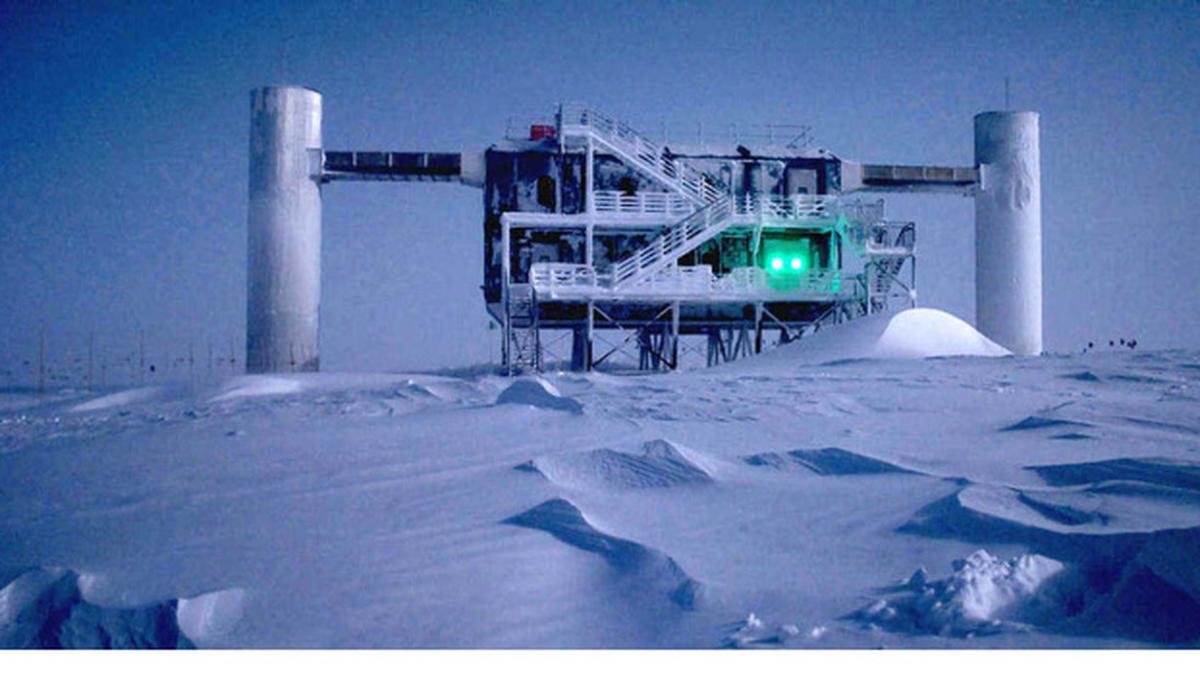
The story so far: Belgian-born U.S. physicist Francis Halzen has won the physics Nobel Prize for 2026 for helping build the IceCube observatory in Antarctica — a telescope that has no mirrors or lenses and doesn’t even point at the stars. Using 5,000 sensors buried deep in the ice, IceCube has explored what natural processes in the cosmos can accelerate subatomic particles to energies far beyond any human technologies have managed so far.
What are neutrinos?
Since the early 20th century, scientists have known that energetic particles called cosmic rays constantly bombard the earth from outer space. Most cosmic rays are protons or the nuclei of elements like helium and iron. Some of these particles have been found to have more energy than the world’s largest particle accelerator — the Large Hadron Collider (LHC) in Europe — can manage.
Scientists thought powerful events like exploding stars or jets of energy emitted by distant galaxies could have given these particles a Herculean push, but they couldn’t know for sure. Just looking in the direction a cosmic ray came from didn’t help. Since cosmic rays are charged particles, they could have been deflected by magnetic fields in space before reaching the earth.
So scientists turned to neutrinos. These subatomic particles have no electric charge, a very small mass, and interact very rarely with matter. Nuclear reactions, like fusion in the sun’s belly, produce neutrinos in copious numbers, and trillions of them pass through your body — and through the earth — every second without leaving any trace. And they travel in a straight line through space.

How do you catch a neutrino?
Halzen and others came up with the idea of IceCube to ‘catch’ and study neutrinos with very high energy. When a cosmic-ray proton strikes other atoms, it can produce particles called pions, which rapidly decay through reactions that could produce neutrinos. And these high-energy neutrinos are an indication that some high-energy event produced them.
But neutrinos’ reluctance to interact with matter also makes them extremely hard to catch. This is why the IceCube observatory is in Antarctica: the enormous volume of frozen water ice is the catcher, and the 5,000 sensors embedded in the ice look for the occasional evidence of a neutrino striking the ice.
This idea actually predated Halzen’s insight, going back to the 1960s. Scientists, including John Learned, once tried to build a detector in the Pacific Ocean but maintaining the facility’s instruments underwater proved too difficult. In 1987, after being alerted to a Soviet Union plan to study neutrinos in Antarctic ice, Halzen, Thomas Stanev, and Enrique Zas concluded the approach would be unsuitable for the energies they were interested in.
Instead, Halzen wondered if it’d be possible to track neutrinos colliding with ice by looking for small flashes of light their collisions might produce. After discussing the idea with Learned, the two physicists proposed using South Pole ice as a neutrino catcher, with Halzen going on to organise the effort, funded primarily by the U.S. National Science Foundation, that eventually became IceCube.

One of the sensors the IceCube detector array uses to spot signs of neutrinos in the ice.
| Photo Credit:
Amble (CC BY-SA)
According to the Nobel committee, Halzen has been feted for proposing the idea as well as keeping hundreds of scientists and engineers working on it for decades. In this sense, the physics prize this year is reminiscent of the same prize for Barry Barish in 2017, who coordinated the complex effort to set up the LIGO gravitational-wave detectors.
How does IceCube work?
After unsurprising delays and setbacks attending to an enterprise of this magnitude, IceCube took its full shape in 2011 following seven years of construction. In particular, crews of experts dug holes in the ice to place the sensors not using shovels but by shooting jets of hot water, then lowering sensors suspended on cables fast enough before the ice froze again.
Today, IceCube includes 5,160 optical sensors on 86 cables, lying 1.4 km to 2.4 km under the ice, altogether encompassing roughly a cubic kilometre of ice. Each sensor has a device that converts the faint light from a collision into an electric signal and records it. The collective data flows to computers on the surface and thereon to researchers around the world.

A schematic illustration showing the arrangement of the laboratory and the sensors. The Eiffel Tower is depicted in the bottom right corner for a size comparison.
| Photo Credit:
Karen Andeen and Matthias Plum/IceCube Collaboration
When an energetic neutrino strikes an atom’s nucleus inside the ice, the event creates charged particles that streak through the surrounding ice. Some of them even move faster than light can in that material. Just as doing this with sound creates shockwaves, outrunning light causes the particles to emit Cherenkov radiation, visible as a dull blue glow. The sensors look for and record this emission.
Different kinds of neutrino interactions produce different kinds of particles that outrun light. Taking this together with which sensors recorded the glow and in what order, IceCube researchers can piece together the neutrino’s energy and direction. Of the lakh or so neutrinos IceCube registers every year above an energy cutoff, only around a hundred come from astrophysical sources in outer space.

What has IceCube found?
In 2013, scientists identified two neutrinos with around 140-times the energy of a proton accelerated by the LHC. With more data and analysis, the collaboration established that a population of high-energy neutrinos was coming to our planet from elsewhere in the universe — and that IceCube could spot them. It was a landmark event in a new field called neutrino astronomy.
In 2017, IceCube found an energetic neutrino coming from a distant galaxy, whose central black hole was also powering a jet of radiation pointed roughly at the earth. In 2022, the instrument found more neutrinos than expected coming from NGC 1068, a galaxy 46 million lightyears away, also with an active central black hole.
The observatory has also been a centerpiece of multi-messenger astronomy, in which astronomers study the universe using a combination of messengers — e.g. light particles (e.g. visible light, gamma rays, etc.), neutrinos, and gravitational waves — to acquire a picture more complete than only one of these modes could reveal.
IceCube’s own work remains unfinished as scientists are still working on the sources of the universe’s most energetic neutrinos and how neutrino-catching events can be correlated with, say, observations in gamma rays. IceCube has won Halzen his prize, then, for opening a window into parts of the universe that were until recently beyond our reach and for showing that an international scientific collaboration can achieve more than the sum of its parts.
mukunth.v@thehindu.co.in
Published – October 07, 2026 07:00 am IST