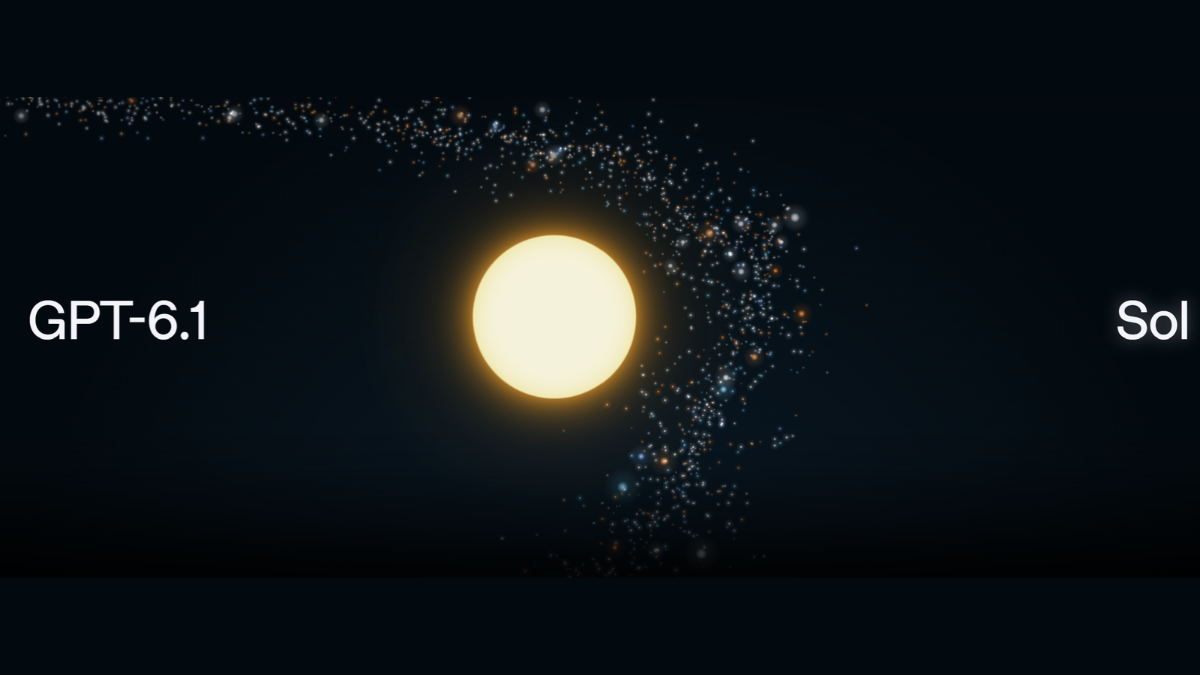
OpenAI launched its new GPT-6.1 Sol on Tuesday as the successor to its recently released GPT-6 Sol AI model. The new model was introduced during the OpenAI Dev Day 2026 event on Tuesday, along with the ChatGPT Dots agent and its new collaborative platform called ChatGPT Space. OpenAI claims that its latest GPT-6.1 AI model delivers enhancements on multiple fronts over its predecessor, including agentic coding, computer use, and professional work. It is claimed to “nearly match” GPT-6 Astra’s capabilities, while being notably more cost-efficient. The Sam Altman-led AI giant also claims that the GPT-6.1 Sol outperformed Anthropic’s Opus 5.5 with fallbacks.
GPT-6.1 Sol Availability, Pricing
During the OpenAI Dev Day 2026, the AI giant’s annual developer conference, the Sam Altman-led firm launched the latest GPT-6.1 Sol AI model, which succeeds the GPT-6 Sol. The new AI model is currently available to all Plus, Pro, Business, Enterprise, and Edu users. Subscribers can access GPT-6.1 Sol via ChatGPT Work and Codex. However, it has yet to be released in Chat. Meanwhile, developers can access the AI model via the OpenAI API.
In terms of API pricing, GPT-6.1 Sol costs $2 (roughly Rs. 192) per million input tokens, $0.10 (about Rs. 10) per million cached input tokens, and $10 (roughly Rs. 960) per million output tokens. The company also plans to release GPT-6.1 Sol Ultrafast in the coming days, which is claimed to deliver up to 8x faster token generation than the standard speed in Codex.
GPT-6.1 Sol Improvements, Capabilities
OpenAI claims that GPT-6.1 Sol nearly matches the intelligence of the GPT-6 Astra AI model in agentic coding, computer use, and professional work. However, it delivers these capabilities at one-fifth the standard input and output token prices and 95 percent less cached input token prices than the GPT-6 Astra model. It is also more cost-efficient than its predecessor, costing 50 percent less than GPT-6 Sol’s cached input token prices.
At the same time, GPT-6.1 Sol is claimed to be better than GPT-6 Sol at executing complex professional tasks, like writing and debugging code, understanding documents, and executing multi-step business workflows. On DeepSWE’s benchmarking test, GPT-6.1 Sol nearly matched the performance of GPT-6 Astra, while executing the same task at one-fifth the cost. Moreover, it outperformed GPT-6 Sol by 6.4 percent at a lower reasoning effort.
On the GDP.pdf test, GPT-6.1 Sol outperformed Anthropic’s Opus 5.5 with fallbacks, while costing less than half for each task in various reasoning settings. Similarly, on AutomationBench, the AI model outperforms Opus 5.5 by 2.2 percent at medium reasoning effort, while performing the task at one-third the cost.