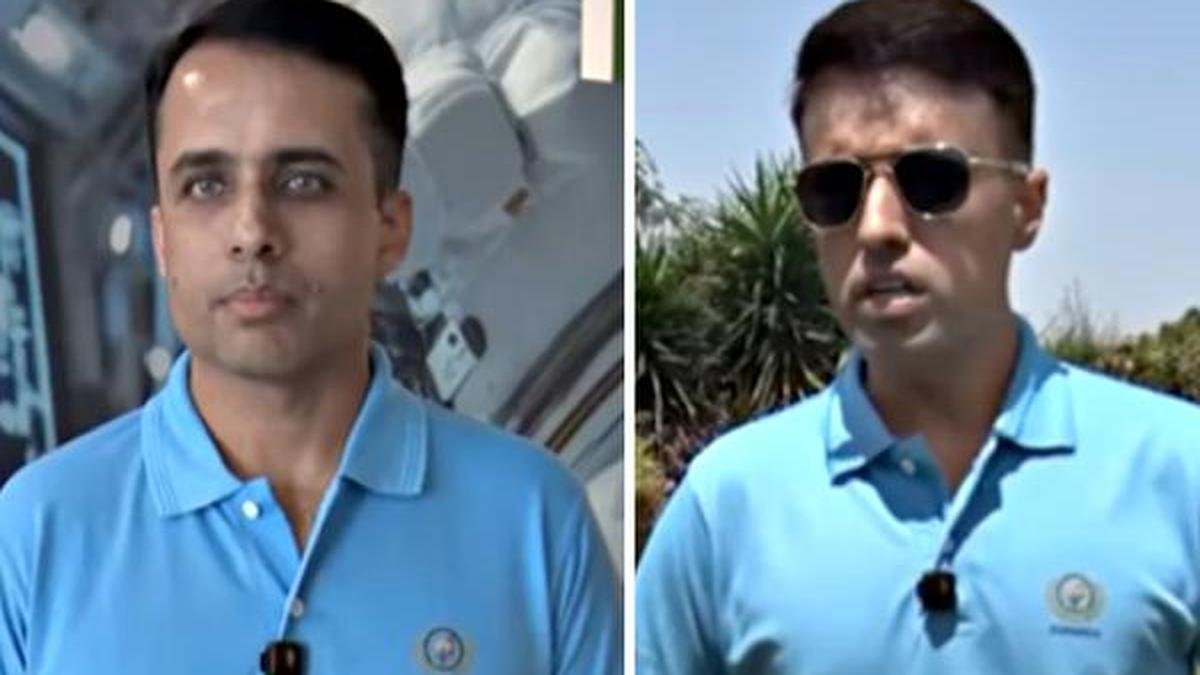


Khurram Daud (left) and Muhammad Zeeshan Ali.
| Photo Credit: Ministry of Information and Broadcasting, Govt. of Pakistan/Facebook Ministry of Information and Broadcasting, Govt. of Pakistan/Facebook
Two Pakistani pilots are memorising Mandarin, spinning in centrifuge drills, and learning to eat, sleep and repair equipment while weightless as a decision nears on which one will become the first foreign astronaut aboard China’s Tiangong space station.
The voyage into space would be a first for the South Asian nation. It is part of broader cooperation with Beijing that straddles the Belt and Road Initiative and has produced Chinese-launched Pakistani satellites, a joint satellite-navigation system and a Pakistani-built rover due to fly on China’s Chang’e 8 lunar mission around 2028.


Pilots Zeeshan Ali and Khurram Daud have spent months training at the China Astronaut Research and Training Center in Beijing for a mission that was conceived by the two countries in 2019, said Amer Gilani, who oversees human spaceflight cooperation at Pakistan’s space agency, SUPARCO.
China has not said which of the two will fly or when, but Gilani said a final astronaut selection decision is expected in mid-to-late October.
Whoever is chosen will not return to Pakistan before launch, setting off into space directly from training in China and returning home after a recovery period following the return to Earth, Gilani said in an interview.

Training includes intensive Chinese-language instruction, learning spacecraft systems, and adapting to both the microgravity of orbit and the g-forces of liftoff, he added.
“You cannot easily find scientists who are familiar with travelling and facing high-level g-forces,” SUPARCO’s director of artificial intelligence Uzair Ansari said, explaining this is why the two men with backgrounds in high-speed flying were chosen.
The details shared by Gilani and Ansari are the first insight provided by SUPARCO to foreign media since the pilots were selected and deployed to China.
China’s space agency did not respond to a request for comment about the selection process.
Once in space, the chosen pilot will carry the title of “payload specialist”, which is astronaut-speak for someone whose job in orbit is running Pakistan’s science experiments rather than flying the ship, Ansari said.
Of more than 300 proposals SUPARCO fielded from universities in Karachi, Lahore and Islamabad after a year-long campaign, Gilani said Chinese institutes picked four for this flight: biotechnology experiments that will help combat food insecurity and climate change.
Every experiment is built and pre-tested in SUPARCO’s own labs before Chinese engineers sign off.

The scientific payload is modest next to a station that has already hosted more than 180 experiments and produced over 500 research papers and 150 patents, Ansari added.
Tiangong’s three modules weigh about 77 metric tonnes combined and house roughly 14 experiment racks spanning life sciences, materials, fluid physics, combustion and radiation exposure, Gilani said.
The astronaut will fly aboard a Chinese-built spacecraft, launched from a Chinese site, trained by Chinese instructors and communicating in Mandarin in orbit.
Pakistan has no independent launch vehicle or crewed spacecraft of its own, and the stay itself will last a week.
The Pakistani astronaut is due to return with two members of a Chinese crew that arrived at the space station in May because the third member is expected to stay for a year to enable the study of long-duration human physiology in space.
Published – September 28, 2026 12:13 pm IST