
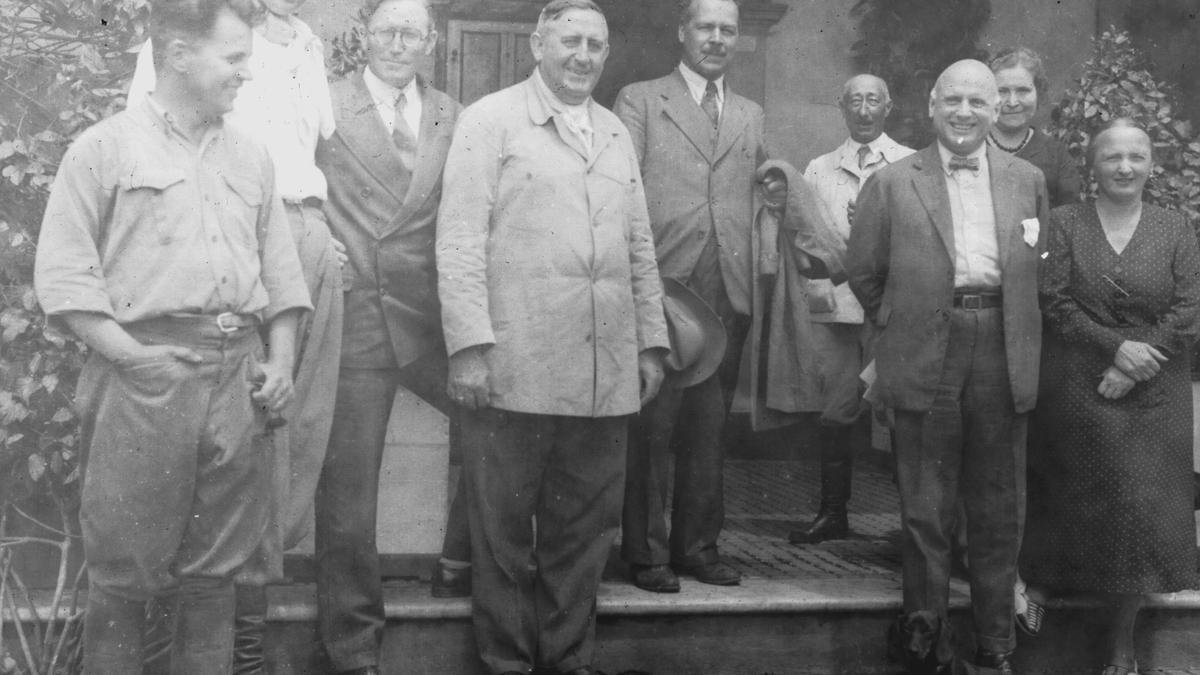
Nicolai Ivanovich Vavilov (1887-1943) was a remarkable agricultural scientist in the former USSR. His name is familiar to some as an ‘Indiana Jones’ who roamed around the world collecting crops and seeds, as someone who established the first global seed bank, as a martyr who died in prison despite his extraordinary accomplishments, and as the person who inspired so many scientists to sacrifice their everything to save a priceless seed bank during the Second World War.
Such a list, however, does not capture his intellectual contributions, which were fundamental to the utilitarian development of the seed bank.


Centres of origin
One of Vavilov’s major contributions was his paper titled ‘Studies on the origin of cultivated plants’, published in 1926. Even today, one century later, it continues to be the foundation for the study and use of crops and livestock. In fact, this work has been critical to preserving plant genetic resources and to protect the rights of farmers who had initially developed crop diversity. It is also central to the United Nations Convention on Biological Diversity and related discussions.
Humans use the plants they find where they live. But If they see something new and it does not grow nearby, they have also been known to go to extremes to get it. A familiar example is pepper, which ancient Rome traded for gold. We know about pepper because there are records that tell us the history of its spread. But what about in pre-historic times, say 6,000 years ago? We can find out from archaeological remains, which tell us about the prehistory of different peoples and cultures. We can also find out using good-old-fashioned taxonomy.


Vavilov found that most of our crops came from just eight regions of the world, which he was also the first to demarcate, and called the ‘centres of origin’. The foods on our plate today may thus have come from very different places.
| Photo Credit:
Redwoodseed (CC BY)
This was what Vavilov did, combined with the (then) new methods of genetics and evolutionary biology. Just like Charles Darwin and Alfred Russell Wallace, Vavilov travelled around the world, in his case looking for crop varieties.
He observed that varieties and their closest wild relatives tended to be confined to a geographic region. This is what we expect under evolution: every species originates at a particular time and place, and undergoes changes as it spreads to other regions. Vavilov went further than others, like Alphonse de Candolle, and examined not just one or two crops but an array, as well as the prehistoric cultural conditions in which they were modified.
Vavilov thus found that most of our crops came from just eight regions of the world, which he was also the first to demarcate, and called the ‘centres of origin’. The foods on our plate today may thus have come from very different places.

Seed bank
Time is as important as geography. We know that the potato originated in Peru and spread to other parts of South America. We know from historical records that it had been transported to the rest of the world, including India, in the post-Columbian period. So if you went back to the times of the Cholas in the ninth and tenth centuries, you would not have been able to savour potato chips.
For thousands of years, human beings selected crops for the features they wanted. These needs varied according to factors such as the climate, soils, landscape, and cultural history. Vavilov explored and collected seeds of a large number — some 2.5 lakh — of crop varieties and species. The seeds were maintained in a facility that he built into a global seed bank in 1921 in Leningrad (now St. Petersburg).


A view of the Institute of Plant Industry, where Vavilov created the world’s first seed back, at St. Isaac’s Square in St. Petersburg.
| Photo Credit:
Sergey Galchenkov (SS BY-SA)
He and his associates also conducted careful, methodical studies in a large number of field stations located in different climatic and geographical regions of the former Soviet Union. It was a large-scale experiment that allowed the scientists to analyse crop variations in diverse conditions at the field level. These efforts speeded up the rate at which varieties with suitable features could be identified for introduction or breeding in different regions.

A giant himself
Vavilov stood on the shoulders of giants — botanists, geneticists and breeders who preceded him. The scientist Eduard Regel had already put Russia on the forefront of applied botany. Regel also recognised Vavilov’s talents and placed him in positions that allowed Vavilov to interact with leading scientists across the world.
His concept of the centres of origins of crops also holds, broadly. Modern approaches, especially molecular biology, have suggested that the centre of diversity may not always be the centre of origin of a crop, as initially conceived. Thus, centres of diversity continue to be important in discussions on biodiversity and bioresources.
Undoubtedly, Vavilov was a giant himself, and deserves to be more widely recognised and remembered today.
R. Geeta is retired professor, Delhi University.
Published – September 27, 2026 08:15 am IST