


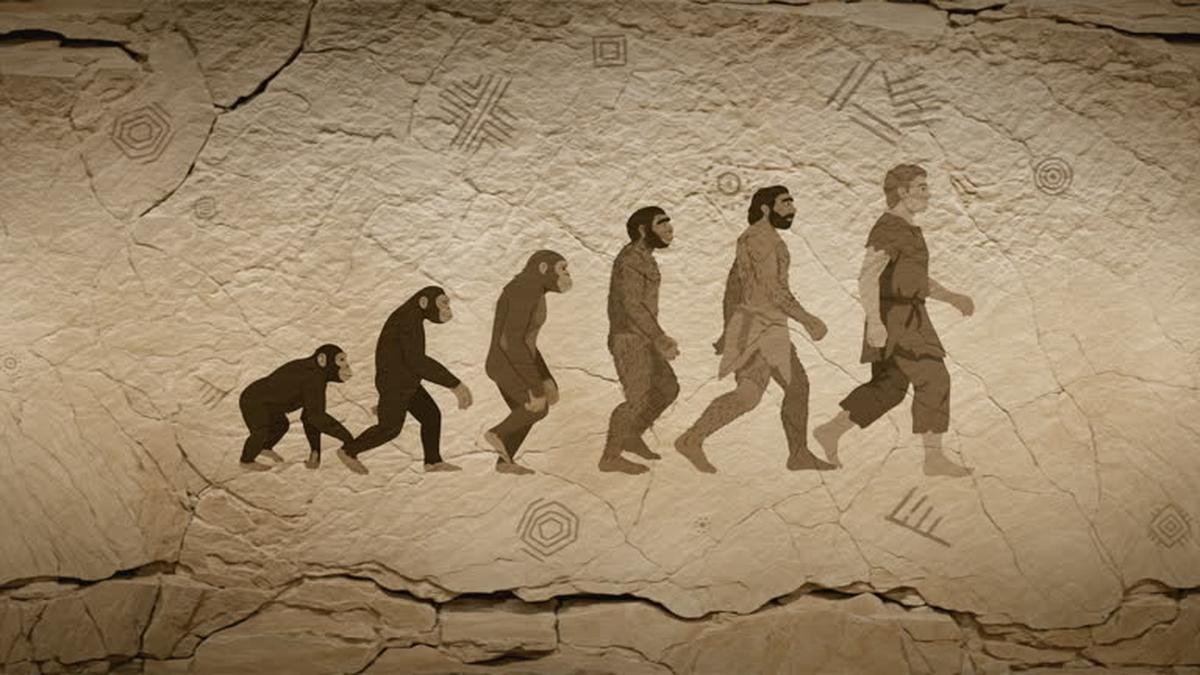

The evolutionary question about our terrestrial bipedalism has piqued paleoanthropologists for years.
| Photo Credit: Getty Images
The Hindu’s weekly Science for All newsletter explains all things Science, without the jargon.
(This article forms a part of the Science for All newsletter that takes the jargon out of science and puts the fun in! Subscribe now!)
When did our ancestors begin walking on two legs? This evolutionary question about our terrestrial bipedalism has piqued paleoanthropologists for years.
Now, a new study gives us the most conclusive evidence of when archaic humans transitioned from regularly climbing trees to habitually walking upright on the ground: and the answer is 1.8 million years ago. “Since the time of Darwin and Huxley, terrestrial bipedalism has been posed as a central tenet of the human ecological niche,” said the research paper published in the journal Science Advances.
Scientists from the University of the Witwatersrand (South Africa) and University of Southern California arrived at this conclusion after studying the internal strength of limb bones from two fossil skeletons: one, the Little Foot (a 3.67-million-year-old Australopithecus individual from Sterkfontein Cave in South Africa) and a 1.8-million-year-old archaic human from Georgia.
Much research has focused on determining the when this locomotor behaviour changed in human evolution, going back to our common ancestor, that is the time when human and chimpanzee lineages diverged 9.3 to 6.5 million years ago.
But this latest study looks at the strength of bone shafts of each species, which reflects the physical demands placed on them and how much time each species spent on trees, rather than just at the skeletal shape of their limbs. The bone strength ratios of arms and legs bone in these fossils was compared to those of modern humans, chimpanzees, gorillas and orangutans.
While the Little Foot’s limb proportions were more akin to African arboreal apes, the limb strengths in the Dmanisi Homo specimen were closer to modern humans.
The famed “Lucy,” (the 3.2-million-year-old Australopithecus afarensis found in Ethiopia) for instance, had limb strength proportions between those of modern humans and chimpanzees, “but closer to chimpanzees, indicating increased forelimb weight-bearing loads relative to modern humans.” This means a greater time spent on trees.
It is still a mystery why this shift emerged when it did, but the authors hypothesise that it could be linked to changes in their range, foraging behaviour and other factors that demanded stronger lower limbs for an adaptation to life on the ground. At the same time, it is probable that there was a shift to greater use of the forelimbs for stone-tool manufacture and enhanced (high speed) throwing for hunting, said the paper.
In 2020, another research paper published in the Proceedings of the National Academy of Sciences, which studied the shape and structure of fossil leg bones suggested that our human ancestors could have been regularly climbing trees two million years ago.
From the Science Pages
Question Corner
Why are moths attracted to bright lights?
Flora and Fauna
Published – September 21, 2026 04:57 pm IST