


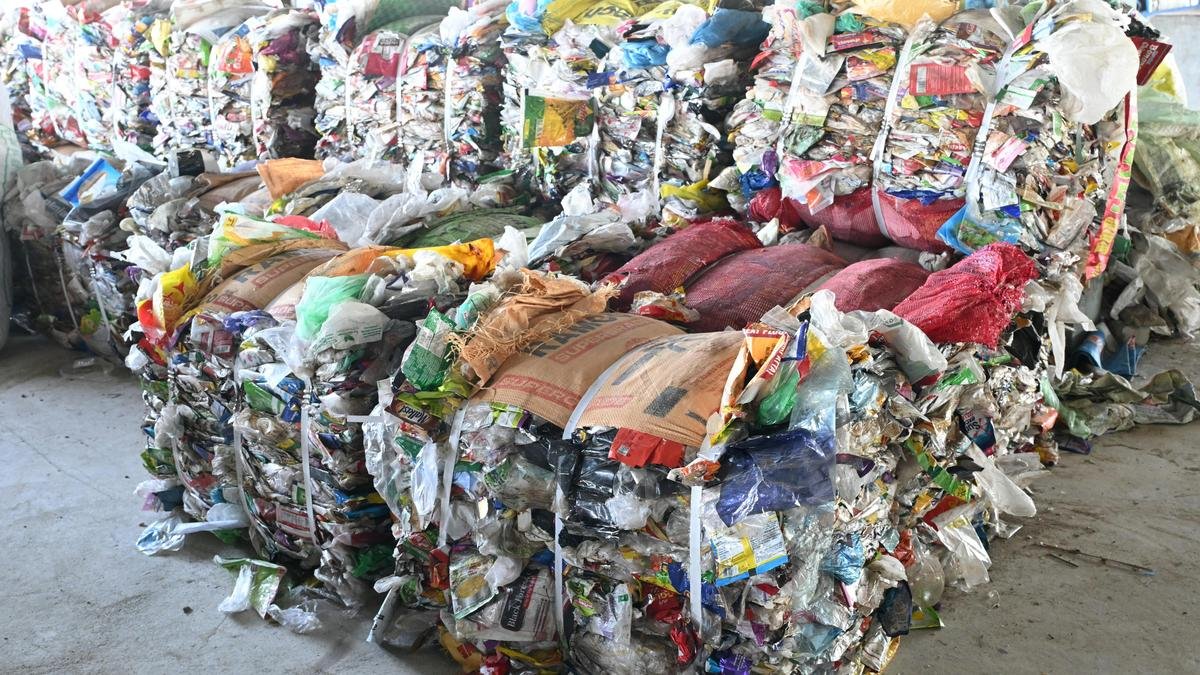

Bundles of plastic waste after being segregated at Jothi Nagar Centre in Thoothukudi, Tamil Nadu, on September 6.
| Photo Credit: RAJESH N./The Hindu
Since their synthesis by the chemist Leo Hendrik Baekeland and the explanation of their structure by Nobel laureate Hermann Staudinger, and their use since the 19th century, plastics have become convenient materials for daily use and are preferred over glass, which breaks easily. Plastics are manufactured by industry and used every day for their convenience by people, and much more in cities and suburbs than in rural villages.
A vast amount of this material is used by the consumer and most of it is thrown away as waste after a single use. India contributes more than 6.5% of the world’s plastic use. According to official estimates, the country’s plastic waste amounts to about 4.1 million metric tonnes per year. However, the Central Pollution Control Board (CPCB) has found that India generates 26,000 tonnes of plastic waste every day, which leads to 9.5 million tonnes a year. The major polluters are the cities and their suburbs, although several hundred tonnes of waste are generated in the rural areas as well, where it remains largely uncollected.

The CPCB, the non-profit group Plastics-India Foundation, which works on reducing, reusing and recycling plastics, and several private companies have been involved in collecting and reusing discarded plastics to recycle them to produce bottles that can hold oils and medically safe materials such as drugs and body lotions. Recycling has also involved making plastic chairs, tabletops, and windowpanes. Plastics like Teflon and Nylon are being used for packaging consumer goods. Plastics are also used in countries such as Australia and Canada to make bank notes, rather than using paper for the purpose. In India, we still use paper currencies, although our credit and debit cards and PAN and Aadhar cards are made with plastic.
Plastic wastes are also used to produce fuel using high heat in a process called pyrolysis. In this connection, the technologist P. Sahasrabuddhe of Pune had collected domestic waste, including plastics, from his home and produced a gas for cooking called ‘Vaayu’. Mr. Sahasrabuddhe now runs a factory that manufactures this gas and supplies them to hotels and users. Likewise, a firm in Hyderabad produces cooking gas from vegetable wastes and discarded plastics across the city. Several other cities across India have also been successful in doing so.
Plastic wastes can also produce hydrogen gas, which can be oxidised to generate clean energy. A recent paper from University of California, Los Angeles, researchers (PNAS 123 (28) e2537552123) showed how hydrogen can be produced from plastic waste using heat and atmospheric carbon dioxide as the fuel. This hydrogen, when combined with oxygen in the atmosphere, generates electricity.

A waste-to-energy plant in Karnataka has burnt some of Bengaluru’s garbage and generated electricity. Similarly, Ujjwal Pal’s group at the CSIR-Indian Institute of Chemical Technology, Hyderabad, has shown how to produce hydrogen from sea water using catalysts. It should be possible to do the same with the water in rivers and that stored in dams. A group from Columbia University has also reported a way to produce hydrogen from seaweed as the biomass (Nat. Commun. 11, 3783 (2020)). Generating hydrogen from plastic waste and seaweeds is thus useful as well as possible.
The Indian Railways also recently demonstrated a long-distance railway service that used hydrogen as fuel, instead of coal. The nuclear power plant in Kalpakkam in Tamil Nadu has also been producing hydrogen gas by heating copper chloride.
dbala@lvpei.org
Published – September 18, 2026 09:00 am IST