
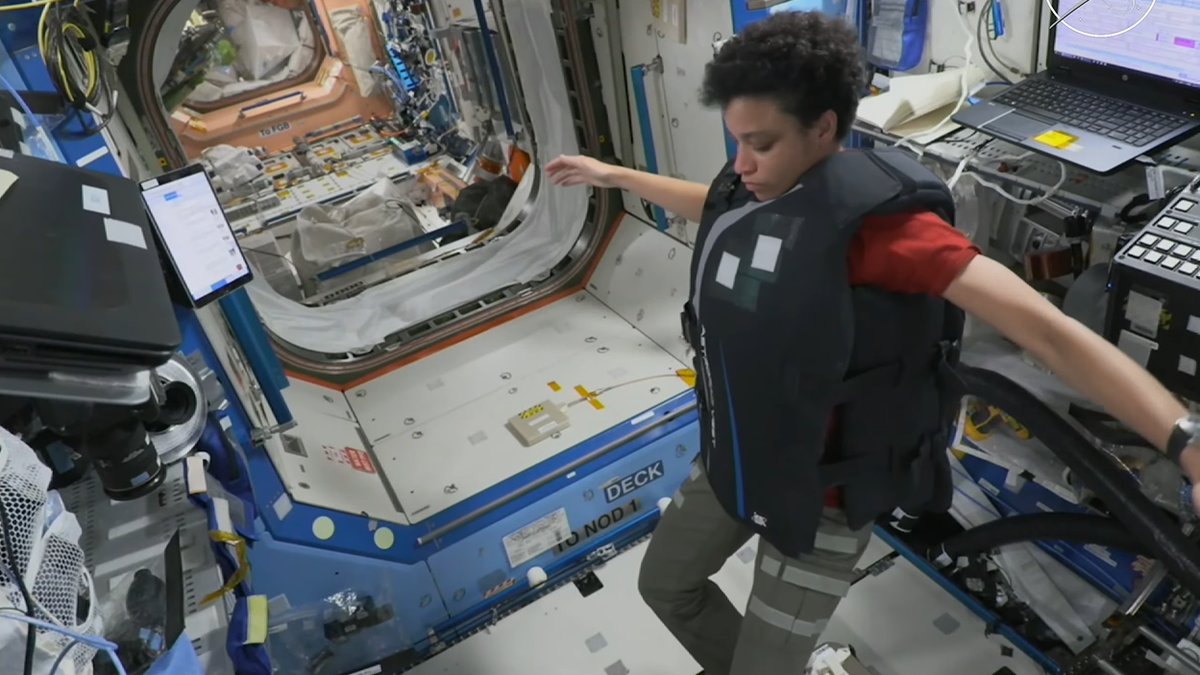


NASA astronaut Jessica Watkins evaluates the AstroRad vest onboard the International Space Station, July 17, 2022.
| Photo Credit: 2s0ckz (CC BY-SA)
Despite their best efforts to settle the moon and later Mars, humans may never become a spacefaring species, more than a few experts have said over the years. An important reason for this view is radiation. The earth has a magnetic field that keeps harmful radiation at bay, but astronauts who fly beyond this field are at risk of developing cancer and other serious health problems.
A common fix for this problem has been to add more shielding for astronauts. However, every additional kilogram increases the launch cost by a large amount, and it is often also impractical to add enough shielding to a crew capsule to cope with a major outburst of radiation from the sun.
To this end, an Israeli company named StemRad has, along with Lockheed Martin, developed a vest called ‘AstroRad’. StemRad had originally made the suit for emergency responders on the ground who may be exposed to nuclear radiation. The company adapted it for spaceflight, with a twist: AstroRad has more safeguards over the chest, abdomen, and pelvis, where there are large amounts of bone marrow, which make blood, and sensitive organs like the heart and the lungs. It also uses hydrogen-rich polymers to block radiation — materials rich in hydrogen slow energetic particles efficiently because hydrogen nuclei are similar in mass and so maximise energy transfer during collisions — rather than lead, which is more dense.
Overall, the vest is light, and made of panels pieced together to allow the astronaut sufficient freedom of movement.
In 2019 and 2020, NASA arranged for astronauts to test AstroRad onboard the International Space Station. They wore it as they performed ordinary activities and gave feedback on its comfort and functionalities, allowing engineers on the ground to make improvements.
NASA tested the improved version onboard its Artemis I mission in 2022. In this mission, the crew capsule carried two human-shaped dummies named Helga and Zohar as it travelled around the moon before returning to the earth. Both Helga and Zohar were fit with materials designed to mimic human tissue as well as radiation sensors. Zohar wrote AstroRad while Helga did not.
The results of analysing the data retrieved from the dummies were published in Science Advances on August 12. Using data collected during Artemis I to inform models of historical solar radiation events, researchers — from StemRad, Lockheed, the German, Israeli, and U.S. space agencies, and institutions in the U.S. — found AstroRad could reduce the effective radiation dose an astronaut would have received during the August 1972 solar storm by 60% and during the October 1989 solar storm by 40%. These amount to 193 and 131 fewer days, respectively of exposure to deep-space radiation.
Per the team, for astronauts heading back to the moon and eventually to Mars, AstroRad could allow astronauts to partially work through a solar storm instead of having to shelter themselves for the duration — a small but important step towards making interplanetary human spaceflight a safe reality.
That said, one particular shortcoming of the vest is that it can only deal with particles from the sun. Galactic cosmic rays that originate beyond the solar system remain harder to block.
From the Science pages
Question Corner
Flora and fauna
Published – September 02, 2026 02:20 pm IST