


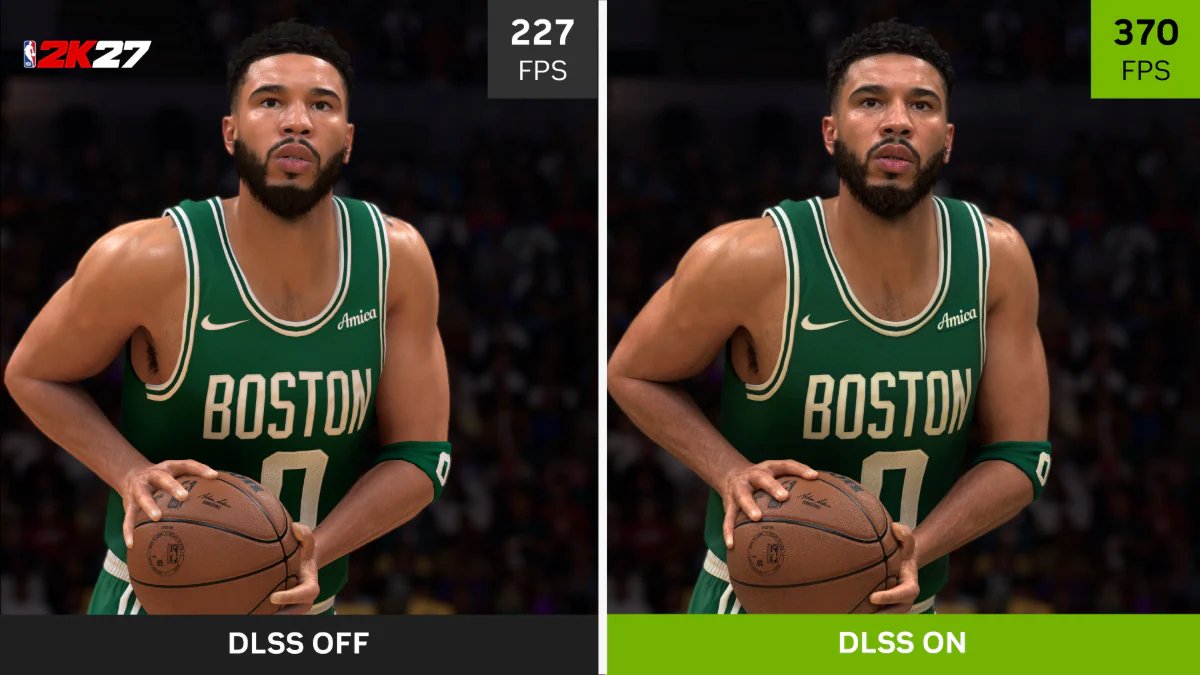
Nvidia’s controversial DLSS 5 graphics upscaler is launching this week in NBA 2K27, the company has announced. The latest iteration of the AI-powered upscaler, which faced backlash from gamers and was labelled “AI slop filter” when it was unveiled earlier this year, will be available September 3 for all GeForce RTX 50 Series GPUs and laptops and GeForce Now.
DLSS 5 utilises AI-powered 3D-guided neural rendering to produce photoreal visuals in PC games. Nvidia calls it a “major step forward in using AI to bring real-time graphics closer than ever to Hollywood-grade photorealism”, but the graphics upscaler has faced criticism over its tendency to produce visuals that stray from the original intent of the artist.
But in its announcement, Nvidia said it provided developers with granular control over the technology so that they could fine tune the intensity of the upscaled image to match the game’s creative vision.
DLSS 5 will debut in NBA 2K27, the next entry in publisher 2K and developer Visual Concept’s long-running basketball sim franchise, on Thursday, September 3 at 9pm PT. NBA 2K27 launches on PC, PS5, Xbox Series S/X, and Nintendo Switch 2 on September 4.
How DLSS 5 Works
The latest iteration of Nvidia’s Deep Learning Super Sampling graphics upscaling technology reportedly leaked last week via NBA 2K27 game files. Following the leak, several users posted screenshots from DLSS 5 enchanced games on X, with many criticising the photorealisic results over their departure from the original look of the games.
The latest version of the upscaler is claimed to enhance visual quality in games through lifelike material interactions, natural skin subsurface scattering, realistic light transmission through hair and foliage, and deeper contact shadows alongside global illumination.
The result is a more photoreal image that attempts to bring video games closer to cinematic quality seen in films. However, the results produced by the DLSS 5 filter have sparked intense backlash and mockery in the gaming community. Much of the criticism has been focussed on the upscaler seemingly disregarding the artistic vision of human developers in an attempt to push video game graphics towards photorealism.
DLSS 5 Preserves Artisitic Intent, Says Nvidia
But Nvidia has stressed that DLSS 5 is designed to preserve artistic intent. In a blog post, the company said the upscaler puts art-direction tools in the hands of developers, allowing them to control how and where the technology is applied to their games. PC gamers who do not want the DLSS 5 upscaler changing how their games look can simply toggle it off.
“Through the DLSS 5 SDK, developers have several models to choose from, with different parameter weights that produce different outputs, allowing them to pick the model that works best for their game,” Nvidia said in the blog post.
“This model choice can be applied to the entire game, or they can mix-and-match the models in different scenes. For example, artists can select one model for dense outdoor foliage, and another model for dramatic indoor scenes. They can also mix-and-match different models for gameplay and cutscenes, whichever fits their artistic vision.”
The company also shared a dev diary video detailing its collaboration with NBA 2K27 developer Visual Concepts. DLSS 5 promises to enhance the sports title to make it more realistic, closer to a real NBA or WNBA broadcast. Here’s a comparison of NBA player Cade Cunningham in NBA 2K27 with DLSS 5 off and on:

NBA 2K27 wil DLSS 5 off
Photo Credit: Nvidia

NBA 2K27 wil DLSS 5 on
Photo Credit: Nvidia
With DLSS 5 on, at 4K with the Ultra Preset and ray tracing, Nvidia is promising GeForce RTX 5090 owners an average framerate of up to 370fps in NBA 2K27.
To enable the new upscaler in NBA 2K27, PC gamers can download a new GeForce Game Ready Driver launching on September 3rd at 9pm PT. Following the driver update, the option for DLSS neural rendering will appear in-game.
DLSS 5 was unveiled in March, showcasing “photoreal” visuals in games like Resident Evil Requiem and Starfield, powered by Nvidia’s real-time neural rendering model. The results, however, sparked criticism from gamers, with some labelling the technology an “AI slop filter”.
Some of the early DLSS 5 results in games like Resident Evil Requiem and Starfield resembled an Instagram or Snapchat beauty filter that fundamentally changed the original look of the characters in the game.
The impact of DLSS 5 on Resident Evil Requiem’s protagonist, Grace Ashcroft, received particular backlash as the upscaler seemed to add make-up, eye shadow, and fuller lips covered in lipstick.