


Quantum physics has made numerous strange predictions, and scientists have checked and confirmed many of them. But one of the strangest ones persists unresolved. In the 1930s, the German physicists Werner Heisenberg and Hans Heinrich Euler proposed that empty space is not really empty. Instead, they predicted that in the presence of a magnetic field, the vacuum of space would behave like a crystal, changing the properties of light passing through it.
The trouble with testing this prediction — called vacuum birefringence — is that the magnetic field has to be extraordinarily strong.
In a study published in Nature on August 5, astronomers from Australia, Canada, Japan, South Africa, Taiwan, and the U.S. reported it had observed such birefringence using two satellites and a telescope in Australia, almost confirming the prediction at long last.
The work could prove ‘nothingness’ is actually a complex and active medium and also potentially help scientists refine their maps of the universe.

Staggering numbers
In classical physics, a vacuum is absolute nothingness. But in quantum electrodynamics (QED) — which is a theory in quantum physics — a vacuum is a soup of virtual particles: pairs of electrons and anti-electrons that constantly pop in and out of existence, and so quickly that they cannot be observed.
Normally, these virtual particles have a negligible effect on light. But when a magnetic field nearby becomes strong enough, it changes how the short-lived charged particles can move, so they respond differently to light depending on the direction in which its electric field is vibrating. This part of space will then behave like a calcite crystal when light passes through it, splitting it into different paths depending on its electric field. (As an electromagnetic wave, light consists of electric and magnetic fields travelling through space.)
For vacuum birefringence to become noticeable, the magnetic field has to be around 88 trillion times stronger than the earth’s magnetic field, and more than 500 million times as strong as the ultra-powerful magnets in the world’s largest science experiment, the CERN supercollider. These are staggering numbers far beyond the abilities of current technologies, so physicists have been looking for proof of vacuum birefringence in outer space, where objects called magnetars generate the universe’s most extreme magnetic fields.
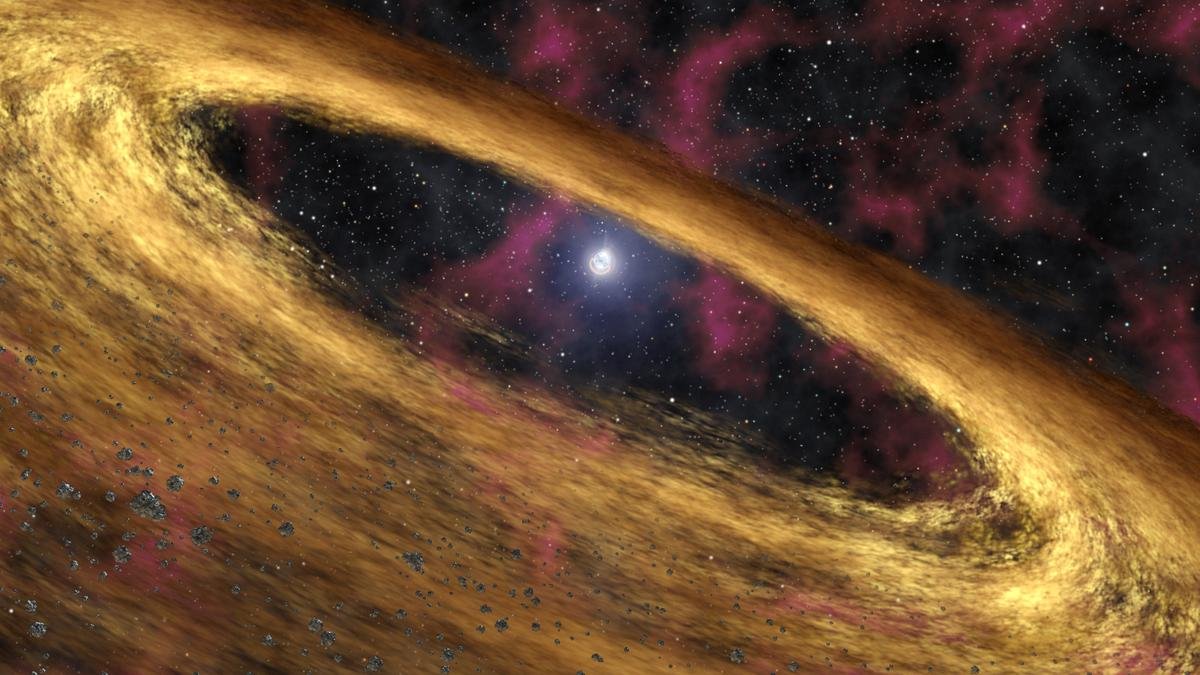
Sometimes the core of a dead star can collapse to form a neutron star. Neutron stars with powerful magnetic fields are called magnetars.

Railroading polarisation
The international team focused its attention on one magnetar named 1E 1547.0-5408, located 14,700 lightyears away. As independent experts Ekaterina Sokolova-Lapa and Joern Wilms wrote in a commentary accompanying the team’s paper, “1E 1547.0−5408 belongs to a rare subclass of magnetars that also emit pulses at radio wavelengths”.
By combining X-ray and radio frequency measurements, then, the team could piece together the geometry of the magnetar’s magnetic field.
If the vacuum of space were truly empty — as in classical physics — the X-rays from the magnetar would reach the earth with a low degree of polarisation. But the team found the opposite: the NASA Imaging X-ray Polarimetry Explorer (IXPE) satellite in particular detected very high levels of polarisation, up to 80% in some instances, which is the smoking gun of vacuum birefringence.
As X-rays leave the magnetar and move through the surrounding space, QED predicts that their electric field will have to lock itself into one of two directions — a condition that unmagnetised space does not impose — thus polarising the light. Since these directions are defined by the direction of the magnetic field, the X-rays’ polarisation is effectively railroaded along the magnetic field lines. And as the X-rays travel away from the magnetar, their polarisation will stay fixed even as the magnetic field becomes less and less able to ‘hold on’.
According to the team, the amount of polarisation dropped as the energy of the X-rays increased, which QED predicts as well. The team was also able to elucidate that the magnetar rotated along an axis that aligned almost perfectly with its magnetic poles, like a top spinning upright — a detail that informed the team’s models of how the X-rays from the magnetar would look with and without vacuum birefringence.
The models that did not account for the phenomenon fit substantially worse with the telescope data than those that included it.

Direct observation
Other than IXPE, the team had also used the Neutron Star Interior Composition Explorer instrument onboard the International Space Station and the Murriyang radio telescope in Australia.
The finding takes a big step towards bolstering space’s character as a complex medium that both gravity and magnetism can manipulate.
On a final note, the team wrote in its paper that its next goal is “to more directly probe the nature of the … polarisation”. And this, the commentary noted, requires “coordinated astronomical campaigns that observe multiple magnetars and cover a wider part of the electromagnetic spectrum”.
The current finding is indirect because the astronomers recorded polarised light and inferred from that that it had passed through extremely magnetised space.
As Sokolova-Lapa and Wilms put it, the high polarisation reported in the study only proves vacuum birefringence if the team’s model of the magnetar’s geometry is correct. If, instead, its axis of rotation and magnetic poles are further apart, the X-rays could have been polarised by plasma on the magnetar’s surface. A paper published in The Astrophysical Journal by researchers from Italy, Spain, and the U.K. has already raised doubts about the alignment.
Physicists are also interested in the vacuum resonance: a distinctive dip in the polarisation — from one of the two allowed directions to the other — at a specific energy level. The international team itself reported a dip but said it was too noisy to be dispositive.
But one way or another, the dark voids between the stars we see when we look up are far from dead, buzzing with activity.
Published – August 31, 2026 09:00 am IST