
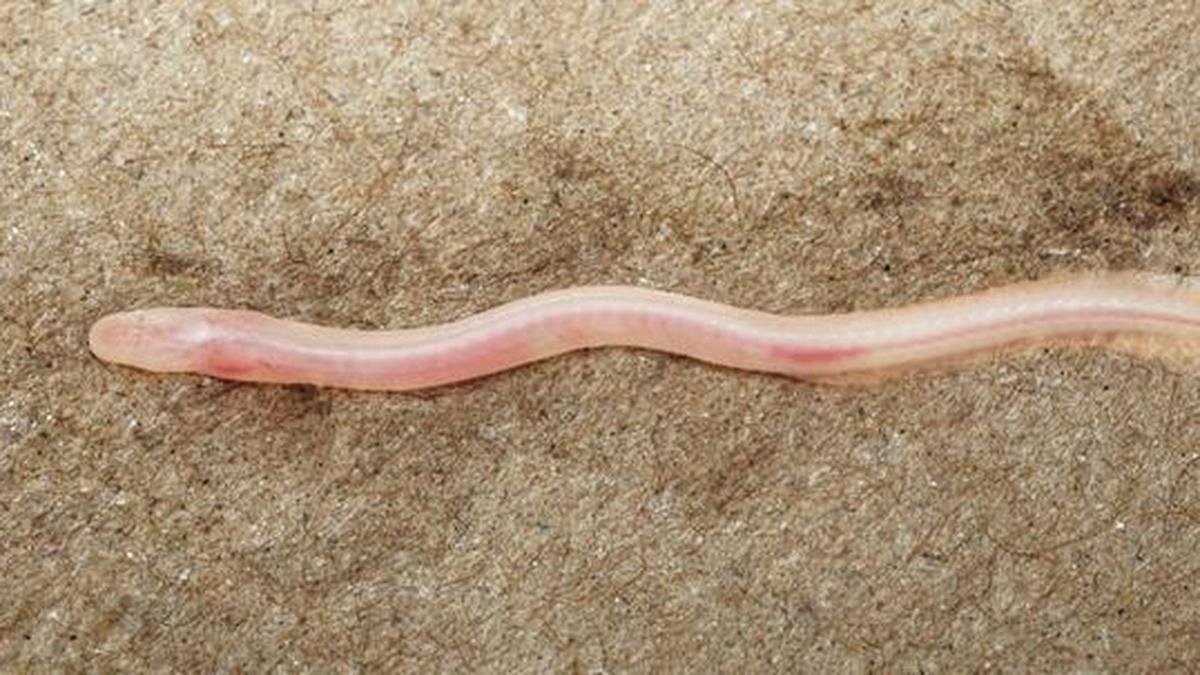


Gangaichthys indonepalicus, the newly discovered species
(This article forms a part of the Science for All newsletter that takes the jargon out of science and puts the fun in! Subscribe now!)
In 2024 a short video clip circulated on TikTok showed an unknown, tiny, colourless creature emerge from a borewell near the border between India and Nepal, beneath the Indo-Gangetic plain. Scientists soon began studying this first recorded subterranean eel-like fish in the Gangetic Basin and named it Gangaichthys indonepalicus.
“Gangaichthys” means “fish of the Ganga” while “indonepalicus” connotes the species’ geographical distribution. The new species was reported in the journal ZooKeys. No more than 4 cm in length, these fish are have clearly evolved to survive in complete darkness: their eyes are covered by skin and their bodies are translucent.
But studying the new species was no easy task. The international team of scientists had to manually pump thousands of litres of groundwater in Bihar to collect three specimens. The first individual was caught after the researchers pumped 2,000 litres of water from borewells (a machine-drilled shaft used to access water from underground aquifers), but it succumbed to injuries. Then, after pumping 500 more litres of water, a second live specimen emerged.
For the study, the scientists sampled more than 15 borewells which they pumped by hand; they were able to collect three specimens of the new species from two borewells.
The new fish differs from the large family of Chaudhuriidae, or earthworm eels that comprise seven genera and 11 species of small, elongated, freshwater fishes. In contrast, Gangaichthys indonepalicus has a complete absence of body pigmentation, has smaller eyes, and an apparent absence of ribs.
The unique morphology of the fish in the TikTok video, “and the fact that there are no known stygobitic fish [aquatic animals that live in underground water] known from the region, motivated us to track down the species to ascertain its identity,” said the scientists in a release.
The scientists behind this discovery included those from the Thackeray Wildlife Foundation in Mumbai, Shivaji University in Kolhapur, the Shanghai Synchrotron Radiation Facility at the Chinese Academy of Sciences and the Zoological Survey of India.
Co-author Akshay Khandekar of the Thackeray Wildlife Foundation described the technical difficulties in capturing these fish. “Identifying potential handpumps [that suck out water from aquifers], and obtaining permission from their owners to extract water for the purpose of searching for the fish proved difficult. This became more intensive when we finally began manually pumping water,” he said in a release.
From the Science pages
Question Corner
Flora and fauna
Published – August 26, 2026 05:59 pm IST