Budget and mid-range gaming laptops tend to improve in small increments, a slightly better chip here, a marginally brighter screen there. MSI’s Cyborg 15 series takes a bigger swing this generation, and it now comes in two configurations that split that improvement two different ways. One pushes the power ceiling as high as the platform allows. The other keeps the same chassis and display at a gentler price and power point. This guide walks through what actually changed, how the two configurations differ, and which one fits how you plan to use the laptop.
Why the Cyborg 15 Max Marks a Real Step Up
Chassis Borrowed From the Racetrack
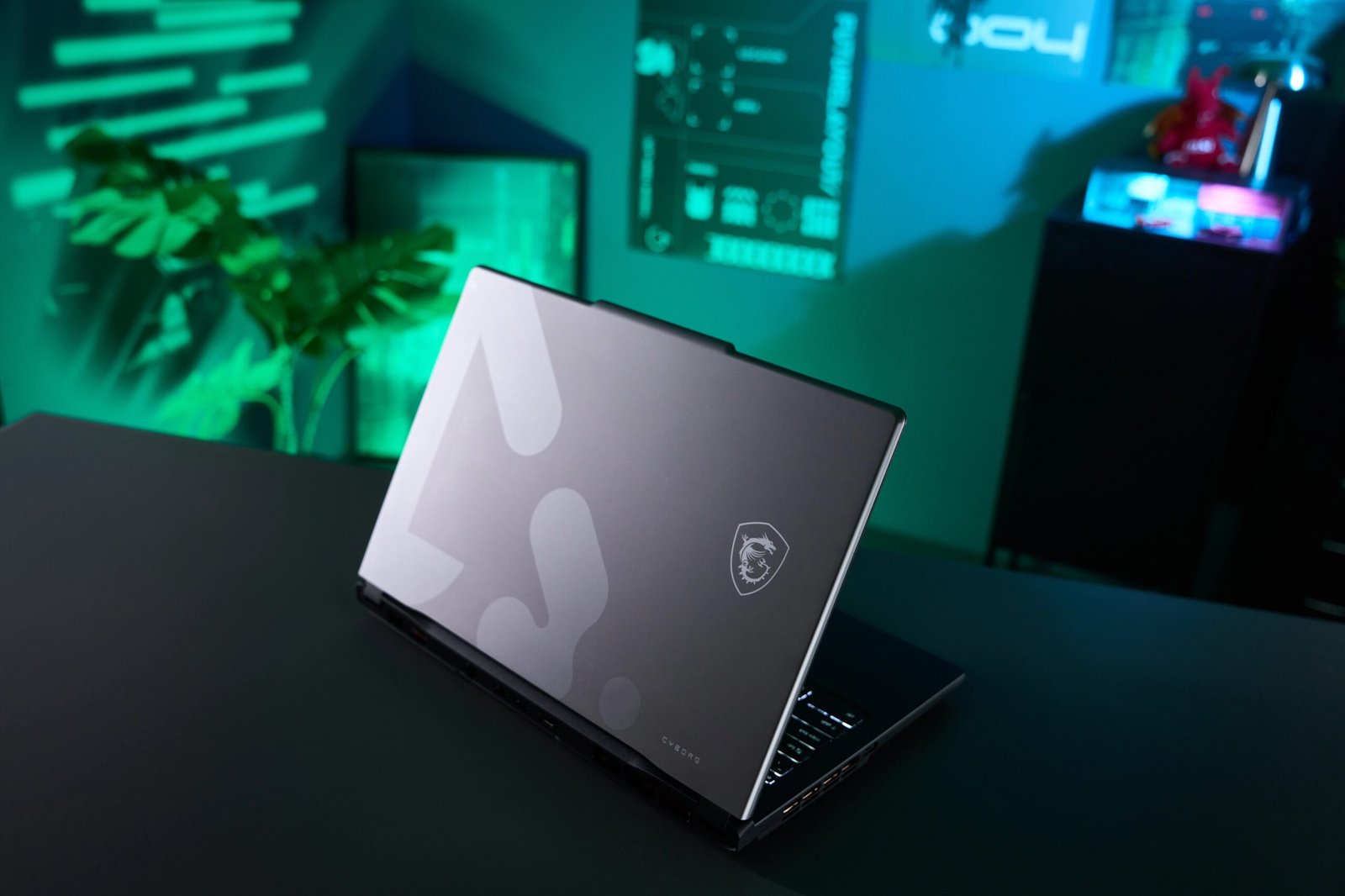
The redesign starts with the logo. MSI calls it a “Cyborg Heart”, a symbolic mark meant to evoke a cybernetic organism, etched into the lid and deck rather than announced across the chassis. The rest of the shell follows the same restraint: MSI says the design is shaped by McLaren-style curves, keeping the chassis thin at 21 to 22.9mm while keeping a clean rear I/O layout that the company positions as both stylistic and practical for cable management at a desk.
Display Built for Fast-Moving Games
Both configurations share the same panel: a 15.6-inch FHD (1920 x 1080) IPS-level display running at 144Hz with 100 percent sRGB coverage (typical), according to MSI’s specifications. That combination targets the segment’s usual demand, a screen fast enough for competitive titles without giving up the colour accuracy needed for everything else that fills the hours between matches.
Cooling Had to Catch Up First
MSI could not simply raise the power ceiling without also reworking how the Cyborg dissipates heat, and that shows up as the biggest hardware difference between the two configurations. The Cyborg 15 Max gets a dual-fan cooling system paired with three heat pipes, a phase-change thermal compound, and a quad-exhaust heatsink design, all new to the Cyborg lineup. The standard Cyborg 15 keeps a single fan and a dual-exhaust heatsink instead. MSI frames the Max’s setup as what lets the system hold performance steady through longer, more demanding sessions rather than throttling as things heat up. That same trait matters for gaming marathons, and it matters just as much for steady, power-hungry workloads like local AI inference, which run at a constant load instead of gaming’s short bursts.
GPU Power Takes a Big Jump on the Max
The clearest result of that cooling work is how much power MSI is willing to feed the graphics chip. The Cyborg 15 Max supports a maximum GPU power draw, or TGP, of up to 100W, a sizeable jump from the 45W ceiling on the previous generation, and MSI says the chassis can draw up to 140W combined across CPU and GPU. The standard Cyborg 15 sits lower on both counts, which is the trade-off for its simpler cooling hardware and lower price position.
Platform That Also Handles Hybrid AI Workloads
The Cyborg Max’s headroom isn’t only useful for holding frame rates steady. Running AI models locally, alongside cloud-based tools, is sustained, power-hungry work rather than the short bursts typical of gaming. That’s exactly the load MSI built the Max’s cooling system to handle without throttling. The open second RAM slot matters here too. Workloads that mix a local model with everything else running on the machine benefit from the ability to push past the 16GB it ships with, up to 96GB, without replacing what’s already installed.
MSI’s Cyborg 15 Lineup at a Glance
- Cyborg 15 Max: For buyers who want the highest power ceiling and the most cooling headroom the platform offers, whether that’s for gaming or for running AI models locally.
- Cyborg 15: For buyers looking for a distinctive design, a more portable form factor, and a balanced performance experience.
Cyborg 15 Max: The Full-Power Configuration
Best for: Gamers who want the most graphics headroom the platform offers and users running hybrid AI workloads, combining local models with cloud tools, who need cooling and power that hold up over long sessions.
The Max is where MSI puts everything the redesign made possible. It brings the higher GPU wattage, the dual-fan cooling system, and a set of internals built to be added to rather than replaced. That combination suits gaming’s short, intense bursts of load just as well as it suits the longer, steadier draw of running AI models locally. It ships with 16GB of RAM seated in a single DDR5 module even though the chassis supports up to 96GB across two slots, an approach that leaves the second slot open for a straightforward upgrade later rather than requiring a swap. Storage follows the same logic. A 512GB SSD occupies one of two available M.2 slots, so adding capacity down the line does not mean removing the drive that shipped with the machine. Charging is handled through the standard adapter or, when that is not on hand, USB Type-C with Power Delivery 3.0.
Key Specs:
- Design: McLaren-inspired curves, “Cyborg Heart” logo, 21 to 22.9mm chassis thickness
- Display: 15.6-inch FHD (1920×1080), 144Hz, IPS-level, 100% sRGB (typical)
- Cooling: Dual-fan system with 3 heat pipes, phase-change thermal compound, quad-exhaust heatsink
- Graphics: Up to NVIDIA GeForce RTX 5070 (85W+15W), up to 100W TGP
- Power: Up to 140W combined CPU and GPU power; 180W adapter
- Memory: 16GB DDR5 shipped in a single module, up to 96GB across 2 slots
- Storage: 512GB SSD installed, second M.2 slot left empty for expansion
- Charging: USB Type-C with Power Delivery 3.0 supported alongside the standard adapter
- Weight: 2kg
Cyborg 15: The Standard Configuration
Best for: Buyers who want the redesigned chassis and display without paying for the top power ceiling, and who are fine with a single-fan cooling setup.
The standard Cyborg 15 shares its chassis, its 144Hz display, and its upgrade-friendly DDR5 layout with the Max, but pairs them with a lower-wattage GPU option and simpler cooling. It’s the pick for buyers who want the redesign at a lower price point, without the top-end power ceiling.
Key Specs:
- Design: Same chassis language and McLaren-inspired curves as the Max
- Display: 15.6-inch FHD (1920×1080), 144Hz, IPS-level, 100% sRGB (typical)
- Cooling: Single fan with dual-exhaust heatsink
- Graphics: Up to NVIDIA GeForce RTX 5060
- Power: Up to 105W combined CPU and GPU power; 150W adapter
- Memory: Up to 96GB DDR5 across 2 slots
- Storage: 1x PCIe Gen4x4 M.2 slot (max 4TB)
- Weight: 1.98kg
Quick Comparison: Cyborg 15 Max vs Cyborg 15
|
|
Cyborg 15 Max |
Cyborg 15 |
|
Best For |
Highest power ceiling, most cooling headroom |
Distinctive design at a lower power point |
|
Hybrid AI Use |
Sustained cooling and RAM headroom support local inference alongside cloud tools |
Not positioned for sustained AI workloads |
|
Graphics |
Up to RTX 5070 (85W+15W), up to 100W TGP |
Up to RTX 5060 |
|
Combined Power |
Up to 140W (CPU + GPU) |
Up to 105W (CPU + GPU) |
|
Cooling |
Dual fan, 3 heat pipes, quad-exhaust heatsink |
Single fan, dual-exhaust heatsink |
|
Display |
15.6″ FHD, 144Hz, 100% sRGB |
15.6″ FHD, 144Hz, 100% sRGB |
|
Memory |
DDR5, 2 slots, up to 96GB |
DDR5, 2 slots, up to 96GB |
|
Storage |
2x M.2 slots (one populated) |
1x M.2 slot |
|
Adapter |
180W |
150W |
|
Weight |
2kg |
1.98kg |
How to Choose Between the Two
Pick the Cyborg 15 Max if you want the highest graphics headroom the platform offers, plan to lean on the extra cooling for longer sessions, or want the headroom to run AI models locally alongside cloud tools. Pick the standard Cyborg 15 if you want the same chassis, the same display, and the same upgrade-friendly memory layout, but do not need the top-end power ceiling or the second storage slot.
Frequently Asked Questions
Q: What is the real difference between the Cyborg 15 Max and the standard Cyborg 15?
A: Mainly graphics power and cooling. The Max supports a higher-wattage GPU option, up to 140W of combined CPU and GPU power, and a dual-fan cooling system with a phase-change thermal compound. The standard Cyborg 15 shares the same chassis and display but tops out at 105W combined power with a single-fan cooling setup.
Q: Does the Max’s extra cooling hardware change anything in daily use?
A: According to MSI, the dual-fan, quad-exhaust design paired with the phase-change thermal compound is what allows the higher 140W power budget to be sustained rather than throttled during longer gaming or creative sessions, which is the main practical benefit over the standard model’s single-fan setup.
Q: Can I upgrade the RAM and storage myself later?
A: On the Cyborg 15 Max, yes on both fronts: it ships with 16GB in a single DDR5 module, leaving a second slot free, and a 512GB SSD in one of two M.2 slots, leaving the second empty. The standard Cyborg 15 shares the same open RAM slot while its single M.2 slot allows storage upgrades by replacing the existing SSD with a higher-capacity one.
Q: Is the Cyborg 15 Max suited to AI workloads or just gaming?
A: Both. The dual-fan cooling and 140W combined power budget that keep the Max steady during long gaming sessions are also what let it sustain local AI inference, a steadier, more power-hungry load than gaming’s bursts, without throttling. The open second RAM slot adds headroom for running a local model alongside everything else on the machine.
Q: Does either laptop support USB-C charging?
A: Yes. Both configurations include a USB Type-C port with Power Delivery 3.0 support, giving you the option to charge from a compatible USB-C charger in addition to the laptop’s standard adapter.