


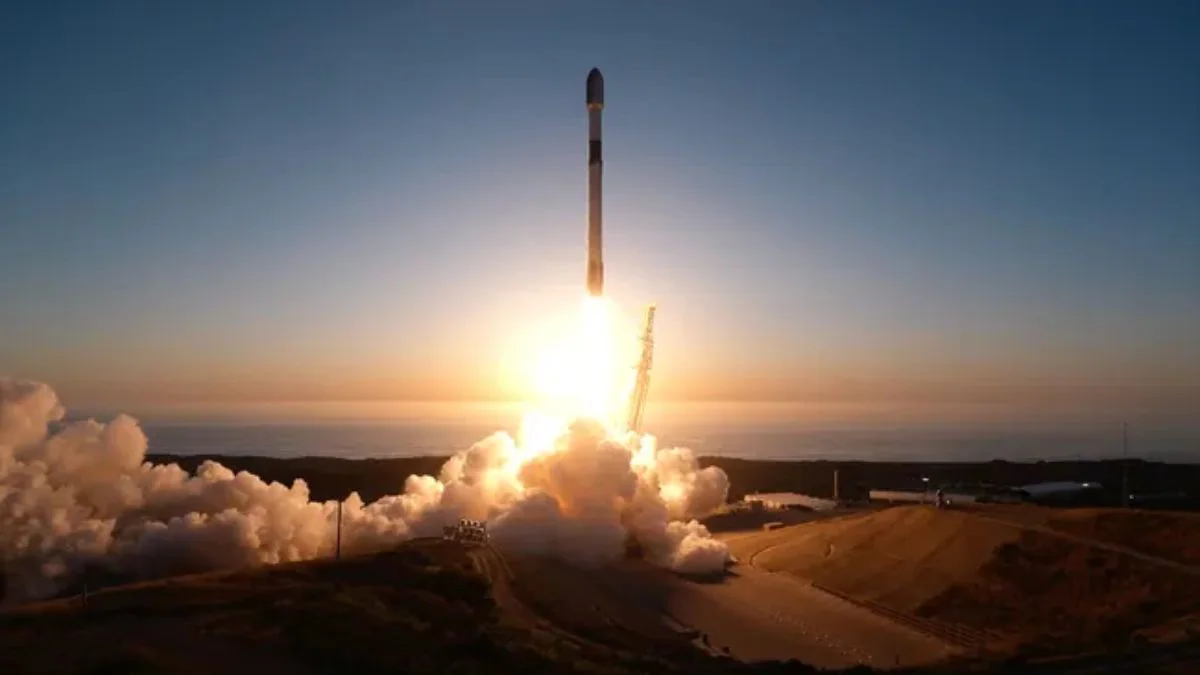
SpaceX made its second launch of the year towards its expanding internet network on Tuesday, May 19, 2026, launching 24 more satellites to the network from the Vandenberg Space Force Base in California. The satellites, part of group 17-42, were launched into orbit aboard the Falcon 9 rocket, which lifted off from Space Launch Complex 4 East at 10:46 p.m. EDT. The satellites reached a provisional orbit within nine minutes and were completely deployed within 50 minutes.
A Veteran Booster Sticks the Landing
According to Space.com, the booster B1103 was at the helm of this endeavour, having flown only once before. Following its launch into space with the upper stage and the satellite cargo onboard, the first stage successfully performed its reentry manoeuvre to land directly onto SpaceX’s floating drone ship named “Of Course I Still Love You.” The ability to reuse rockets is what makes SpaceX’s Falcon 9 missions economically viable. Instead of disposing of a rocket that could cost millions of dollars after a one-time usage, SpaceX lands and refuels it for multiple uses.
A Megaconstellation Closing in on 10,500
As a result of this latest launch, the total number of active satellites orbiting Earth as part of the Starlink constellation is just shy of 10,500, says satellite tracker Jonathan McDowell. Each of these small satellites circles our planet in low-Earth orbit, flying at altitudes between about 340 kilometers and 570 kilometers above our planet’s surface—much closer than typical geostationary communications satellites that operate from an altitude of roughly 35,786 kilometers. The close distance ensures a latency of less than 27 milliseconds, allowing applications like video conferencing and online gaming in locations where Internet access was previously unavailable.