


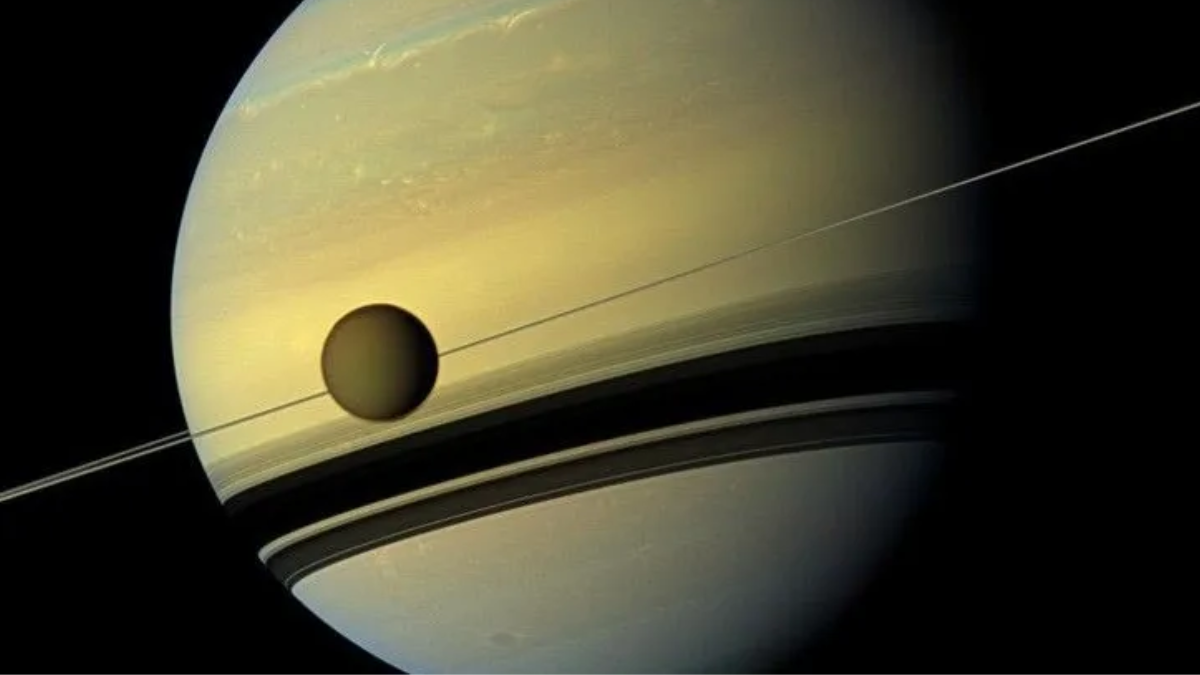
New research indicates that Saturn’s famous rings and its biggest moon, Titan, have a shared history of violent origins. Titan probably developed through a collision between a “Proto-Titan” moon and a smaller moon that occurred 100 to 200 million years ago. The enormous impact created a new surface for Titan because it removed all of its ancient craters while sending material into space. The Cassini mission discovered that Saturn’s rings have an unexpected age of approximately 100 million years, which indicates their formation resulted from this moon-collision event.
Titan’s giant moon merger
According to the simulations, Saturn originally possessed an additional moon that eventually lost its stable orbital path. The majority of simulations demonstrate that this moon eventually crashed into Titan during the time period between 100 million and 200 million years ago.
The cataclysmic event “resurfaced Titan” by destroying ancient craters and opening pathways for gases to escape from its underground spaces. The impact changed Titan’s orbit to a wider path with increased eccentricity.
The collision debris most likely formed into Hyperion, which exists as Saturn’s unique sponge-shaped moon that maintains a 4:3 orbital resonance with Titan.
Birth of the rings
After Titan’s violent birth, its new orbit destabilized smaller moons. Resonant tugs drove collisions among Saturn’s inner satellites. Most fragments would recombine into moons, but ice debris scattered inward to form the rings.
This links the rings’ ∼100-million-year age to Titan’s moon-merger event. Independent NASA studies confirm the rings are young and likely formed when such moonlets were shattered.
Future missions like NASA’s Dragonfly (arriving 2034) could test this model by searching Titan’s surface for geological or chemical traces of the ancient collision.