


Star clusters are groups of stars that formed from the same gas cloud and remain loosely bound together. The study of these celestial objects provides information about the formation process of the Milky Way galaxy. A significant fraction of cluster stars are binaries, two stars orbiting each other, and these pairs influence cluster structure and evolution. Deep Hubble observations enable astronomers to conduct a thorough binary census of star clusters.
Binary Stars in the Pismis 24 Cluster (NGC 6357)
According to NASA, NGC 6357 (the “Lobster Nebula”) contains Pismis 24, a young star cluster roughly 5,500 light-years away with dozens of hot O-type stars. Many of its most massive stars turn out to be multiples: Hubble images show the brightest member, Pismis 24-1, is actually three ∼100-solar-mass stars orbiting each other, and another massive star in the cluster (Pismis 24-18) is a binary.
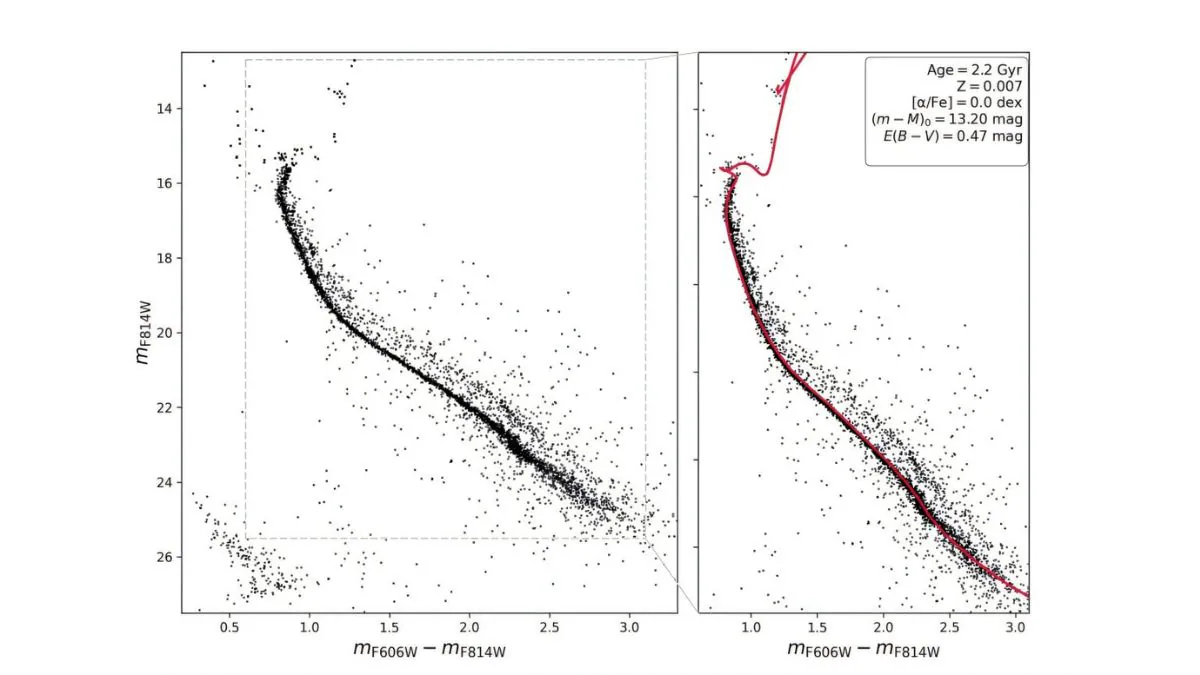
These examples suggest a high binary fraction among the cluster’s stars. By comparison, a recent Hubble survey of an older open cluster found that roughly 38% of its stars are in binaries, consistent with values seen in many clusters.
Binaries and Cluster Evolution
The binaries behave like “engines” inside the star cluster. The interaction of binaries with single stars increases the kinetic energy of the star cluster, thus slowing down the gravitational collapse of the star cluster and even expelling some of the stars. The binaries also play a role in creating exotic stars, such as unusually hot stars called “blue stragglers” resulting from stellar mergers, and also in expelling stars at high speeds if one of the stars in the binary system explodes as a supernova.