


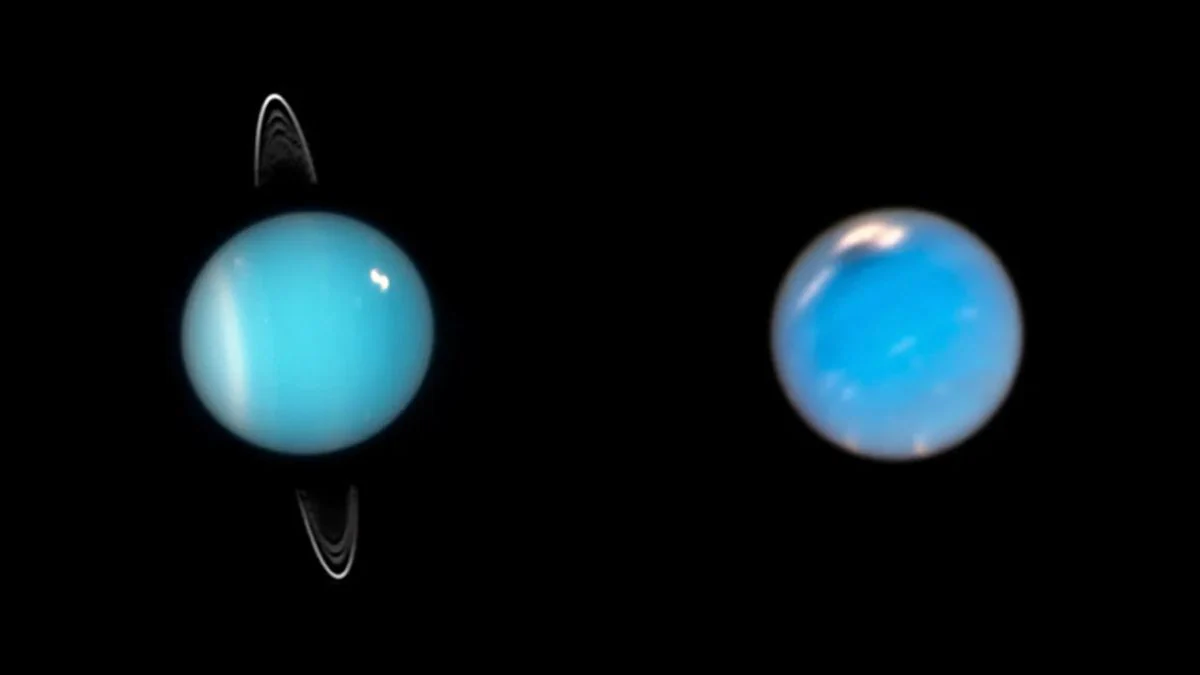
The space scientists have long referred to Uranus and Neptune as ice giants due to the belief that their interiors are abundant in ice (frozen water), ammonia, and other ices. However, new research argues that we actually know very little about what is going on inside and gives these planets a new name of rocky giants. An example of this is that researchers ran numerous random interior models and compared them with the sparse data that we do possess, as opposed to using old assumptions.
Surprising Interiors
According to the new pre-print study, researchers used a fresh, assumption-free modeling approach, generating many possible interior structures for each planet. This yielded a startling result: scientists say we “may not have any idea what the interiors of Uranus and Neptune are really like”.
For example, one model gave Uranus a rock-to-water ratio from 0.04 (nearly all water) to 3.92 (nearly all rock), and Neptune’s composition is similarly unconstrained. In effect, an extensive range of interior structures remains consistent with the sparse data, so the “ice giant” picture is far from certain.
New ideas of Formation and Exploration
If so, the name of the ice giant would be a misnomer. Uranus and Neptune might, in fact, have rocky material as much of their mass, perhaps more than of the Jovian or Saturnian. This would disturb models of the solar system formation: scientists would have to provide an explanation of how much solid material was accumulated in these faraway orbits.
To end the debate, scientists assert that the composition of Uranus or Neptune can be finally discovered only after a special mission to the Kuiper Belt, like an orbiter.
For details of the latest launches and news from Samsung, Xiaomi, Realme, OnePlus, Oppo and other companies at the Mobile World Congress in Barcelona, visit our MWC 2026 hub.