


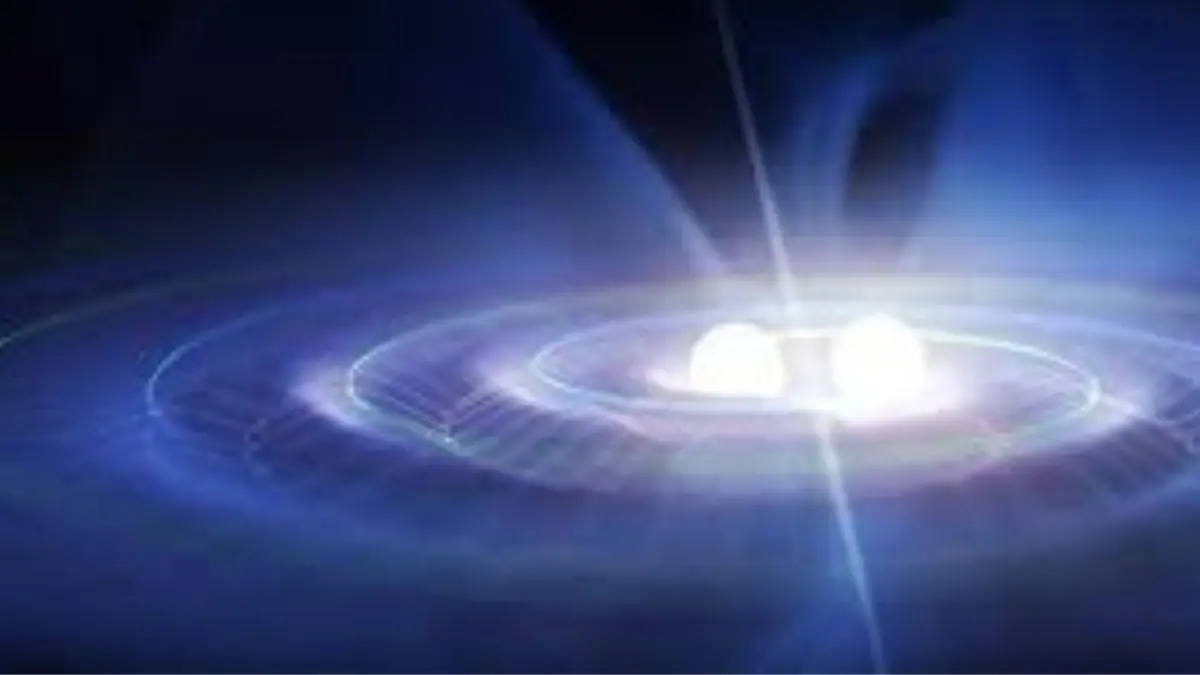
Ripples in spacetime caused by catastrophic cosmic events are known as gravitational waves. Although they were first discovered in 2015, Einstein had long predicted them. Physicist Ralf Schützhold (HZDR) now suggests using laser light to reshape these waves instead of merely observing them. His scheme modifies the frequency of light by exchanging tiny energy packets (gravitons) with passing waves using powerful laser beams in a kilometer-scale interferometer.
Laser Control of Gravitational Waves
According to the study, Schützhold’s proposal is an extension of the LIGO interferometer. Strong laser pulses would be reflected back and forth a million times in kilometer-long arms. As a result, a small amount of energy may be lost or gained by each laser beam—an amount that is carried by a graviton, making it weaker or stronger. As a result, when these beams are reunited, it will be seen that a beam that lost energy will be slightly lower in frequency.
Probing Gravity’s Quantum Nature
The observation of such a phenomenon will be the same as the observation of the emission and absorption of gravitons, as indicated by Schützhold. With the application of the entangled photons, there will be an increased possibility to detect the quantum state of the gravitational field, as indicated by Schützhold.
The occurrence of the interference phenomenon will be an indication that the theory on the quantisation of the gravitational field is valid; otherwise, the theory will be flawed.Observing interference via entangled photons could reveal graviton-like effects, enabling detection of gravity’s quantum state and confirming gravitational field quantisation; absence of interference would challenge the theory at its core.