


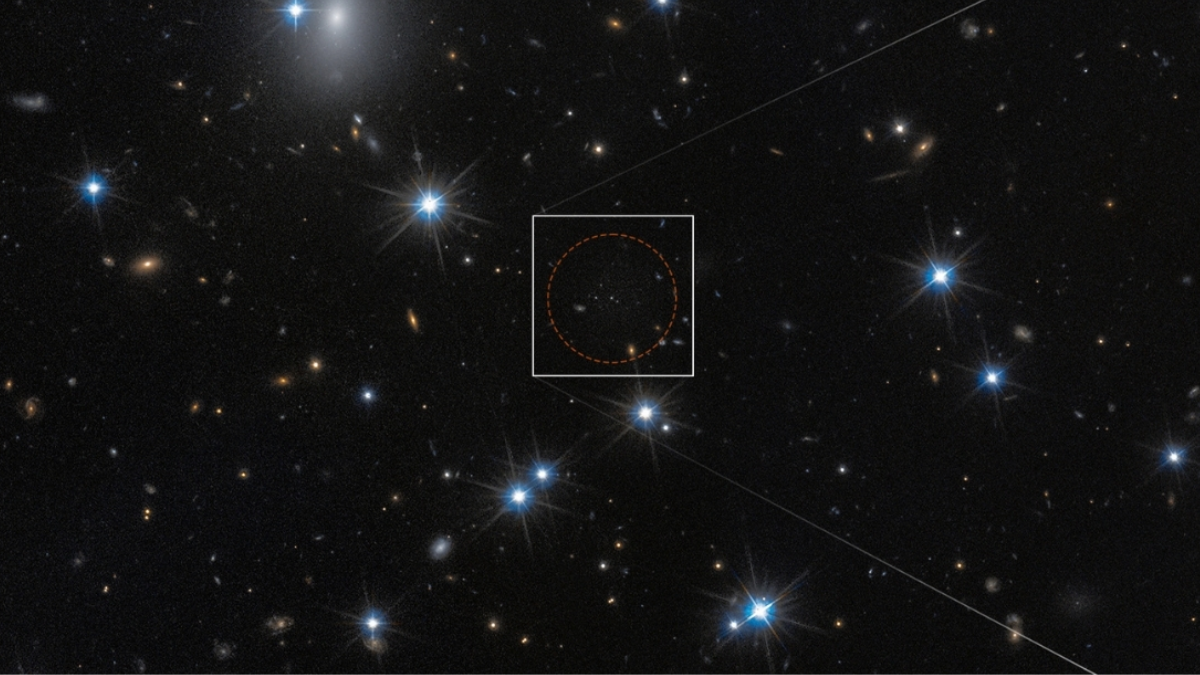
Astronomers have found a faint galaxy that consists almost entirely of dark matter. The object CDG-2 is located in the Perseus galaxy cluster and is 300 million light-years away from Earth. It could be the most dark-matter-dominated galaxy that has ever been found. The discovery was made by a group of researchers led by Dayi (David) Li of the University of Toronto using data from the Hubble Space Telescope, Euclid, and Subaru telescopes.
Detecting an Invisible Galaxy
According to NASA, the search for the “hidden” galaxy was not conducted by looking for the stars, but rather by looking for the globular star clusters, which are spherical concentrations of stars orbiting galaxies.
The researchers used data from the Hubble Space Telescope, the Euclid telescope from the European Space Agency, and the Subaru telescope from Japan to identify four dense globular star clusters in the Perseus cluster, which is 300 million light-years away.
The researchers combined images from the Hubble, Euclid, and Subaru telescopes to reveal a faint glow around the clusters.
A Dark-Matter Dominated Galaxy
Analysis indicates that CDG-2 has a total starlight of only six million suns (16% of which is in its star clusters), and that 99% of its total mass is dark matter. According to the lead author, Li, this is the first galaxy to be discovered solely on the basis of its globular clusters.
The researchers hypothesize that CDG-2 probably lost most of its gas due to gravitational interactions within the Perseus cluster, resulting in a galaxy composed almost entirely of dark matter and star clusters. Future surveys using telescopes such as NASA’s Roman Space Telescope or the Vera C. Rubin Observatory might detect additional dark galaxies.