


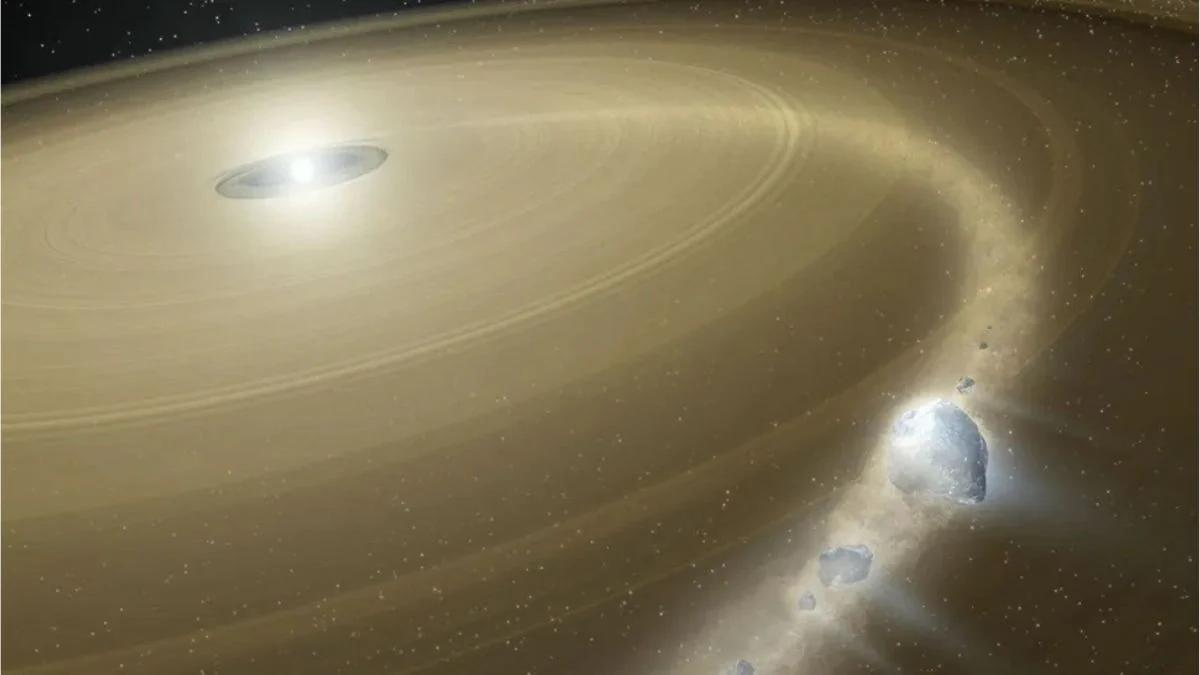
Observing a cosmic cataclysm with the Hubble Space Telescope, a team of astronomers has found a white dwarf, the compact remains of a star the size of the Sun, eating the icy cores of a Pluto-like planet some 260 light-years distant. This piece is made of volatile materials, and thus, not only does it help us understand how planetary bodies in older star systems might be, but it also presents an interesting view of how our own solar system will be in a billion years.
The Discovery and Evidence
According to the paper, a team of researchers led by Snehalata Sahu of the University of Warwick used Hubble’s Cosmic Origins Spectrograph to detect volatile elements, including carbon, sulphur, nitrogen, and a high oxygen content, falling onto the white dwarf. These chemical fingerprints reveal that the consumed object was rich in ices: about 64% water ice, along with nitrogen ices reminiscent of those found on Pluto. The material likely came from a large icy planetesimal in the system’s Kuiper Belt analogue, pulled inward and torn apart by the white dwarf’s intense gravity.
What it tells us
This observation has some important implications. It indicates that volatile-rich bodies may survive till late stellar evolution stages, unlike the expectation that they are normally expelled at early stages. Also, the event provides a glimpse into the distant future of our Sun: the Sun will become a white dwarf and will likewise be able to accrete icy debris in the far-off corners of the solar system. Future observations with a telescope such as the James Webb Space Telescope will seek further to investigate the molecular characteristics such as water vapor and carbonates to comprehend these dramatic endings better.