


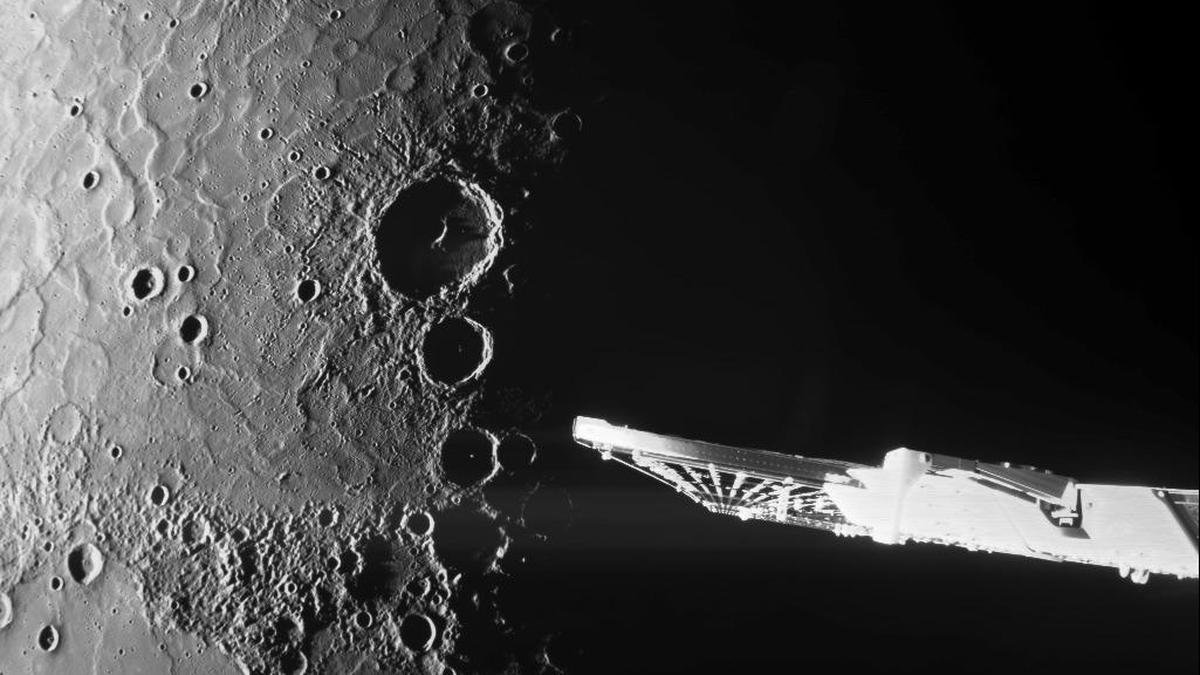

Close-up photos of Mercury’s north pole captured by the European-Japanese spacecraft BepiColombo.
| Photo Credit: AP
After an eight-year journey, the European-Japanese spacecraft BepiColombo has begun orbiting the solar system’s smallest and innermost planet Mercury, though the European Space Agency said on Sunday (November 22, 2026) a glitch has occurred involving its thrusters.
Mercury, only slightly larger than Earth’s moon, is the least explored of the four planets in the inner solar system, with BepiColombo only the third spacecraft to visit the planet and just the second to orbit it.
It is a joint mission of the European Space Agency, or ESA, and the Japan Aerospace Exploration Agency, or JAXA.
ESA confirmed on Saturday (November 21) that BepiColombo had begun its orbit. In a social media post on Sunday (November 22), ESA said the spacecraft had a successful entry into orbit, but during the manoeuver, “the thruster burn was shorter than planned following a software issue.”
“The spacecraft is safe and teams at ESOC (the European Space Operations Centre) are working to understand what happened,” ESA said, adding that “updates will be provided on Monday.”
The robotic spacecraft, launched in 2018, is a composite of ESA’s Mercury Planetary Orbiter and JAXA’s Mercury Magnetospheric Orbiter, which have different scientific objectives and are due to separate on December 9 and 10. Routine science operations are slated to commence in April.

The mission will seek to answer questions about Mercury such as why it has a magnetic field, why ice exists in the polar craters of a sun-scorched planet, and what is the nature of enigmatic depressions called “hollows” on its surface.
Mercury’s surface looks similar to that of the Moon, with numerous impact craters. There are expanses of smooth terrain as well as cliffs, some up to a mile (1.6 km) tall.
Mercury is about 60% closer to the Sun than Earth. That means that from its surface, the Sun appears more than three times as large and seven times as luminous as it does when seen from Earth. Mercury’s diameter of 3,032 miles (4,880 km) is less than 40% of Earth’s diameter of 7,926 miles (12,753 km).
Published – November 23, 2026 08:07 am IST