


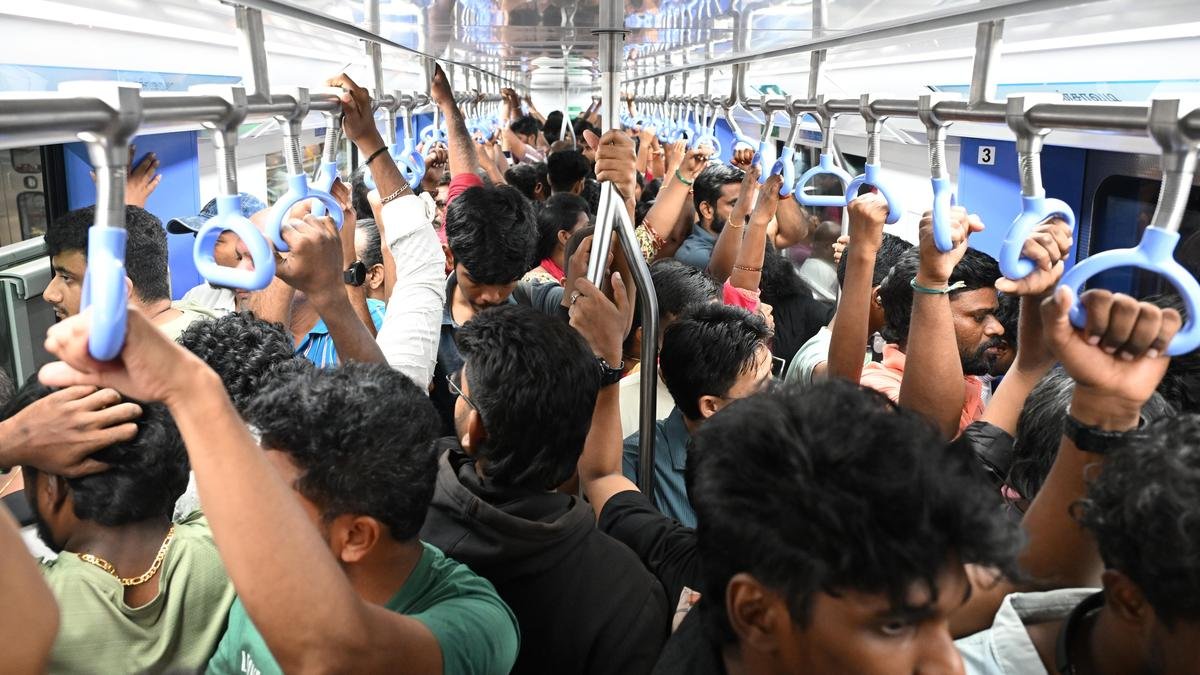

A team of researchers from IIT Madras swabbed 96 samples from 12 stations and trains on Chennai Metro’s Blue and Green Lines in December 2021 and January 2022, targeting four high-touch surfaces: station handrails (bannisters), ticket-vending kiosks, train handrails (rods), and ticket counters. Photograph used for representational purposes only
| Photo Credit: JOTHI RAMALINGAM B
From waste-water surveillance to public transport surfaces, mankind is constantly on the lookout for diverse microbial sources to test, to understand anti-microbial resistance patterns in a particular society. The latest in the urban transport systems sweep, performed at Chennai Metro Rail stations, showed that Chennai had a distinctive ‘transit biome’ – influenced by the city’s coastal climate, humidity, urban density and relatively nearby agricultural activity.
A team of researchers from IIT Madras swabbed 96 samples from 12 stations and trains on Chennai Metro’s Blue and Green Lines in December 2021 and January 2022, targeting four high-touch surfaces: station handrails (bannisters), ticket-vending kiosks, train handrails (rods), and ticket counters. The team swabbed 96 samples from 12 stations and trains and after quality control, 47 samples were sequenced using whole-genome metagenomic sequencing. Metagenomics is defined as the direct genetic analysis of genomes contained with an environmental sample.
Published – November 12, 2026 06:00 am IST