


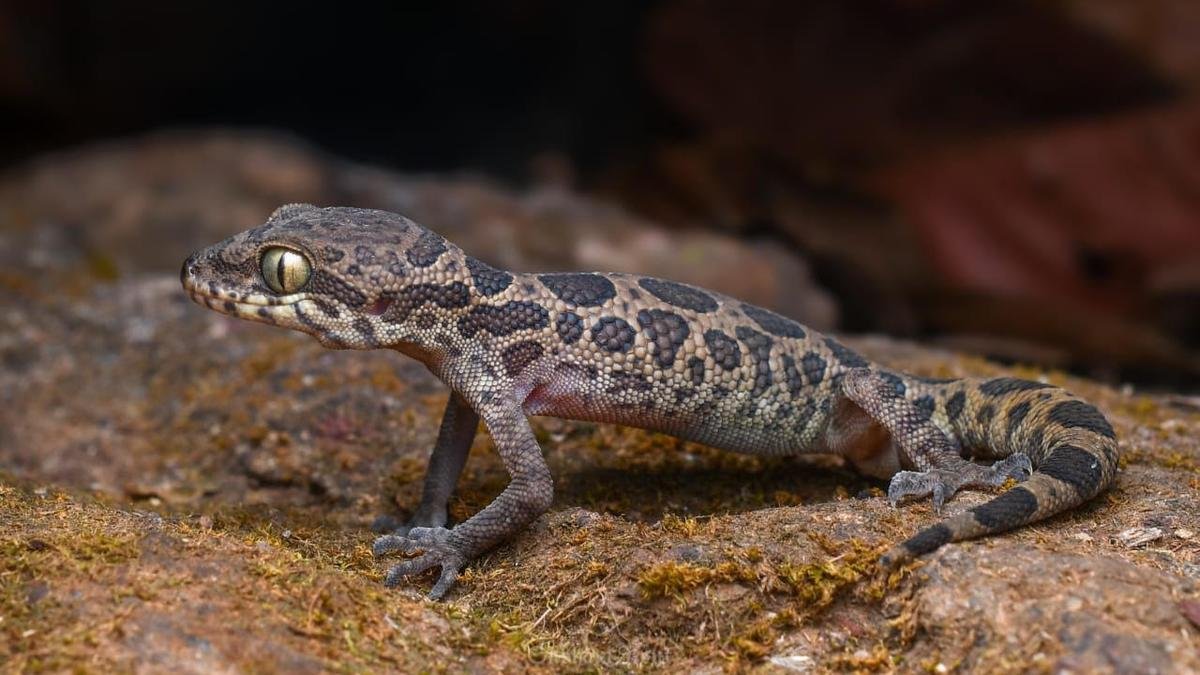
In the crevices of boulders and beneath the rustle of leaf litter in the hills of the Eastern Ghats in Odisha and Andhra Pradesh lives a tiny population of the strikingly-patterned Jeypore ground gecko, which was presumed extinct for 130 years until it was rediscovered in 2010 by an Indian scientist.
Just four individuals of this endangered species have been documented in the past year in Odisha’s Balda hills, worryingly, within the site of a proposed bauxite mining project by an Adani-linked group.
The nocturnal gecko, some 3.6 inches long, with a comparatively large head, and a yellow-orange body, was originally described as far back as 1878 by the British naturalist Richard Henry Beddome. It was only in 2010 that herpetologists Ishan Agarwal and Aniruddha Datta-Roy sighted a specimen in Odisha’s Koraput district.
Later, happily for the herpetologists, there were more sightings: one in 2025, and three this year, including one this month. One of the least studied reptiles in the country, this gecko’s behaviour, habits and lifecycle continue to elude scientists.
What is known, however, is that its habitat is fast shrinking, owing to its transformation to coffee plantations, hydropower projects and mining. In fact, the habitat where it was first sighted in the 1870s, Potangi in Odisha, has already been lost to bauxite mining by the National Aluminium Company Limited (NALCO), where the animal is believed to be now extinct.
And today, the spectre of Adani’s opencast bauxite mine proposal, covering 147 hectares of forest in the Balda hills, within the Nageswari reserve forest, threatens the very future of this vulnerable species.
Adivasi uprising
The bauxite mining project has also been the site of much contention among resident Adivasis of the Nageswari reserve forest, who have protested the proposal for the past two years. The Bondo and Porja Adivasis, whose ancestral land this is, lodged a complaint against the Adani-subsidiary Kalinga Alumina Ltd. in February, but to no avail.
“The communities have also applied for forest rights over the hill, which the government has refused to recognise,” naturalist Yuvan Aves told The Hindu. “There was a demonstration earlier this month too, and when the Adani group flew drones to scope the area, the Adivasi people stopped the exercise, asserting that this is their ancestral land,” he added.
Ecologist Ishan Agarwal, who rediscovered this gecko in the Eastern Ghats in 2010, said that the gecko is “an ecologically and biogeographically significant species having split from its closest relatives over 20 million years ago.” This is a relatively range-restricted species that is only found in high-elevation (900–1,400 metres) forests in the northern Eastern Ghats. “Anything that threatens their habitat is the major risk. Coffee [though we don’t understand to what extent], hydel, mining are all potential threats,” he told The Hindu.
The Balda hills are a treasure-trove of biodiversity and host a unique assemblage of species, including the unique limbless amphibian, Gegeneophis orientalis, said Dr. Agarwal. Another endemic species likely to be found in the region is the Araku worm gecko, he added.
The Jeypore ground gecko is a “flagship species of the area,” said the renowned herpetologist Romulus Whitaker and added that the proposed mining project will most definitely see the end of the habitat of this important species, as well as others, including some yet undescribed. “I strongly advise against the mining of bauxite in the Balda hills and insist on prioritising the conservation of biodiversity of the area, in particular the Jeypore ground gecko,” Mr. Whitaker said in a release.
Published – October 14, 2026 07:25 pm IST