


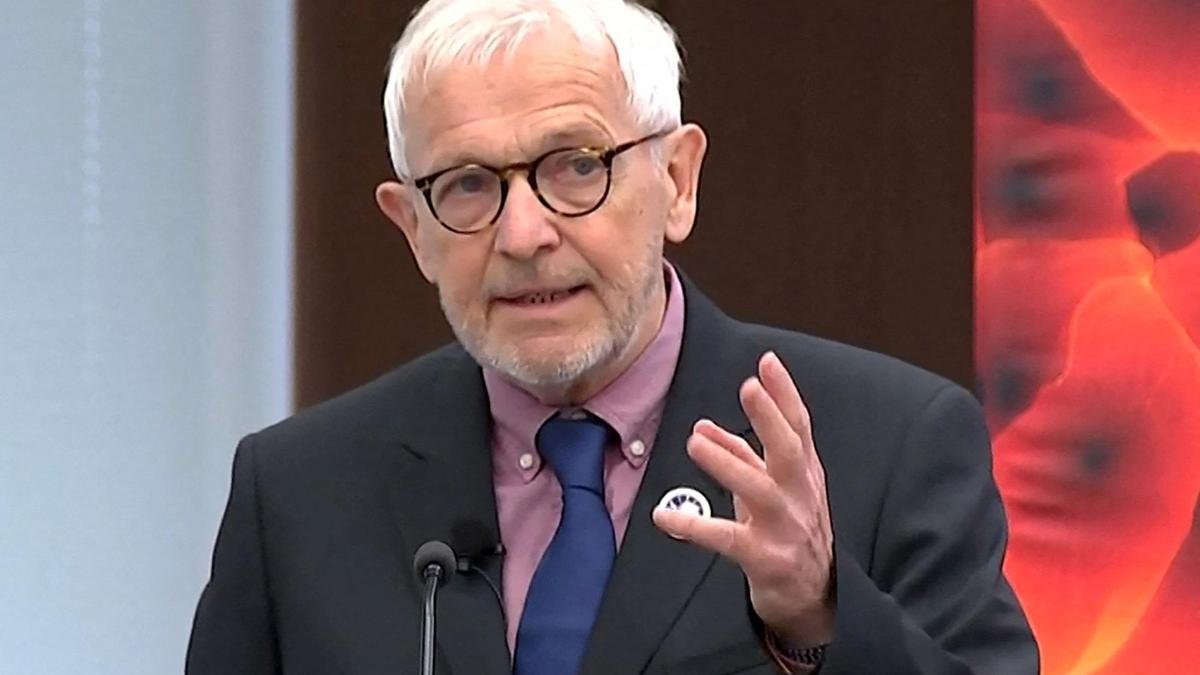

Belgian-American particle physicist Francis Halzen of the University of Wisconsin-Madison, winner of the 2026 Nobel Prize in Physics, speaks about his work on the IceCube project to detect neutrinos in Antarctica in Alexandria, Virginia, U.S., on July 12, 2018, in a still image from video.
| Photo Credit: Reuters
This year’s Nobel Prize in Physics has been awarded to Francis Halzen for his contributions to IceCube, a neutrino observatory in the South Pole, and for the discovery of high-energy neutrinos of astrophysical origin.
While there are several massive detectors for these extremely elusive particles, IceCube is designed to find high-energy neutrinos that are believed to have originated far in space from energetic collisions.
These “cosmic neutrinos” with extremely high energies are very rare and an enormous volume of ice is needed to observe an adequate number of collisions. Mr. Halzen first presented his vision for capturing neutrinos at the South Pole in 1988. Pure, undisturbed ice is an ideal medium to capture these neutrinos: when they occasionally collide with atomic nuclei, they produce charged particles that announce themselves as a flash of pale blue light. Even though trillions of neutrinos pass through the Earth, and even our bodies, at any given moment, it is worth remembering that the atoms that make up matter are mostly empty space. If an atom is a cathedral, its nucleus would, in relative terms, be the size of a fly. Neutrinos are point-like particles with no measurable size and no electric charge, which is why they so rarely interact with the atoms they pass through.

The South Pole’s ice has many advantages, as it is free from various types of interference and the area is geologically stable, with little seismic activity. Mr. Halzen’s idea caught on and, just a few years later, preliminary testing was conducted on sensors in ice.
IceCube covers an entire cubic kilometre (or about 917 million litres of water) and was completed in 2010. It has 5,160 optical sensors to detect the Cherenkov light produced by neutrino interactions, with its principal scientific focus on higher-energy astrophysical neutrinos. The Cherenkov light is the blue flash produced when a charged particle travels through a transparent medium, such as water or ice, faster than light can travel through that medium.

Researchers reported the first high-energy cosmic neutrinos in 2013 and, in 2018, traced one such neutrino to a distant blazar, a galaxy with a supermassive black hole at its centre that fires a jet of particles and radiation almost directly towards Earth.
“Francis Halzen has led an international team of researchers and engineers who have provided us with a fantastic instrument. His tenacity and scientific vision has paved the way for a new kind of astronomy,” Mark Pearce, Chair of the Nobel Committee for Physics, said in a statement.
The neutrino interactions that are continuously collected by IceCube will provide researchers with novel knowledge about the violent settings in which high-energy neutrinos can be created – and could even reveal previously unknown cosmic phenomena, a press statement added.
“It was a great surprise and I obviously didn’t expect it,” Mr. Halzen told the Nobel Committee by phone from Italy, the Associated Press reported.
Neutrino research in India
India has a long history in neutrino physics. In the 1950s and early 1960s, physicists from the Tata Institute of Fundamental Research, Mumbai, began using the deep shafts of the Kolar Gold Fields in Karnataka to study cosmic rays. In 1964–65, an international collaboration installed detectors about 2.3 km underground and recorded atmospheric neutrinos, almost simultaneously with a competing experiment in a South African gold mine. The KGF experiments continued for decades, but ended when the mines closed in 1992.

India subsequently conceived the India-based Neutrino Observatory (INO), an attempt to revive this tradition with a purpose-built underground laboratory at Pottipuram in Theni district, Tamil Nadu. Its proposed 50,000-tonne magnetised iron calorimeter (ICAL) was intended to study atmospheric neutrino oscillations and the effects of Earth’s matter on them. The project, however, became mired in environmental and local opposition and never progressed to the construction of the planned laboratory and detector.
INO/ICAL and IceCube are fundamentally different experiments: INO was designed primarily for relatively low-energy atmospheric neutrinos, whereas IceCube is for higher-energy astrophysical neutrinos.
Published – October 06, 2026 03:21 pm IST