


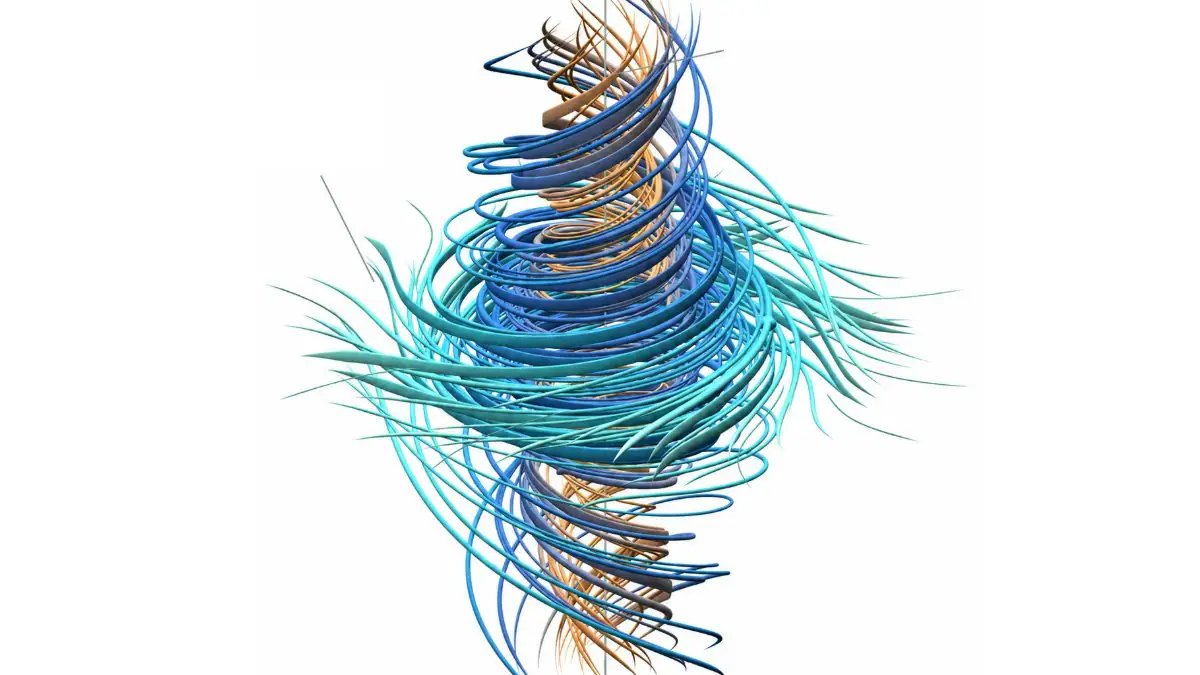
OpenAI announced a solution to the 90-year-old three-dimensional Navier–Stokes problem on Tuesday. The ChatGPT maker used an internal OpenAI system to generate the solution. It took 88 hours and 10,000 concurrent agents. OpenAI confirmed that it does not plan to claim the official Millennium Prize reward, but the result is shown to demonstrate the capabilities of its AI systems. However, the claim has already raised questions from mathematicians.
OpenAI Claims Breakthrough on Navier–Stokes Millennium Prize Problem
In a blog post, OpenAI confirmed that it has used “an internal model that is significantly more capable than GPT‑6 Astra” to solve the Navier–Stokes problem. The Navier–Stokes equations use Newton’s second law of motion to describe the movement of fluids. The company says it has used an internal AI model to produce a proof showing that three-dimensional Navier–Stokes equations can develop a singularity in finite time.
“The fluid has a smooth force applied to it, and its energy remains finite throughout the entire dynamics, from rest to the formation of the singularity. This resolves the Navier–Stokes Millennium Prize problem by establishing statement “C” (and also “D”) in the official Millennium Prize formulation,” OpenAI said.
OpenAI says it has used around 10,000 agents and millions of dollars in computing power for the project. It used a multi-agent system, and the solution was generated in about 88 hours. Lean formalisation and verification took an additional 17 hours via GPT‑6 Astra.
The agents sent 4.9 million messages and used about 300 billion output tokens across all attempted problems. Agents sent 2.7 million messages and used around 130 billion output tokens to solve the Navier–Stokes problem.
The company notes that it does not intend to claim the $1 million Millennium Prize associated with the problem. “Our goal in releasing this result is to report on the substantial progress of our AI models”, said OpenAI.
New York University mathematician Tristan Buckmaster and Anthropic researcher Levent Alpöge have, however, questioned the result. They have been working on related problems in fluid dynamics. Buckmaster raised concerns over whether OpenAI built upon their work or accessed private Codex data.
OpenAI denied using private user data or searching through unreleased research. In an X post, OpenAI said that its researchers and AI agents did not access Alpöge and Buckmaster’s work before its public release. “While unlikely, we cannot rule out that de-identified data derived from their usage of our products helped improve our models”, it said.
We congratulate Levent Alpöge and Tristan Buckmaster on their remarkable mathematical work.
We (the researchers and the agents) did not see any of their work through any means until they released it publicly — in particular, no specific user data was accessed in order to solve… https://t.co/otJKRHnQgb
— OpenAI (@OpenAI) September 8, 2026
The company said proofs differ significantly, and even the precise results proved are different in the Euler case.