


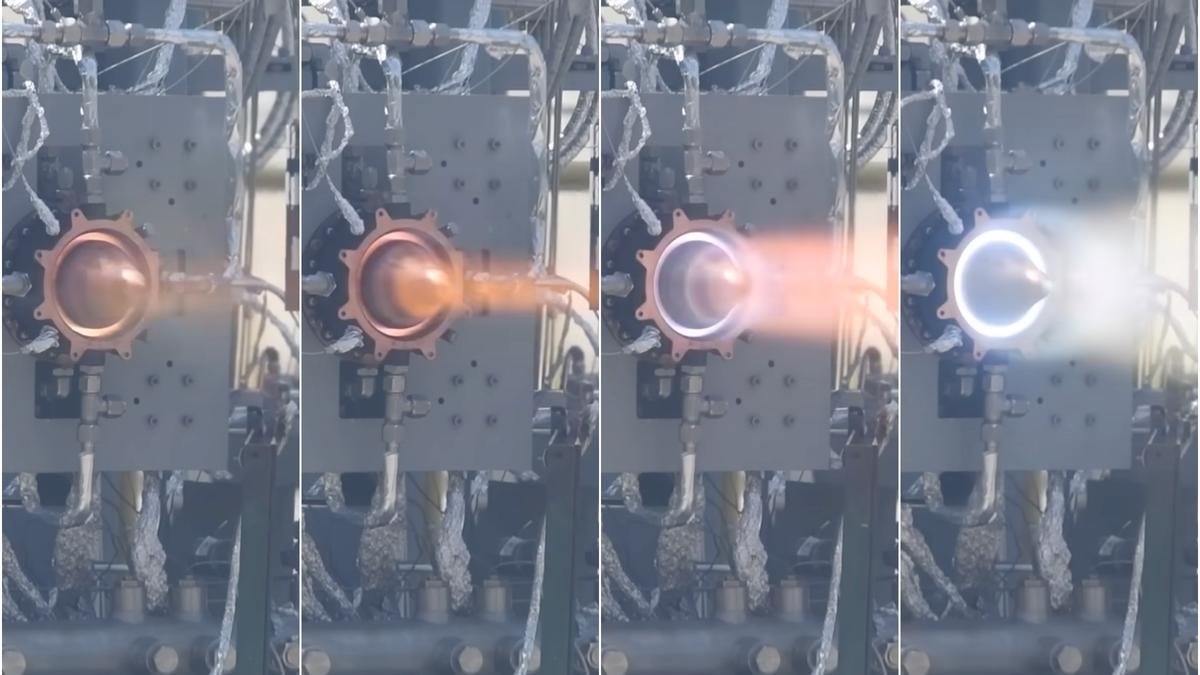
Recently, India-based defence start-up D-Propulse announced that it had successfully demonstrated a rotating detonation engine at a Defence Research & Development Organisation facility in Hyderabad.
A rotating detonation engine, or RDE, is an engine design that promises to use fuel more efficiently than conventional rocket engines. Launching satellites to space on rockets and carrying explosives to distant targets on missiles are both expensive. If an engine can use fuel more efficiently, it will need correspondingly less fuel to achieve the same task. This saving can be passed to the payload, whether a satellite or a warhead, increasing the profitability of the mission. At least on paper.
In January, GE Aerospace and Lockheed Martin demonstrated an RDE for hypersonic missiles (using air from the atmosphere). In February, U.S.-based SpaceWorks reported hot-fire tests of its RDE for rockets. Its compatriots Astrobotic test-fired its Chakram RDE continuously for 300 seconds and L3Harris announced that it had tested two RDEs, in April and May respectively.
The Swiss start-up Stellar Alpina completed a commercial RDE hot-fire test and raised CHF 3.5 million while Juno Propulsion raised $1.4 million to develop an RDE for spacecraft thrusters. In July, Venus Aerospace (then partnered with Lockheed Martin) raised $91 million to scale its tested RDE.
Wait for advances
RDEs are currently confined to research and development. There are no models known to be ready for commercial or military use. The actual data from many tests by commercial entities are also not available in the public domain. But going by their physics alone, RDEs offer around 10% to 25% more thermodynamic efficiency than conventional combustors. The exact value depends on real-world conditions and the engine’s design.
This is considered to be significant for rocket launches. Thermodynamic efficiency measures how much chemical energy becomes useful work. If an RDE improves thermodynamic efficiency by 20%, for instance, it could theoretically require around 17% less fuel for the same output, assuming other losses are unchanged.
Scientists figured out how an RDE could work by the 1960s. Building one was a different matter. Sustaining a continuous detonation in a compact chamber requires engineers to precisely control the injection of the fuel and the internal pressure. The chamber also needs to have a specific geometry to ensure the engine works as desired.
Unlike in regular engines, even small instabilities in the fuel-air mixture in an RDE can destabilise the engine.
The engine materials must also withstand more than 2,000° C, 10-100 atmospheres of pressure (and in brief moments much higher), detonation speeds of more than 1,500 m/s, pressures oscillating at several thousand cycles per second, and potentially tens to hundreds of g, depending on the design.
So to invent working RDEs, scientists and engineers had to wait for advances in high-speed computing, diagnostics, fuel injection, materials, and manufacturing.
Supersonic flame
In a regular engine, the combustion chamber holds the fuel-air mixture. When a flame is introduced in the chamber — like from a spark plug — it travels through the mixture at less than the speed of sound. This is called a deflagration.
When the flame travels through the mixture at more than the speed of sound, it imposes a shock wave on the mixture and heats it up, triggering rapid combustion behind it. This is called a detonation. It is also what happens in the combustion chamber of a detonation engine.
As the flame passes through the mixture in a regular engine, the combustion happens at constant pressure. This means the mixture is free to expand as it heats up instead of being confined under pressure.
But when the flame passes through the mixture as a detonation, the combustion happens at constant volume. This is because the detonation compresses the unburned mixture with a shock wave immediately before combustion, and the mixture doesn’t have enough time to expand under these ‘forces’.
This is also why a detonation engine produces combustion products at a higher pressure, and more of the fuel’s chemical energy is converted into pressure rather than being shed as heat. This is essentially the physics of how a detonation engine can have more fuel efficiency than a ‘regular’ engine with the same fuel.
Pulsed and rotating detonation
A simple type of the detonation engine is called the pulsed detonation engine, or PDE. A PDE has a long tube as the combustion chamber, to allow the detonation to pass through the whole mixture.
First, the detonation races down the tube, rapidly compressing and burning the fuel-air mixture. This leaves behind very hot, high-pressure combustion products. Those gases expand towards the open end of the tube, where they exit at a high speed.
By Newton’s third law, their momentum in one direction produces an equal and opposite momentum on the engine, pushing it forward. Alternatively, if the engine is connected to a piston, the same expanding gases would push on it, generating mechanical energy. The tube is then purged before the next cycle begins.
An RDE makes the detonation a continuous process. Instead of the detonation passing through a long tube, it is made to flow in a circle. In the general RDE design, the combustion chamber has an annular shape, i.e. two concentric cylinders with a narrow ring-shaped gap between them. The fuel and the oxidiser are injected continuously into this gap, called the annulus, even as one or more detonation waves race through.
As the detonation goes round and round, it continuously imposes high pressures and temperatures on the mixture.
And to keep the detonation going, fuel is continuously injected into the annulus just ahead of the detonation wave. The wave consumes the fresh fuel-air mixture and expels the products through the nozzle, along its axis. So as long as the fuel keeps coming at the right time and in the right conditions, the detonation can keep going — even at thousands of times per second.
This is how an RDE can continuously generate thrust (or mechanical energy).
Published – August 18, 2026 08:30 am IST