


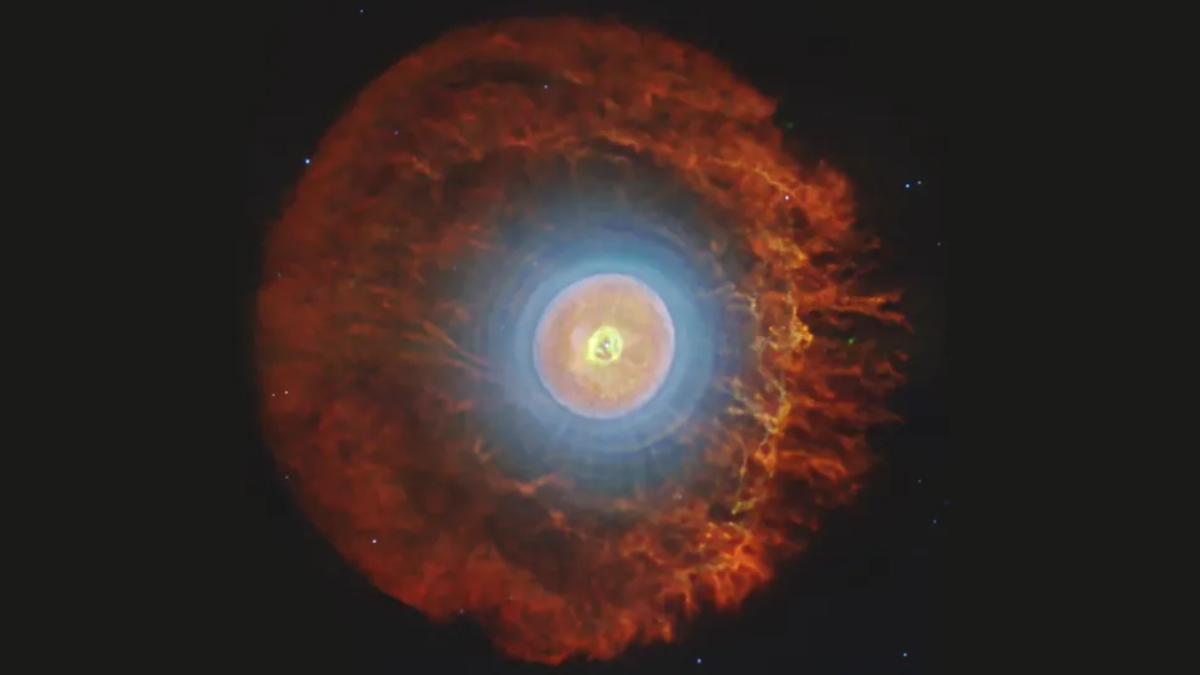
After a sun-like star has burnt through its nuclear fuel, it does not simply disappear but instead sheds its outer layers into space and emits glowing gas – a planetary nebula. The cosmos’ most puzzling carbon molecules, buckyballs, were discovered in a nebula, 10000 light-years away in the constellation Ara. According to NASA scientists, the James Webb Space Telescope (JWST) took the most detailed pictures of its birthplace so far.
What Are Buckyballs?
The research work on planetary nebula Tc 1, led by Professor Jan Cami of Western University, used the Mid-Infrared Instrument (MIRI) of the JWST. Buckyballs, which refer to buckminsterfullerene, are carbon molecules that form a hollow ball arrangement similar to that of a soccer ball. The ball has 60 atoms that are geometrically arranged in pentagons and hexagons. Harry Kroto’s team at the University of Sussex first synthesized fullerenes in 1985, which won the Nobel Prize in Chemistry, and have now been confirmed in space. Overall, they are a class of organic compounds that could be building blocks of life.
What JWST Revealed
The JWST’s fine infrared vision has improved scientists‘ understanding of Tc 1. The images show a bright shell and its wispy filaments. It is also home to a puzzling upside-down question mark that they can’t explain yet. Importantly, the buckyballs are not contextually dispersed randomly; they are instead arranged in a thin shell around the center of the white dwarf. PhD candidate Morgan Giese describes this as buckyballs that are arranged like one giant buckyball. Spectroscopic data have also captured infrared emissions that are unexpected and that current models can’t explain. The team has acquired more telescope time to analyze two other nebulae.
Get your daily dose of tech news, reviews, and insights, in under 80 characters on Gadgets 360 Turbo. Connect with fellow tech lovers on our Forum. Follow us on X, Facebook, WhatsApp, Threads and Google News for instant updates. Catch all the action on our YouTube channel.