


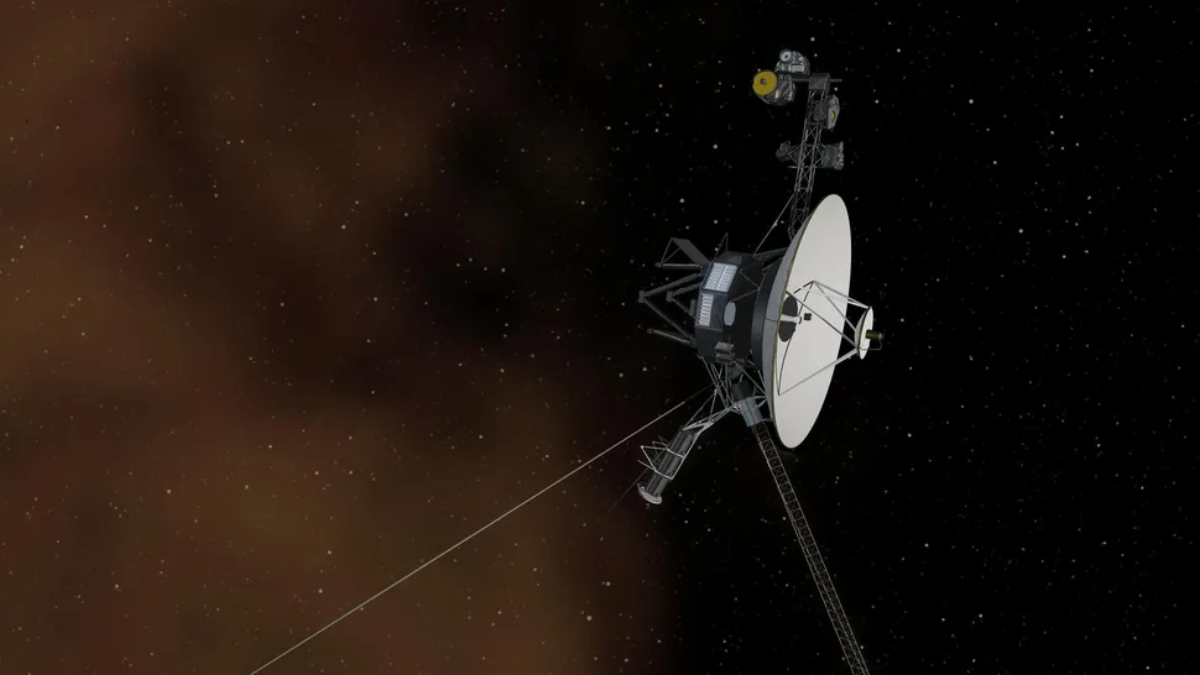
In April 2026, NASA engineers turned off a science instrument aboard Voyager 1 to conserve power and keep it operating. Voyager 1, launched in 1977, is now the farthest human-made object, over 15 billion miles (24 billion km) from Earth and in interstellar space. Its radioisotope power source decays by ~4 watts a year, so mission teams sacrifice some science (the LECP particle detector) to preserve power for the remaining instruments.
Instrument Shutdown Details
According to NASA, on April 17, 2026, NASA’s Jet Propulsion Laboratory engineers sent commands to shut down Voyager 1’s Low-Energy Charged Particles experiment (LECP). The LECP had operated nearly continuously since launch, measuring low-energy ions, electrons, and cosmic rays in the interstellar medium. A planned Feb. 2026 power drop nearly triggered an automatic shutdown, so teams enacted a pre-agreed order of instrument retirements to save energy. Now only two instruments remain active (a plasma-wave detector and a magnetometer). Seven of the probe’s original ten science instruments have already been turned off to keep the mission going.
Future Prospects
According to the engineers, turning off LECP would extend the life of the spacecraft by around a year. They have designed an aggressive program called “Big Bang,” where some parts will be replaced with low-powered substitutes. This would rnesult in the loss of valuable information provided by LECP regarding cosmic rays, but more wattage would become available to power the rest of the devices. Voyager 1 would still be sending data collected by the magnetometer and plasma wave science devices before its power runs out. It is not known when Voyager 1 will cease functioning.