


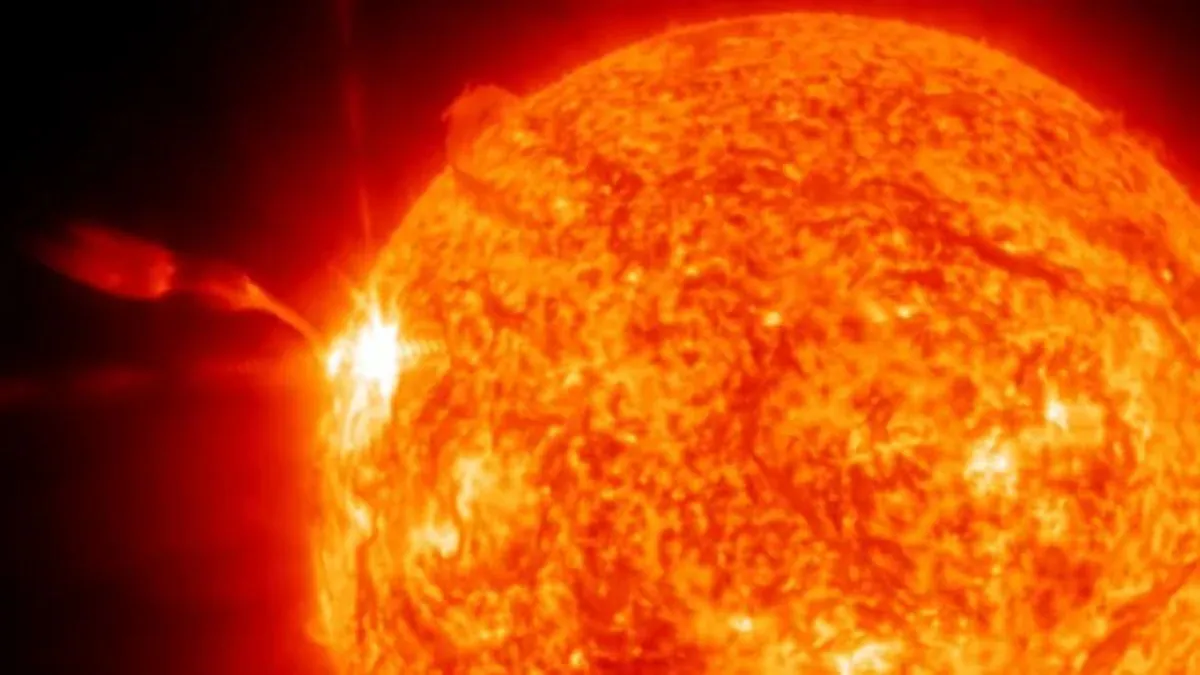
A new study suggests that particles can be thrown by the Sun’s strong flares up to 108 million degrees Fahrenheit (60 million degrees Celsius), which is roughly six times hotter than previous estimates. This finding emphasizes the need to update solar storm models and helps solve a long-standing conundrum. Massive explosions known as solar flares can send radiation and particle bursts into space, endangering astronauts and occasionally interfering with communications and satellites. The Astrophysical Journal Letters published the results.
Surprising Findings from Flare Research
According to the researchers led by Alexander Russell at the University of St. Andrews found that during solar flares, charged atoms (ions) can get far hotter than the electrons around them. Using experiments and computer simulations of magnetic reconnection (the process that powers flares), they showed electrons warm up to roughly 10–15 million °C while ions soar past 60 million °C.
Because ions and electrons take minutes to share heat, the super-hot ions persist long enough to smear the spectral fingerprints of elements in the flare’s light. The faster-moving ions naturally broaden these spectral lines, potentially resolving why those lines have always appeared wider than theory predicted.
Forecasting Space Weather
Our ability to forecast space weather is greatly altered by the realization that flare ions carry a lot more heat. Flare energy may be underestimated by models that assume a single temperature for all particles. In order to improve warnings for satellites, airlines, and astronauts, the study recommends that future forecasts treat electrons and ions separately.
A “multi-temperature” strategy, which is already popular in other plasma contexts, might allow operators more time to get ready for potentially hazardous solar storms. This theory may be tested by future spacecraft missions that measure the ion temperatures in flares directly.