


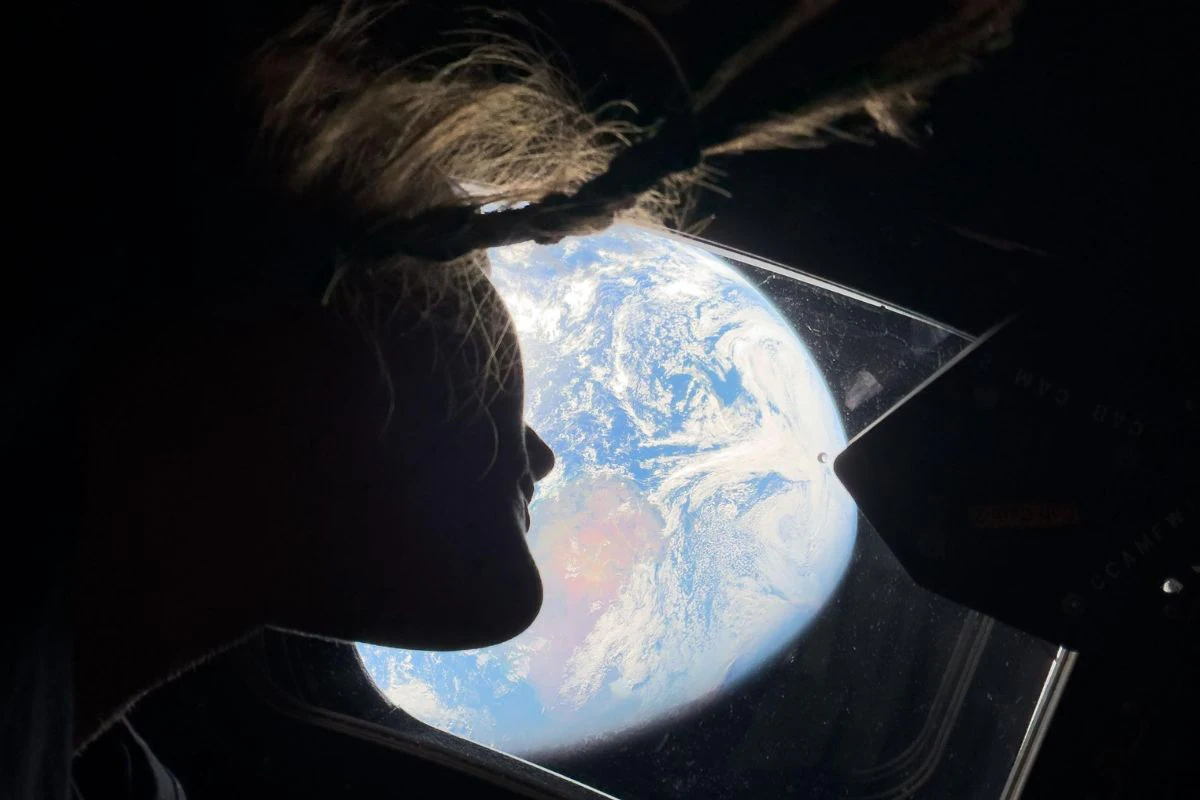
NASA’s Artemis 2 mission is historic for several reasons. It is the first time in 50 years that the space agency has sent a crewed spacecraft into deep space. It is also its first lunar mission in the 21st century. Interestingly, this is also the first time the US space agency has cleared an iPhone for a deep space mission. Each crew member aboard the Orion spacecraft is now carrying an iPhone 17 Pro Max to capture photos and videos for their families and to show them to the world.
NASA Clears iPhone for Deep Space Mission
On its mission page, NASA has been continuously posting images shared by the astronauts aboard the Orion spacecraft. Crew members have shared photos of the Earth from space and a look at the lunar surface as the Artemis 2 mission readies for the flyby. Interestingly, these photos were taken using the iPhone 17 Pro Max, which was launched in September 2025.
The curiosity around these photos comes from the fact that this is the first time the space agency has approved the usage of an iPhone on a space mission. Typically, NASA allows cameras and even GoPros to capture footage of the mission, but this is a first for a smartphone.
The New York Times reports that NASA has a lengthy process to clear any new hardware for a space mission. Citing Tobias Niederwieser, an assistant research professor at BioServe Space Technologies, a research institute at the University of Colorado, the publication claims that the space agency assesses each piece of hardware for safety and potential hazards.
This is done as these pieces of hardware behave differently in zero gravity and microgravity conditions. With that, they also bring unique hazard scenarios. For instance, if the Ceramic Shield display or the Sapphire glass on the lenses of the iPhone 17 Pro Max shatters, the shards will keep floating inside the spacecraft, instead of falling down. This poses a risk that it can cut an astronaut’s face or can also enter their nasal cavity while breathing.
Niederwieser reportedly highlighted that NASA’s evaluation has four phases. First, the hardware is introduced to the safety panel, then the panel identifies the potential hazards. After that, the team creates a plan to deal with such hazards, and finally, the feasibility of the plan is demonstrated.
Notably, the publication claims that Apple denied any involvement in the process to approve the iPhone for the deep space mission. However, the company reportedly stated that this is the first time an iPhone is fully qualified for usage in Earth orbit and in deep space.