


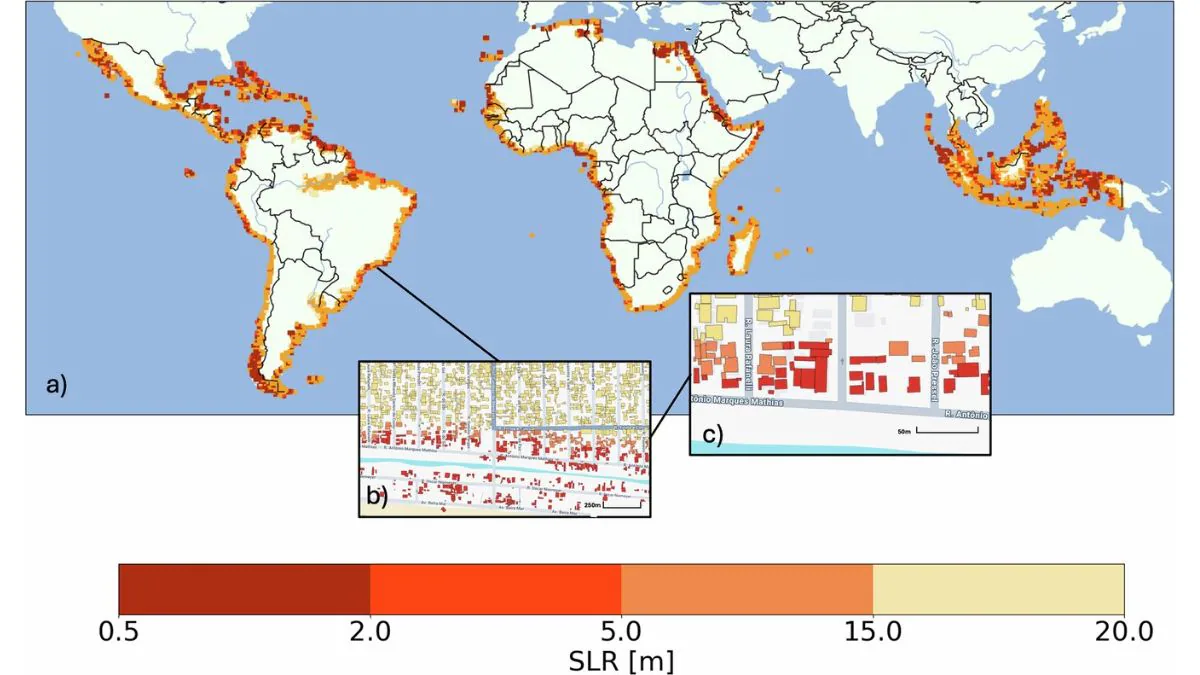
A new McGill-led study revealed that the sea level rise might put over 100 million buildings across the Global South at risk of flooding if fossil fuel emissions are not curbed quickly. Published in npj Urban Sustainability, the research facilitates the first large-scale, building-by-building calculations of sea level rise impacts in Africa, Southeast Asia, and Central and South America. scientists found that even modest increases could inundate millions of structures by using satellite maps and elevation data. It is putting neighborhoods and key infrastructure under threat.
Study Warns Rising Seas Could Inundate Over 100 Million Buildings Without Swift Emission Cuts
As per the report, even in the most optimistic scenario of a 0.5-metre rise, around three million buildings could face flooding. Under the extreme scenarios, exceeding five metres, exposure can surpass 100 million structures, as reported by Phys.org. Many threatened areas include crowded coastal zones and critical infrastructure, namely ports, refineries, and cultural heritage sites. The findings paint a picture of how rising seas are already changing coastlines. Although it threatens communities that depend on these vulnerable regions.
The unstoppable consequence of global warming is pointed out by the researchers, and it is expected to continue for centuries. They also noted that the increase might seem gradual; it has a long-term impact negatively impacts urban regions and economies connected to coastal trade. Regardless of location, every person could feel indirect effects through disrupted food and fuel supply chains, experts added.
In addition, the team developed an interactive map on Google Earth Engine that acts as a fulcrum to trace out high-risk zones. Moreover, it emphasises the adaptation strategies that measure building flood defences, revising land-use policies, and, when necessary, relocating from high-risk zones, which help to drag down future losses. Early planning offers the chance for coastal communities to survive and adapt in a warming world, specified by the researchers.