


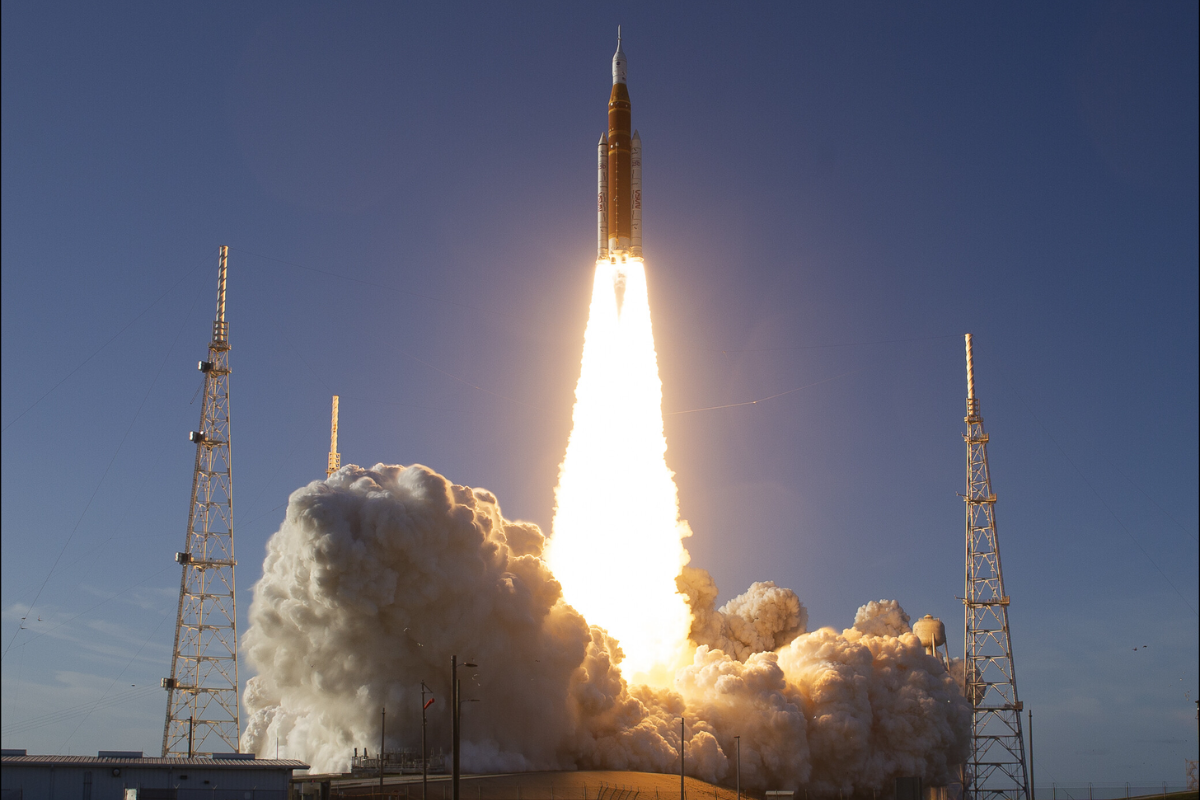
NASA’s Artemis II mission was launched on Wednesday evening, marking the first time in 50 years that the space agency sent a crewed mission towards the Moon. The successful take-off of the new Space Launch System rocket and the Orion spacecraft took place from Launch Pad 39B at the Kennedy Space Center at 6:35pm EDT (Thursday, 4:05am IST). The spacecraft is sending four astronauts on a planned test flight around the Moon and back. The entire mission is scheduled for 10 days.
NASA Successfully Launches Artemis II Mission
In a post on X (formerly known as Twitter), the official handle of NASA announced the successful take-off, adding, “Artemis II will pave the way for future Moon landings, as well as the next giant leap — astronauts on Mars.” In the first hour after launch, the rocket’s upper stage separated from Orion, and the spacecraft deployed its solar array wings to harness energy from the Sun.
Liftoff.
The Artemis II mission launched from @NASAKennedy at 6:35pm ET (2235 UTC), propelling four astronauts on a journey around the Moon.
Artemis II will pave the way for future Moon landings, as well as the next giant leap — astronauts on Mars. pic.twitter.com/ENQA4RTqAc
— NASA (@NASA) April 1, 2026
The crew includes NASA astronauts Reid Weisan, who serves as the commander, the pilot Victor Glover, Christina Koch, who serves as the mission specialist, and Canadian astronaut Jeremy Hansen. Apart from Hansen, the rest of the crew is experienced and has long-term stints at the International Space Station (ISS) under their belt. With this mission, Hansen will become the first Canadian astronaut to fly into deep space.
“Over the next 10 days, Reid, Victor, Christina, and Jeremy will put Orion through its paces so the crews who follow them can go to the Moon’s surface with confidence. We are one mission into a long campaign, and the work ahead of us is greater than the work behind us,” said NASA Associate Administrator Amit Kshatriya.
The Artemis II mission will first make several rotations across the Earth’s orbit before slingshotting towards the Moon. Instead of landing on the lunar surface, it will then make several flybys of the Moon over the next 10 days, observing craters, the surface, and other physical features of the celestial body.
However, the main goal of the mission is to test whether multi-day crewed missions are sustainable for NASA, before it begins preparing for crewed missions to Mars in the future.