


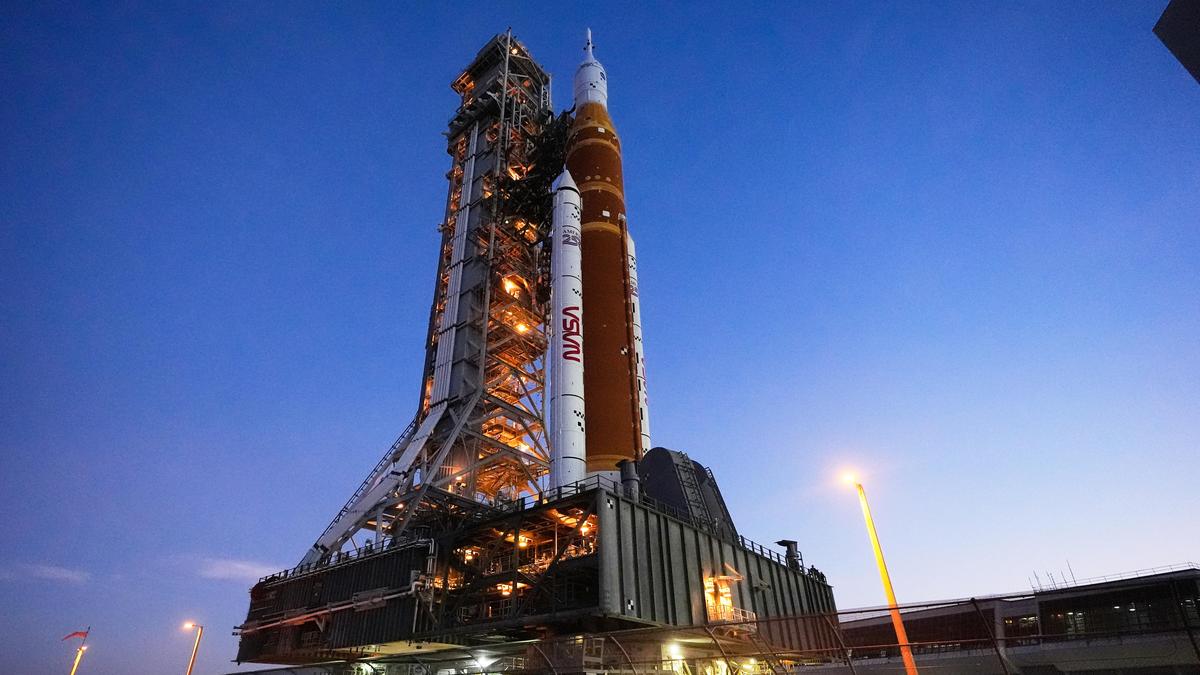
The NASA Artemis II mission is set to launch no earlier than April 1, 2026. If the lift-off is successful, the giant rocket will send humans to near the moon for the first time in more than half a century. In so doing, it will make an important milestone for the U.S. space programme. Its crew — commander Reid Wiseman, pilot Victor Glover, mission specialist Christina Koch, and Canadian Space Agency astronaut Jeremy Hansen — will also become the first humans to travel beyond low-earth orbit since Apollo 17 in 1972. Glover will also become the first person of colour, Koch the first woman, and Hansen the first non-U.S. citizen to embark on a lunar trajectory.

The Artemis II mission uses the Space Launch System (SLS) rocket and the crew capsule is called Orion. The SLS will propel Orion into a free-return trajectory around the far side of the moon, reaching around 7,500 km from the moon’s surface before the earth’s gravity pulls them back to splash down in the Pacific Ocean in a little over a week.
The mission does not plan to land on the moon. Instead, NASA is flying it to prove that the whole system — from the ground teams to the rocket and its crew — works as designed and the processes to land humans on the moon are ready.
Mission profile
After the SLS core stage is separated, the crew will spend 24 hours in a high orbit around the earth as it checks the capsule’s life-support and environment systems. If they’re all in order, they will fire Orion’s trans-lunar injection burn. The crew will also test manual piloting and proximity operations, communications and navigation systems, and a high-speed data relay and collect data about physiological and biological responses of the human body to deep-space travel.

Once Orion has finished going around the moon, it will be pulled towards the earth by gravity. NASA engineers expect the capsule will enter the earth’s atmosphere at a speed of around 40,000 km/hr. Its 5-metre-wide heat shield will endure temperatures as high as 5,000 C.
NASA will be collecting important data at this time because during the Artemis I mission in 2022, engineers found that Orion’s heat shield was eroded during re-entry as gases trapped in the shield’s material cracked it. In response, NASA used the same material but this time modified the re-entry trajectory so that Orion spends less time in the atmosphere as it descends.
Artemis overhaul
Artemis II will be the first test flight in the programme since NASA Administrator Jared Isaacman overhauled the programme’s milestones earlier this year. In the older plan, the Artemis III mission was to land humans on the moon for the first time in the 21st century. In the new plan, however, Artemis III will launch a crewed Orion capsule to earth orbit to dock with prototype lunar landers designed by SpaceX and Blue Origin to ensure the technology works. Mr. Isaacman has said this mission is currently planned for 2027. NASA will actually land American astronauts on the moon in the Artemis IV mission, currently planned for 2028.
This is why SpaceX and Blue Origin recently announced that they would focus on their plans to help U.S. astronauts reach the moon in the near future.
The restructure also addressed a deeper operational problem. NASA flew the Artemis I test flight in late 2022 and Artemis II will (likely) fly in 2026. This three-year gap included workforce attrition that could have resulted in loss of institutional memory, forcing parts of the mission to start afresh. So instead, NASA abandoned a plan to upgrade SLS for the Artemis II mission; instead, it will fly with the same configuration that flew on Artemis I. NASA also said it will increase the launch frequency, with the additional mission in 2027 followed by at least one mission landing on the moon’s surface from 2028 onwards. The agency is increasing mission cadence: an additional mission in 2027, and at least one surface landing every year thereafter.
NASA also cancelled the Lunar Gateway project to build a space station orbiting the moon, and reallocated its components to infrastructure that will eventually be installed on the moon’s south pole.
The Chinese pressure
Mr. Isaacman wasn’t only responding to technical challenges. A big reason for NASA to change its plans to return to the moon so drastically is China. As he put it: “… with credible competition from our greatest geopolitical adversary increasing by the day, we need to move faster, eliminate delays, and achieve our objectives.”
China is set to conduct a test flight of its new Mengzhou crewed spacecraft this year. Its new and powerful Long March-10 rocket made its first low-altitude flight on February 11. The Lanyue lunar lander, which will carry astronauts from orbit to the surface, is expected to make its maiden flight between 2028 and 2029. As for robotic missions: the Chang’e 7 moon mission is also expected this year. It will explore the moon’s south pole region for resources like water. The Chang’e 8 mission is expected around 2029: it will have technologies to use resources on the moon itself, like a 3D-printer that will try to build structures using lunar soil.
Importantly, China also plans to land humans on the moon by 2030. It also has plans for its ‘International Lunar Research Station’ in the 2030s.
As the U.S.-China rivalry continues to dig in on the earth, with the entrenched hegemon reluctant to cede dominance and the rising power determined to reshape the international order, the space race they’re leading wouldn’t be what it is if it weren’t for a particular limited resource: water on the moon.
There are craters in the moon’s south pole region that have been permanently shadowed. These areas have escaped the drastic temperature swings on the parts of the moon that are exposed to the sun (from 127 C during the day to -173 C at night). As a result, they are expected to contain water ice. The thinking goes: whichever country establishes infrastructure first in this area could corner these water ice deposits and shape the scientific and geopolitical rules for everything that follows.
But in 2025, former NASA Administrator Jim Bridenstine told a Senate Commerce Committee hearing that without significant changes, it is highly unlikely the U.S. will beat China’s projected timeline to land people on the moon.
If Artemis II and III go as planned and Artemis IV is able to lift off on time, U.S. astronauts could reach the moon’s surface at least two years before China’s mission. However, that depends on many things happening right on schedule — perhaps too many. Artemis I was delayed four times before it launched; Artemis II has been delayed at least thrice so far. More broadly, whereas China has followed an incremental approach driven by the state, the U.S. has been following a commercial model with a large coalition: more than 50 countries (through the Artemis Accords) plus private companies like SpaceX and Blue Origin.
Scenarios: success, failure, delay
If the Artemis II mission succeeds, (i) it will prove the SLS rocket and the Orion crew capsule work; (ii) it will encourage NASA’s partners to focus on Artemis III; and (iii) it could galvanise political commitment to land U.S. astronauts on the moon before China does.
If Artemis II is delayed again, (i) both public and institutional confidence in SLS and Orion will erode further; (ii) there will be cascading complications for NASA’s partners, including the European and Japanese space agencies; and (iii) it could prompt the U.S. government to revisit the question of whether the programme is too expensive.
It has so far cost at least $93 billion and each new launch costs at least $2 billion. SpaceX also still has to demonstrate the in-orbit refuelling technology that lunar missions require.
And if Artemis II fails, (i) the consequences range from a small but important delay if the failure is non-catastrophic to a delay of several years as the programme is halted altogether if the failure is catastrophic; (ii) give reason for NASA’s partners to consider whether they should suspend or possibly exit their involvement; and (iii) the U.S. could launch a more panicked programme to beat China to the moon.
When Artemis II launches, it will send four people farther from the earth than any mission has in 54 years — and thus show that the U.S. is still in the race. China on the other hand has kept the U.S. anxious by almost always sticking to its schedule even as it thunders towards a crewed landing on the moon by 2030.
mukunth.v@thehindu.co.in
Published – April 01, 2026 10:00 am IST