


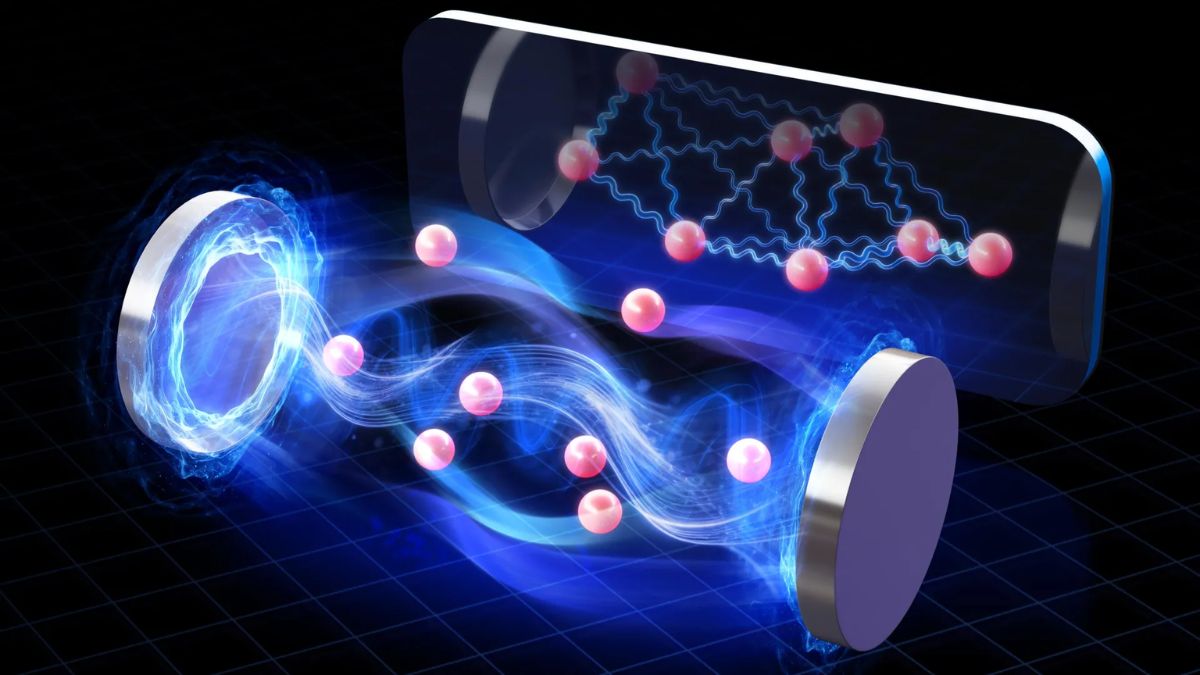
Physicists from the University of Warsaw’s Faculty of Physics and Emory University have discovered that interactions among entangled atoms can boost a collective light emission called superradiance. Superradiance occurs when excited atoms synchronize their emissions, creating a burst far brighter than their individual outputs. The researchers found the bursts were significantly stronger after including these interactions and full entanglement. By incorporating quantum entanglement into their models, they reveal that these interactions can enhance energy-transfer efficiency, offering new design principles for quantum batteries, sensors, and communication systems.
How entanglement enhances light emission
As reported in a paper published in Physical Review Letters, the findings suggest new design rules for future quantum devices. In many optical-cavity experiments, atoms share a common light mode (the pattern of light between mirrors), enabling collective emission. The researchers developed a model that explicitly includes short-range forces between atoms, effects that are often ignored in simpler approaches. They show these atom-atom forces can reinforce the photon-mediated coupling responsible for superradiance. By fully including quantum entanglement in the simulation, the study found that the interactions lower the energy threshold for superradiance and even produce a new collective state of atoms, meaning the atoms light up more easily and intensely.
Applications in quantum technology
These findings have practical significance for emerging quantum technologies. Cavity-based atomic systems underpin devices like conceptual “quantum batteries,” theoretical energy storage units that exploit collective emission to charge quickly. Enhancing superradiance means such devices could charge and discharge faster, improving efficiency. In fact, the researchers say their findings provide design rules: by keeping entanglement in the model, engineers can predict how quickly a device will charge or respond. Similar principles could also benefit quantum communication networks and high-precision sensors.