


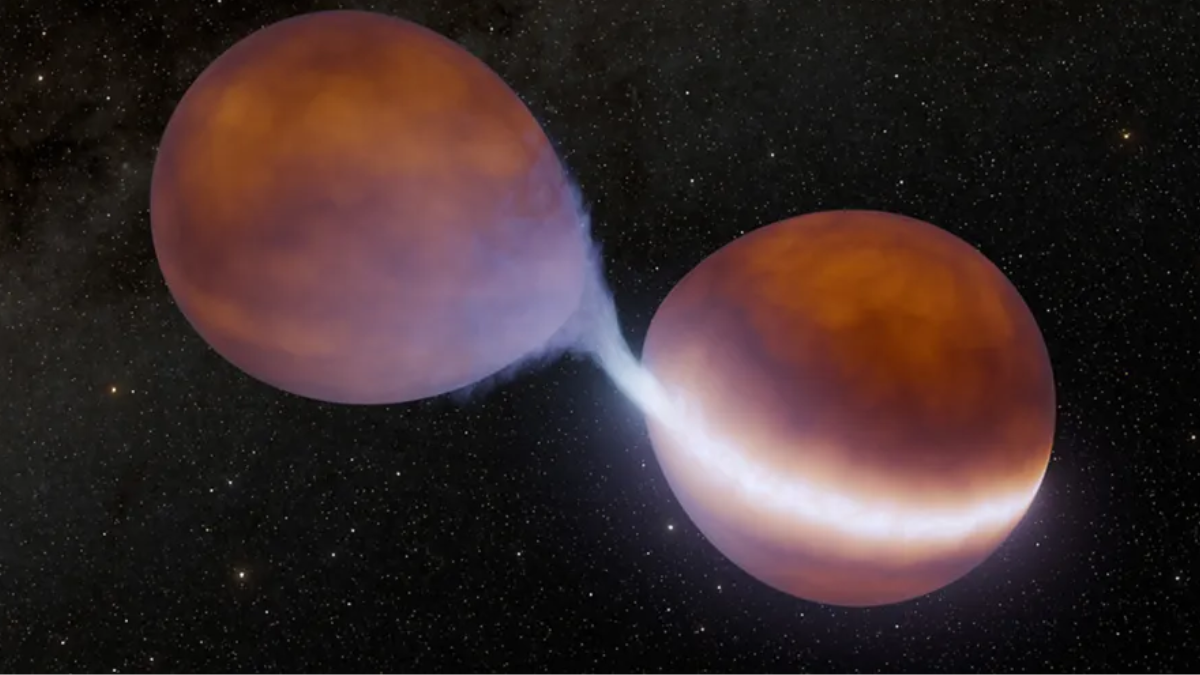
Brown dwarfs are the underachievers of the universe. They are objects that are too massive to be planets but not massive enough to become stars. Brown dwarfs have masses between 13 and 80 times that of Jupiter. They do not have enough mass to sustain nuclear fusion in their cores, the process that powers stars. However, astronomers have made a remarkable discovery. Two of these failed stars may find their path to redemption in the form of a merger.
A Record-Breaking Discovery 1,000 Light-Years Away
According to a recent study, using the Zwicky Transient Facility (ZTF), researchers identified ZTF J1239+8347, a brown dwarf binary undergoing stable mass transfer with an orbital period of just 57.41 minutes. The entire system would fit within the distance between Earth and the moon. Both objects weigh roughly 60–80 times Jupiter’s mass. Until now, this type of mass transfer between binary objects had only been seen in much heavier objects, such as white dwarfs, the dead remnants of sun-like stars. Lead researcher Samuel Whitebook of Caltech described it: “The failed stars get a second chance.”
Two Futures, One Outcome
There are two possible outcomes of this scenario. Firstly, the brown dwarf might continue to accrete and eventually reach a mass where it is capable of nuclear fusion reactions. Secondly, they might collide and merge, resulting in a brand new star. This means that, in both instances, two less luminous objects might combine to form one very luminous one. There are plans to make further observations of ZTF J1239 with NASA’s James Webb Space Telescope, which might shed further light on this interesting system. There are probably many other such systems waiting to be discovered by Chile’s upcoming Vera Rubin Observatory.
Get your daily dose of tech news, reviews, and insights, in under 80 characters on Gadgets 360 Turbo. Connect with fellow tech lovers on our Forum. Follow us on X, Facebook, WhatsApp, Threads and Google News for instant updates. Catch all the action on our YouTube channel.