


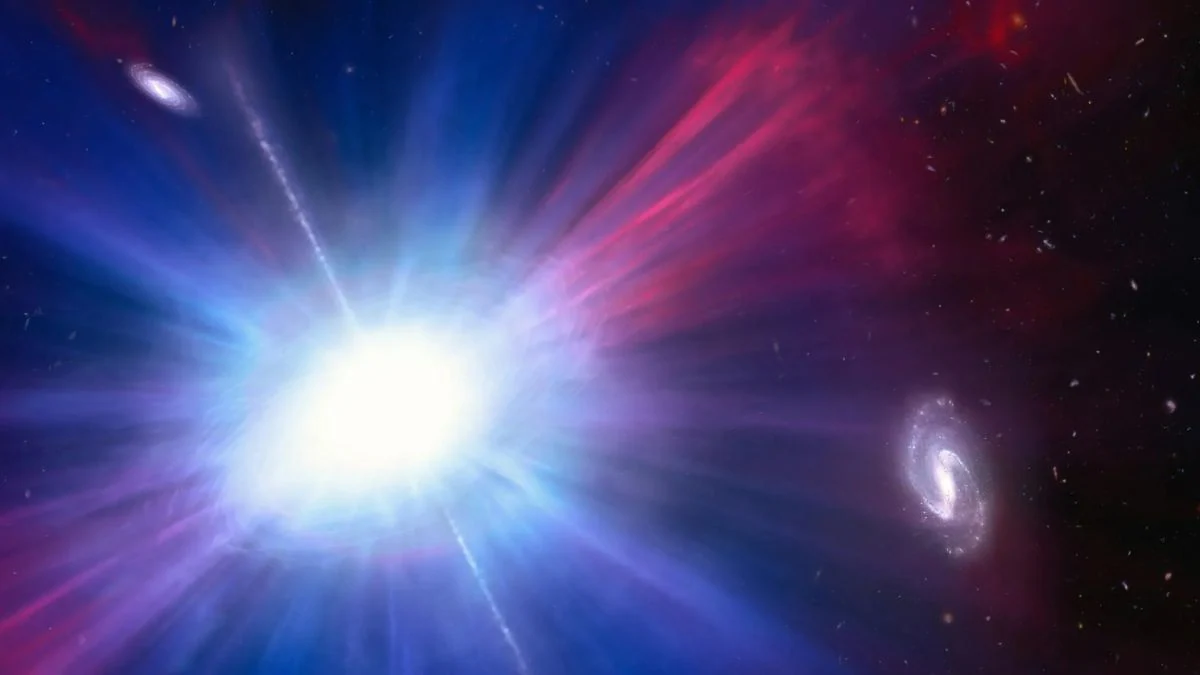
Scientists have detected a supernova, the explosive death of a star, from only 730 million years after the Big Bang, deep into the era of reionisation. This stellar explosion, catalogued as SN in GRB 250314A, was initially indicated by a high-energy gamma ray burst (GRB) in March 2025 and subsequently confirmed by the follow-up observations with the James Webb Space Telescope. The discovery provides a rare view of the first stars that died in the early universe.
Distant Supernova Discovered
According to the paper, astronomers used JWST and other telescopes to identify the explosion (SN in GRB 250314A). It was first flagged by a powerful gamma-ray burst on 14 March 2025, caught by the SVOM satellite, and its great distance confirmed by ESO’s Very Large Telescope. About 110 days later, Webb’s infrared camera separated the fading supernova from its dim host galaxy. These observations place the blast at just ~730 million years after the Big Bang, deep in the era of reionisation. This makes it the most distant supernova yet confirmed.
Unexpectedly Familiar Explosion
Subsequent analysis revealed the ancient explosion to be surprisingly ordinary. Its light and spectrum are very similar to those of a well-known local GRB supernova (SN 1998bw), thus an extremely bright super luminous event is ruled out. Basically, the first star to die in the universe appears to have been a star of the current generation. This is a surprise to those who expected the first stars to explode in an entirely different manner. Researchers emphasise that it is just one instance, and more observations with JWST are scheduled.