


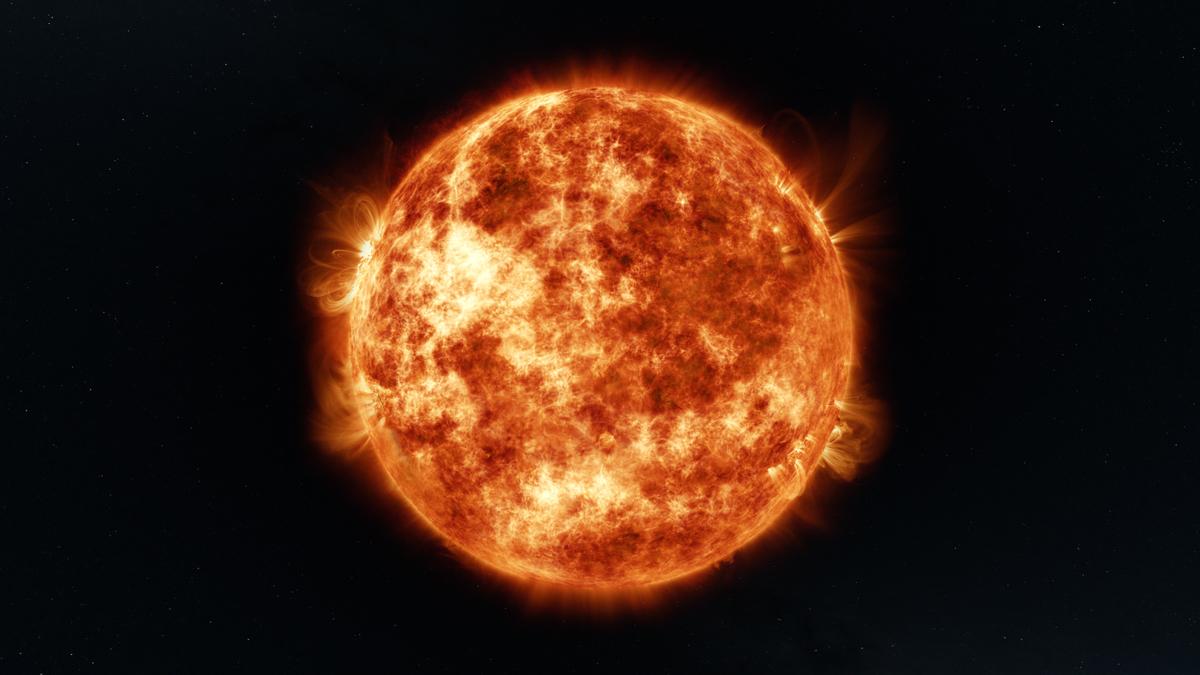
According to the researchers, the sun vibrates constantly with acoustic waves generated by turbulent motions beneath its surface.
| Photo Credit: Getty Images/iStockphoto
GUWAHATI
Researchers from Tezpur University in North-central Assam have found that the subtle vibrations on the sun’s surface could be transporting enormous amounts of energy into its outer atmosphere.
The research, conducted by physicists Souvik Das and Pralay Kumar Karmakar from the university’s Department of Physics, examines the dynamics of solar surface waves known as p-mode oscillations, occurring roughly every five minutes.
Their study, published in The Astrophysical Journal, explored how these oscillations behave in the presence of non-thermal electron populations—high-energy particles that do not follow the usual thermal distribution expected in plasma.
According to the researchers, the sun vibrates constantly with acoustic waves generated by turbulent motions beneath its surface. These waves form global oscillation patterns that allow scientists to probe the sun’s interior in a field known as helioseismology.
They used an advanced statistical model, known as the generalised (r, q) distribution, to examine how both low-energy and high-energy electrons influence these oscillations. Their analysis shows that high-frequency p-mode oscillations can carry significant mechanical energy upward from the photosphere.
The researchers estimated that these waves may transport energy flux exceeding 1 million watts per square metre near the lower solar surface. This energy can travel into the sun’s outer layers and potentially power various solar activities.
Such energy transfer may contribute to the formation of features like spicules — jet-like plasma eruptions from the solar surface — as well as oscillations in coronal loops, the giant arcs of plasma seen in the sun’s outer atmosphere.
The study also found that low-frequency oscillations, known as g-modes, do not significantly contribute to heating the solar corona. The solar corona is the outermost, tenuous layer of the sun’s atmosphere, which extends millions of kilometres into space and appears as a faint white halo during total solar eclipses.
Using numerical simulations and observational data from the Solar Dynamics Observatory, a National Aeronautics and Space Administration satellite, the researchers further examined how the energy carried by these oscillations decreases as it moves higher into the sun’s atmosphere.
“In summary, this study integrates non-thermal kinetic theory, dispersion analysis, energy flux modelling, and observational validation to investigate how the high-frequency p-modes redistribute mechanical energy from the solar interior to the upper atmosphere,” the study said.
“The proposed framework successfully explains the heating mechanisms behind a variety of features in the chromosphere and corona, highlighting the fundamental role of wave-driven processes in solar atmospheric energetics. Future extensions may include nonlinear interactions, magnetic field coupling, and real-time data-driven simulations to further expand the applicability of this model to active and eruptive solar phenomena,” it concluded.
Published – March 18, 2026 02:57 pm IST