


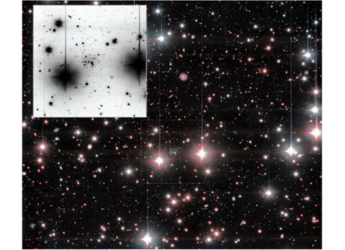
Andromeda XXXVI is a newly discovered ultra-faint dwarf satellite galaxy of Andromeda. It was spotted in archival Pan-Andromeda Survey images by an amateur and confirmed with deep imaging on the 10.4-m GTC (Gran Telescopio Canarias). It lies ~2.5 million light-years away, is extremely faint (absolute magnitude ~–6), and only about 200 ly across. With very few stars and a massive dark-matter component, it is considered a fossil of the early universe.
Discovery and Characteristics of Andromeda XXXVI
According to the research paper, Andromeda XXXVI was first spotted in PAndAS images by Giuseppe Donatiello and confirmed with deep OSIRIS/GTC imaging. Its color–magnitude diagram matches an old (~12.5 Gyr), metal-poor ([Fe/H] ≈ –2.5) stellar population. This places the galaxy ~2.53 million ly from Earth (388 kly from M31). Its absolute magnitude (M_V ≈ –6.0) and half-light radius (~200 ly) make it among Andromeda’s faintest, most compact satellites. Spectroscopic follow-up will be needed to measure its dark matter mass and confirm its classification.
Implications for Dark Matter and Galaxy Formation
Similar to other ultra-faint galaxies, Andromeda XXXVI is quite faint but significantly dark matter-dominated, making it an important laboratory for testing galaxy formation theory and dark matter theories. Should it form most of its stars before cosmic reionization, Andromeda XXXVI can be termed as “fossil”, with its stars being extremely old (~12.5 Gyr), and low on metals. It should also be noted that such a discovery aids the understanding of the complete satellite population around Andromeda. For instance, according to theory, Andromeda is expected to harbour up to ~100 dwarf satellite systems, whereas only about ~50 have been discovered so far.
Get your daily dose of tech news, reviews, and insights, in under 80 characters on Gadgets 360 Turbo. Connect with fellow tech lovers on our Forum. Follow us on X, Facebook, WhatsApp, Threads and Google News for instant updates. Catch all the action on our YouTube channel.