


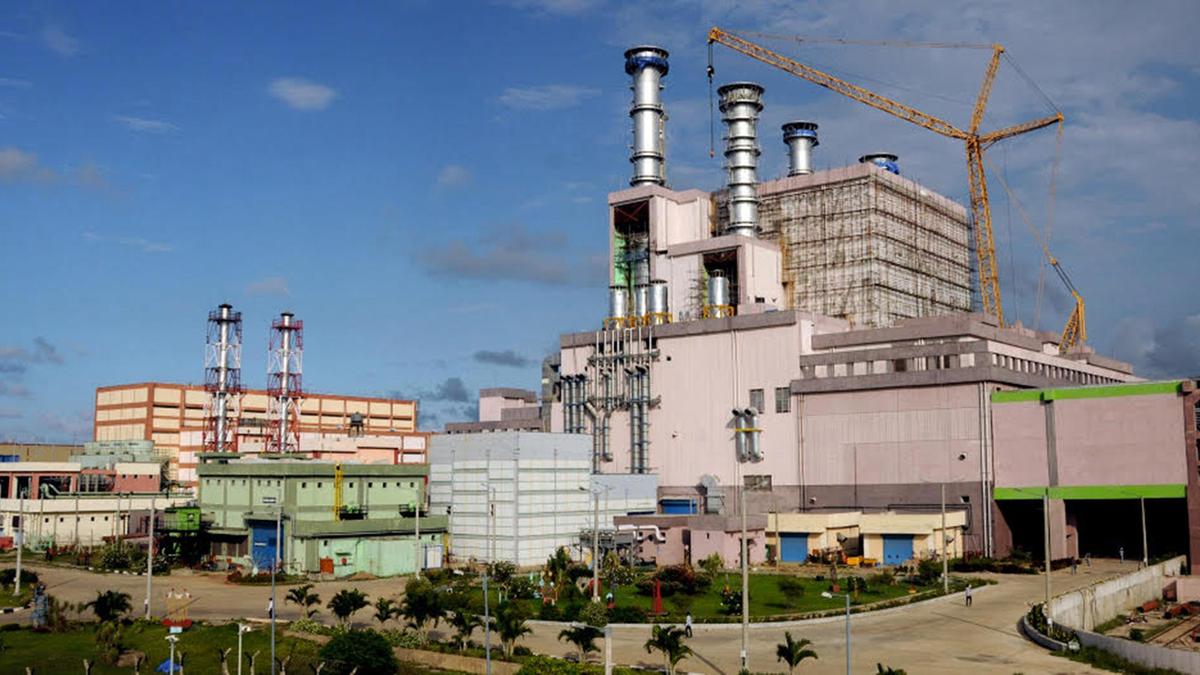
In an important milestone, the prototype fast breeder reactor (PFBR) at Kalpakkam achieved criticality on April 6. The term ‘criticality’ is familiar to India: over the decades, it has been associated with the slow and tedious successes of India’s nuclear power programme. At the same time, in keeping with many terms in the nuclear vocabulary, ‘criticality’ is also often mistaken as an end goal. In reality, it is actually the first step.
What is criticality?
A nuclear reactor becomes critical when its chain reaction is able to sustain itself. That is, when an atom’s nucleus undergoes nuclear fission, it releases neutrons that trigger at least one more fission reaction in the surrounding nuclei. Reactor engineers ensure this happens by controlling the composition of the fuel (the material whose nuclei undergo fission), how well the neutrons are able to ‘access’ more nuclei, and the temperature of the reactor.
Once a reactor is critical, it also means it is in a kind of stable state. However, it does not mean that it is operating in a commercially viable way. That comes much later. After criticality, the operators keep the reactor running as it produces a low amount of power, for months if necessary, while they check if its operating parameters are within design limits. If an operator is sure that the parameters are, they can go to the next stage.
How do FBRs work?
Most of India’s currently operating nuclear reactors are pressurised heavy water reactors (PHWRs). They are designed to support the fission of natural uranium. Natural uranium consists of 99.3% of uranium-238 and 0.7% of uranium-235. ‘235’ and ‘238’ denote the total number of protons and neutrons in the nucleus. In a PHWR, neutrons are introduced into the reactor, where a device called a moderator slows them down. This is necessary for the neutrons to cause uranium-235 to undergo fission. When it does, it releases heat, which the PHWR converts to electricity; a small amount of plutonium; and a few neutrons.
PHWRs are inefficient because only a small fraction of the fuel, around 1%, undergoes fission before it becomes unusable.

A fast-breeder reactor (FBR) is more efficient, achieving a fuel use rate of around 10% or more. Mainly, the fuel consists of plutonium, not uranium. The reactor core is surrounded by a ‘blanket’ of depleted uranium, like the unusable fuel produced by PHWRs. When a fast neutron bombards the blanket, the uranium nuclei are transmutated to plutonium nuclei, which are reprocessed as nuclear fuel. The plutonium-based fuel also uses the fast neutrons to undergo fission, releasing more fast neutrons.
What is India’s three-stage programme?
The nuclear physicist Homi Bhabha is widely credited with conceiving India’s nuclear programme in the first years of its independence. The programme has three stages. In the first stage, PHWRs will use natural uranium to produce plutonium and depleted uranium and electricity. In the second, FBRs will use the plutonium and depleted uranium from the first stage to produce even more plutonium and electricity. Finally, future nuclear reactors will use plutonium and thorium to produce electricity.
Bhabha came up with this programme because India has abundant quantities of thorium but only modest reserves of uranium.
And in this scheme, FBRs have been envisaged as a bridge between the initial step, to use what we have, and the final step, to complete the cycle and thus make India self-sufficient in nuclear power.
Why are FBRs challenging?
That an FBR is easier said than done would be a gross underestimate. The Indian government approved the PFBR more than two decades ago. It was designed by the Indira Gandhi Centre for Atomic Research and built by the Bharatiya Nabhikiya Vidyut Nigam, Ltd. The latter proved to be more challenging than first expected.
Among other features, the PFBR uses liquid sodium as coolant. Sodium becomes liquid at a higher temperature, and at higher temperature heat transfer is more efficient. Liquid sodium also does not need to be pressurised. However, it reacts violently with air and water, so the pumps, pipes, and tanks exposed to liquid sodium need to be perfectly sealed, with stringent leak detection protocols. Water-cooled reactors do not have such operational complexities, nor the additional cost.
India is also not alone in confronting these challenges. Japan’s Monju Nuclear Power Plant suffered a sodium leak and fire in 1995, leading to long shutdowns; the plant eventually had to be decommissioned. The Superphénix in France was once the world’s largest breeder reactor but it was shut down as well, due to technical issues and high operating costs, which also fanned political opposition. Russia, however, has continued to maintain a small fleet of fast-breeder reactors.
In other words, operators have shown FBRs to be technically feasible but they are not yet economically feasible; they have also not won broader public acceptance. Aside from the costs of making them, they also demand rigorous oversight — which depends on both engineering excellence and the safety culture.
How has India pursued FBRs?
India is pursuing FBRs because, as discussed earlier, the three-stage nuclear programme prioritises long-term fuel security. Importantly, it is able to do so because India’s nuclear sector remains largely driven by the state. Its decision-making structure is relatively insulated from the ruling establishment: the Department of Atomic Energy (DAE) reports directly to the Prime Minister’s Office. As a result, as long as there has been political stability, India has been able to sustain nuclear projects across electoral cycles.
On the flip side, this insulation has reduced scrutiny of the nuclear power programme and protected it from the same pressure to deliver that assails other public sector enterprises like the Indian Railways and the National Highways Authority. Engineers have taken on projects with limited transparency on timelines and budgets. When one or both have slipped, the accountability has been spread across agencies. The PFBR’s original cost was Rs 3,500 crore. It came to Rs 6,800 crore in 2019. The DAE also sought multiple deadline extensions. In 2020, it said the PFBR would be commercialised in October 2022. That milestone is still pending.

The economics of FBRs also remain uncertain. In addition to the aforementioned issues, the broader fuel cycle — especially the reprocessing of spent fuel and the fabrication of new fuel assemblies — will require its own infrastructure. And for this the nuclear establishment will have to set up new regulatory processes.
What next for the PFBR?
The PFBR will be operated at a low power level to check its behaviour in different operating conditions. Engineers will collect the data from these tests to inform decisions about raising the reactor’s power output and refining safety protocols. Eventually, they will seek approval from the Atomic Energy Regulatory Board to operate the reactor in commercial mode.
This entails running the PFBR at or near its rated capacity to generate electricity for the grid on a sustained basis, with standard operating procedures and clear regulatory oversight. At this point in time, the reactor will also have transitioned from being experimental to a commercial power plant.
In parallel, the DAE will also develop fuel reprocessing facilities and plan for future FBRs. Once these aims are closer to being realised, the government and India will develop a clearer sense of whether the broader vision of a closed fuel-cycle can be realised.
mukunth.v@thehindu.co.in
Published – April 08, 2026 07:45 am IST