


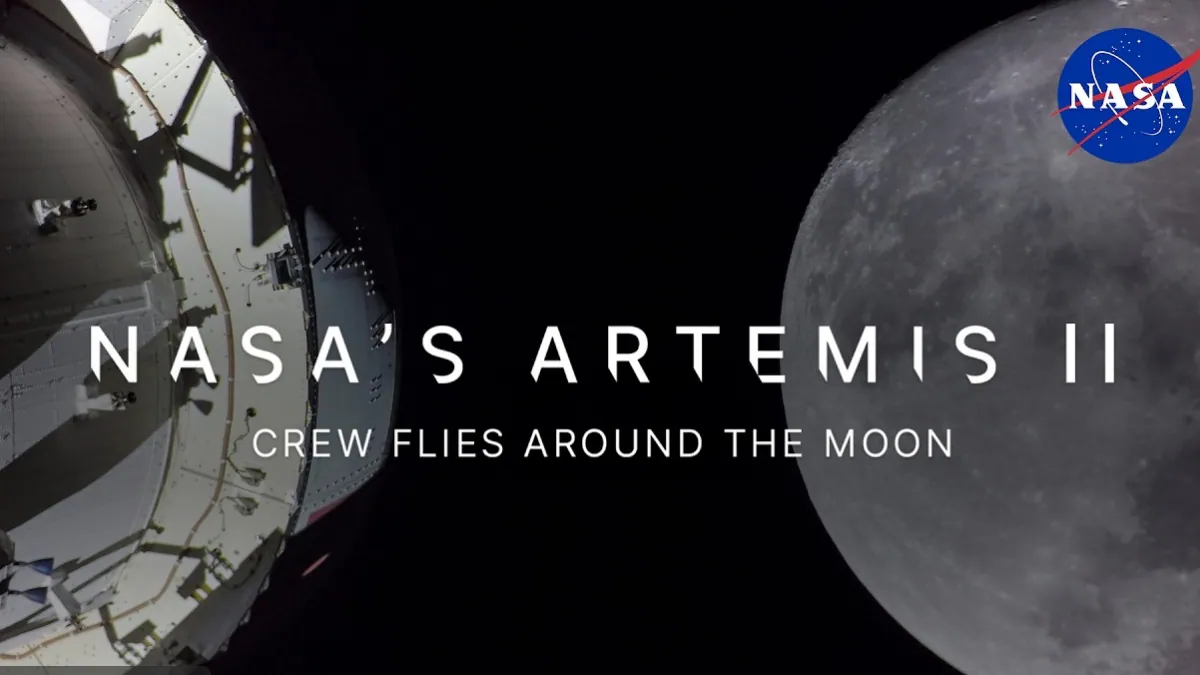
NASA made history last week with the successful launch of the Artemis II mission. The mission carries four astronauts on a lunar flyby. Now, Netflix has confirmed it will broadcast the mission. Besides the California-based streaming company, a few other platforms will also offer live coverage of the Artemis II lunar flyby. During the flyby, the Artemis II crew is expected to surpass the record previously achieved by the Apollo 13 crew in 1970 for the farthest humans have ever travelled from Earth.
Artemis II: How to Watch Live Stream
NASA, through its official blog, announced that it will provide live coverage of the Artemis II lunar flyby on Netflix. The streaming giant has also shared a notice on its website about the official Live. Viewers in India can watch live starting 10:30pm IST today (April 6).
The lunar flyby will be more widely broadcast through NASA+, Prime Video, Apple TV, Hulu, Netflix, HBO Max and Roku starting at 1:00pm Eastern Time, alongside the agency’s coverage on its YouTube channel. The livestream start may change based on real-time operations, NASA said. Interested readers can also watch it live directly from the video embedded below.
The Artemis II crew, comprised of NASA astronauts Reid Wiseman, Victor Glover, Christina Koch, and CSA (Canadian Space Agency) astronaut Jeremy Hansen, will enter the lunar sphere of influence, 41,072 miles from the Moon, around 12:41am ET (11:11am IST). Then the science officer in mission control will brief the crew on their science goals for the upcoming flyby. The record-breaking distance is expected at 1:56pm ET (12:26am IST), with Orion reaching its maximum distance of 252,760 miles, surpassing Apollo 13’s 248,655 miles.
The crew will begin lunar observations, and the Orion will reach its closest approach to the Moon at 4,070 miles above the surface at 7:02pm ET (4:32am IST). During a solar eclipse, the Sun will pass behind the Moon from the crew’s perspective.
As Orion passes behind the Moon, the mission will experience a planned communications blackout of about 40 minutes, since the lunar surface blocks signals from NASA’s Deep Space Network. On Tuesday, April 7, Orion exits the lunar sphere of influence, marking the end of this phase.
The Artemis II marks NASA’s first crewed mission in the 21st century, more than 50 years after the Apollo 17 mission in 1972. During the initial phase, the spacecraft orbited Earth several times to gain momentum. On the second day of the mission, NASA confirmed that the Orion spacecraft had completed a critical engine burn and had begun moving towards the Moon.
During the lunar flyby, the spacecraft is set to break the record for the farthest distance from Earth ever travelled by humans, surpassing the Apollo 13 milestone from April 1970.