


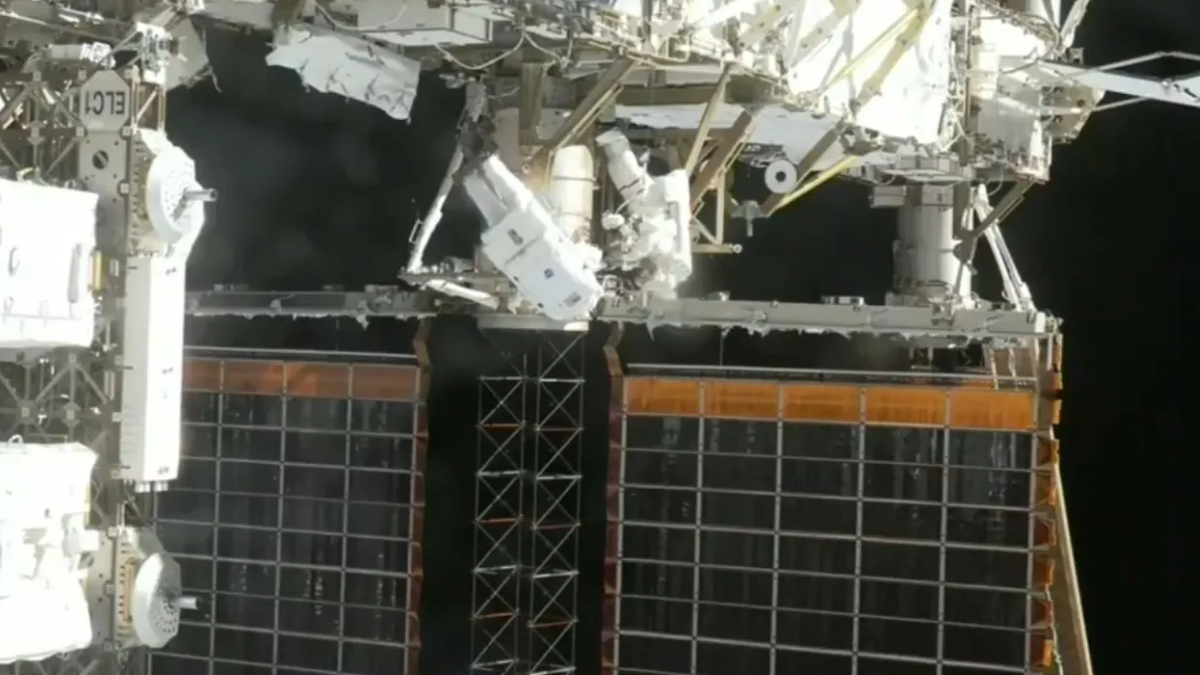
NASA astronauts Jessica Meir and Chris Williams concluded the US Extravehicular Activity 94 outside the ISS on March 18, 2026, at 3:54 p.m. EDT after seven hours and two minutes. The spacewalk was Williams’ first, and it was Meir’s fourth. The main objective of this spacewalk was to pave the way for an essential upgrade of the space station’s power system, which will have long-term implications for its future and eventual retirement.
Preparing the Station’s 2A Power Channel
According to NASA, the main objectives of the astronauts were to prepare the 2A power channel, which will allow for the installation of roll-out solar arrays to provide additional power for the orbiting space station, and its safe and controlled deorbit. The astronauts also installed an electrical jumper to allow for the servicing of the components of the 2A power channel, and they adjusted the bolt torque of a battery box. The managers of EVA activities decided to defer the planned swabbing of microorganisms on the outside of the station and the installation of a lens cover on a camera on the Canadarm2 robotic arm for a future spacewalk, owing to time constraints.
The Bigger Picture: Upgrading Ageing Solar Power
This spacewalk is part of a broader program aimed at mitigating the inherent degradation of the original solar panels of the ISS, which have been in space as far back as 2000. The photovoltaic cells of the original Solar Array Wings of the ISS have undergone gradual degradation, as they were originally intended to last 15 years. Redwire created the roll-out array system, or ROSA, which utilises solar panels launched in a rolled-up configuration, deploying after launch. A second spacewalk, EVA 95, is scheduled to install the matching upgrade on the 3B power channel.