


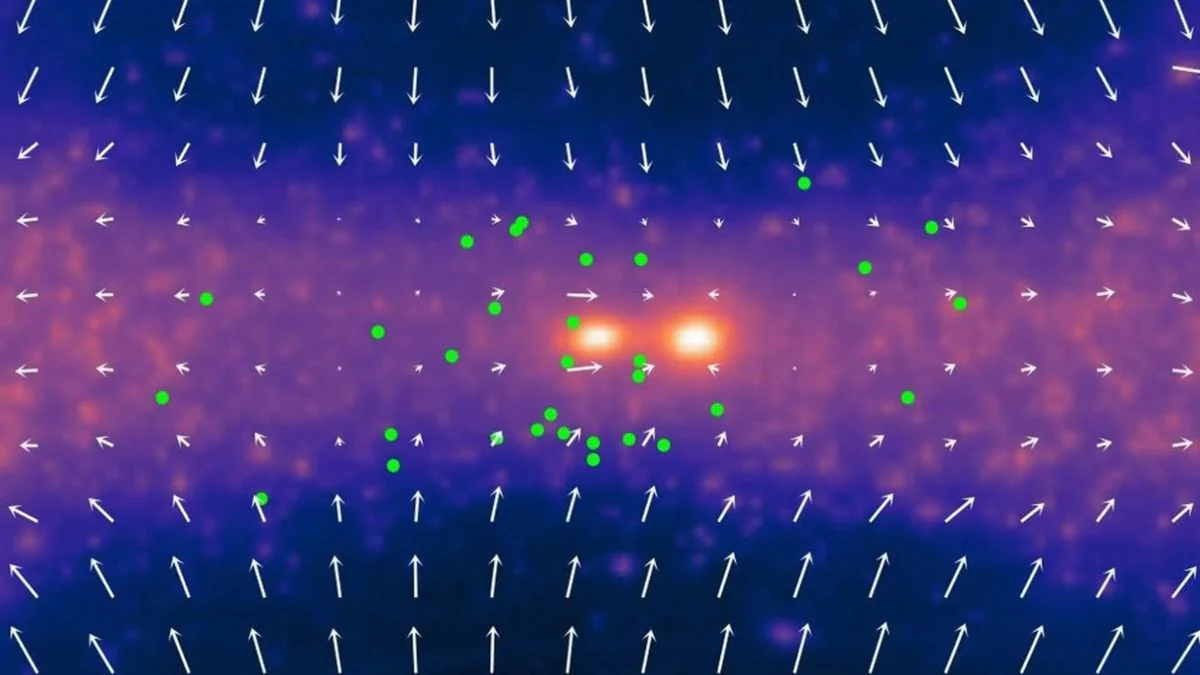
Scientists discovered that the Milky Way functions as a component of a massive flat dark matter sheet, which extends through space for more than tens of millions of light-years. The study solved a decades-long cosmic mystery because all but one of the nearest large galaxies, including our own, are moving away from us instead of being drawn towards us by gravity. The flat sheet exists, which contains enormous empty areas that extend throughout its upper and lower sections.
A giant dark-matter sheet
According to a press release from the University of Groningen, a team led by Ewoud Wempe ran detailed computer simulations of our cosmic neighbourhood from the Big Bang onward, adjusting the arrangement of matter to match today’s Local Group. They found the only way to reproduce observations was if most matter just beyond the Local Group lies in a flat plane about 10 megaparsecs (32 million light-years) across.
Above and below this sheet are large voids with almost no galaxies. In effect, the pull of the Local Group is balanced by distant mass in the plane, so galaxies keep drifting outward. Meanwhile, the voids contain virtually no galaxies to pull inward. This geometry produces a quiet Hubble flow matching observations and fits the standard cosmological model
A cosmic puzzle
Virtually all galaxies move away from the Milky Way, which was discovered by Hubble one century ago. However, Andromeda, the largest neighbour of the Milky Way, is moving towards us at 100 km/s. Moreover, other large galaxies, apart from Andromeda, appear to be oblivious to the Local Group’s gravitational pull, moving away from us. For several decades, scientists have been trying to explain the phenomenon of local galaxy motion.