


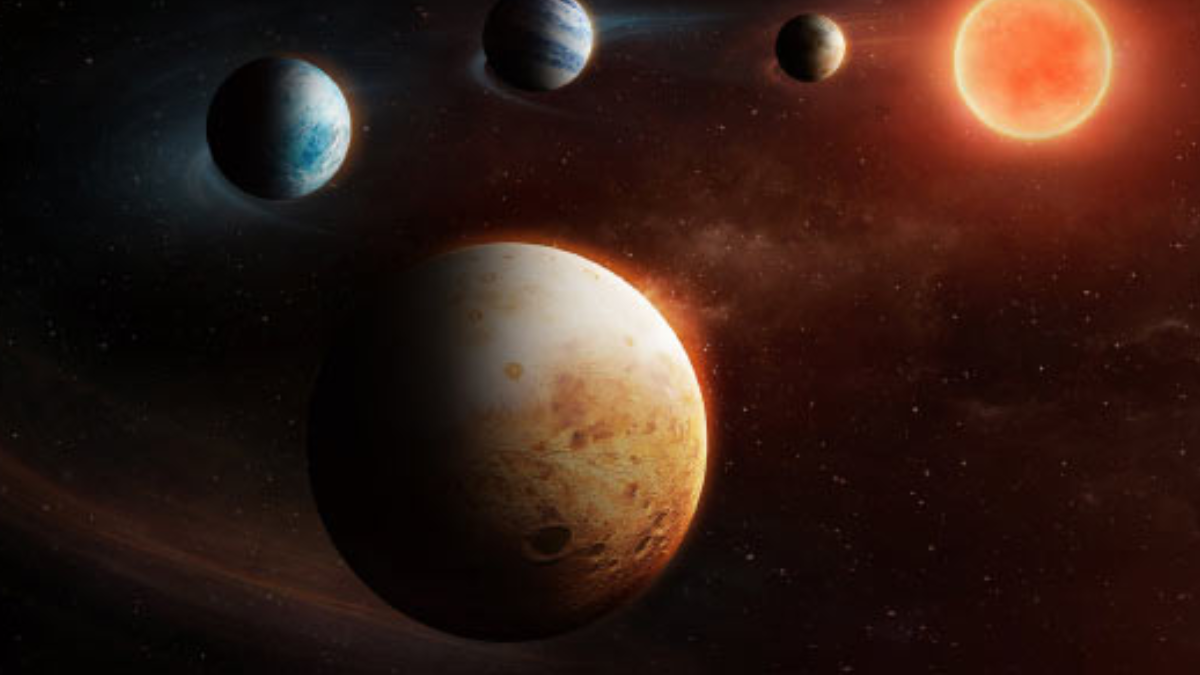
In a discovery made in the early part of 2026, the ESA space telescope CHEOPS (CHaracterising ExOPlanet Satellite) made an unexpected find in the system orbiting the red dwarf star LHS 1903. While three planets match the expected model (a rocky inner planet and two gas giants), the CHEOPS satellite discovered a fourth, outer planet that is also rocky, rather than gaseous. This upends the expected model (rocky inner, gas outer) and indicates that planets can form in ways that challenge our current understanding.
An inside-out planetary system
According to the paper, LHS 1903 is a small, faint red dwarf (cooler and fainter than our Sun) at a distance of 116 light-years. Three planets had been found — a rocky planet close to the star (LHS 1903 b), and two gas giants similar in size to Neptune (c and d), which orbited farther out.
However, CHEOPS was able to detect a fourth planet, LHS 1903 e, which is located at the edge of the system, and it is also a rocky planet. “This is an inside-out system,” explains Thomas Wilson, because “only the inner planets are rocky.”
Planets forming one by one
Simulations ruled out other explanations (a giant impact or orbital swap). Instead, the planets likely grew one after another as the protoplanetary disc evolved. By the time the fourth planet (LHS 1903 e) formed, the gas was almost gone. Wilson notes this is “first evidence for a planet in a gas-depleted environment”.
These findings, published in Science, offer strong evidence that planets can form in gas-poor conditions. As Ryan Cloutier says, this “challenges the assumptions built into our current models”. Astronomers note that LHS 1903 e thus stands as a reminder that exoplanetary systems can defy our Solar System–based expectations, possibly offering the first clue to a completely new planet-formation pattern.