


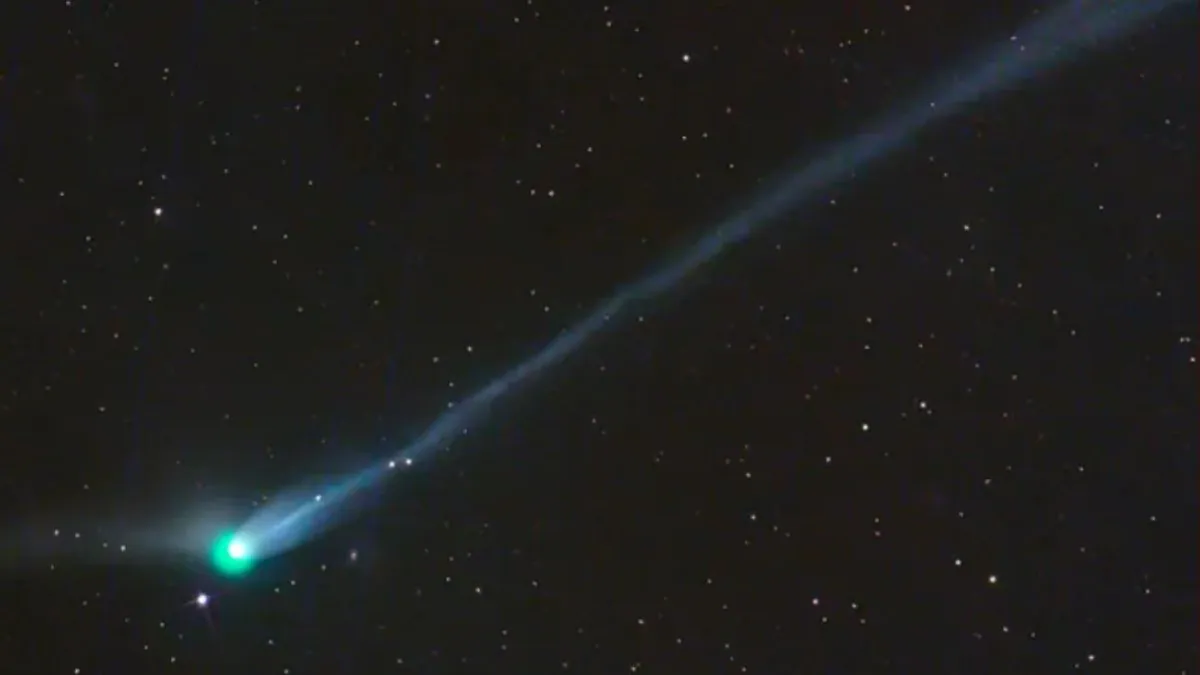
A very bright green comet, the recently discovered C/2024 E1 (Wierzchoś), is rapidly brightening as it heads toward its closest position next week, drawing significant attention from astronomers worldwide. This city-sized icy object, spotted in March 2024, is set to make its nearest approach on February 17, 2026, before being hurled out of the solar system altogether. Scientists suggest that its unusual trajectory and increasing brightness over time make it a rare visitor, much like other long-period comets that enter our solar system only once before being flung into deep interstellar space.
Carbon-Rich Coma and Possible Oort Cloud Origin
According to a Spaceweather.com and Space.com report, the The comet was initially identified by Polish astronomer Kacper Wierzchoś using a telescope at the Mount Lemmon Observatory. Subsequent observations with the James Webb Space Telescope (JWST) revealed an exceptionally high concentration of carbon dioxide within its coma, the luminous cloud of gas and dust surrounding the icy nucleus.
Initial analysis suggested the nucleus was approximately 13.7 kilometers wide (roughly city-sized); however, researchers believe this may have been an overestimate. It is likely a long-period comet originating from the distant Oort Cloud and is traveling on a hyperbolic, non-repeating orbit.
Long Journey Toward the Sun
Experts say the comet most likely spent between one and three million years gradually spiraling toward the Sun before visiting the inner solar system for the first time. Following its recent perihelion in January, it is now moving toward its closest approach to Earth, where it will remain visible through telescopes and binoculars.
Scientists state that its “solar slingshot” will fire it out of the solar system, destined to float through the Milky Way for millions or even billions of years.