


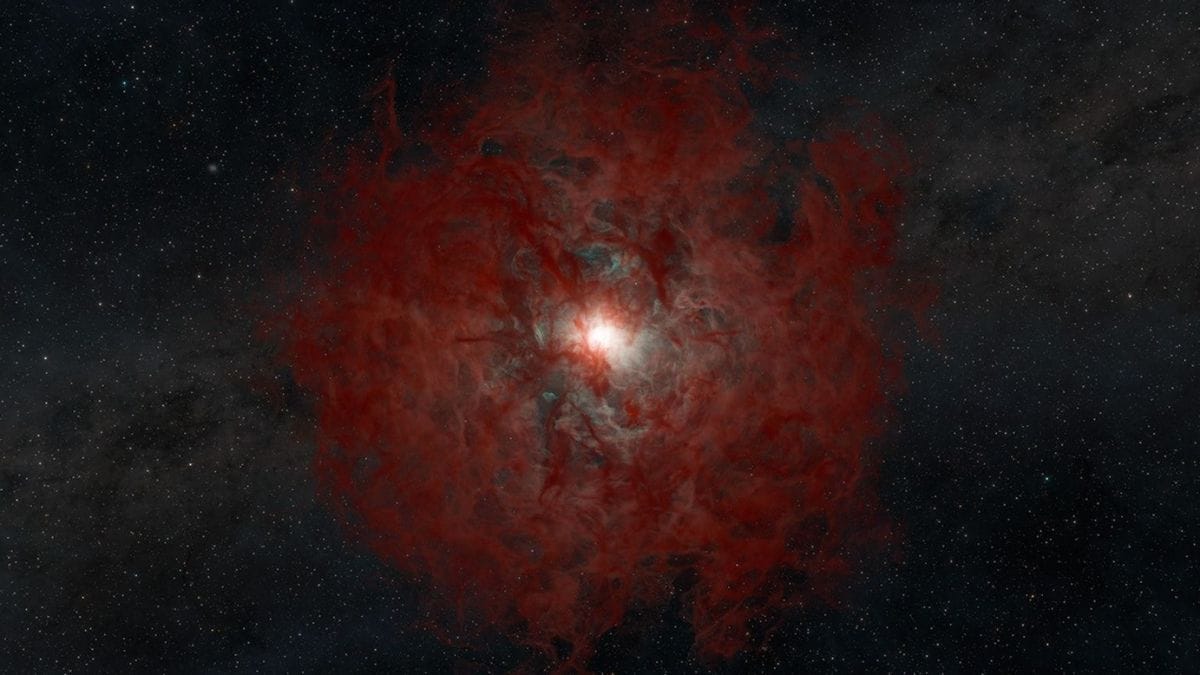
Recently, the NEOWISE, an infrared telescope owned by NASA, has witnessed the quiet disappearance of a massive star in the Andromeda galaxy. Initially, the massive star, dubbed M31-2014-DS1, was emitting visible light in the infrared band but had dimmed by 10,000 times in the visible band by 2023. Astronomers have concluded that M31-2014-DS1 apparently collapsed straight into a black hole instead of having a traditional “supernova.”
Infrared Clues from a Disappearing Star
According to the Archival data from NEOWISE telescopes, the mysterious brightness of the star in infrared light, observed around 2014, was due to hot dust emitted by a shedding process. By 2023, there was practically nothing left from its visible light, which is also in line with the predictions that a calm collapse should leave only a faint afterglow in infrared light. These were pieced together by combining other telescope data.
A Quiet Collapse to a Black Hole
Artist’s concept shows a star shedding gas and dust as its core collapses into a black hole. Instead of exploding, the star collapsed quietly into a black hole. Unlike a tidal disruption event (a star ripped apart by a black hole), this produced no brilliant flash. Astronomers had only one earlier candidate for such a failed supernova (in a galaxy about 10 times farther). Instead, it fits the failed-supernova model: the star ran out of fuel, and its weak shock couldn’t expel its envelope, so the core collapsed inward. This is the clearest example yet of a star turning into a black hole, helping scientists understand how many massive stars may fade unnoticed. Quiet collapses may be more common than realised.