


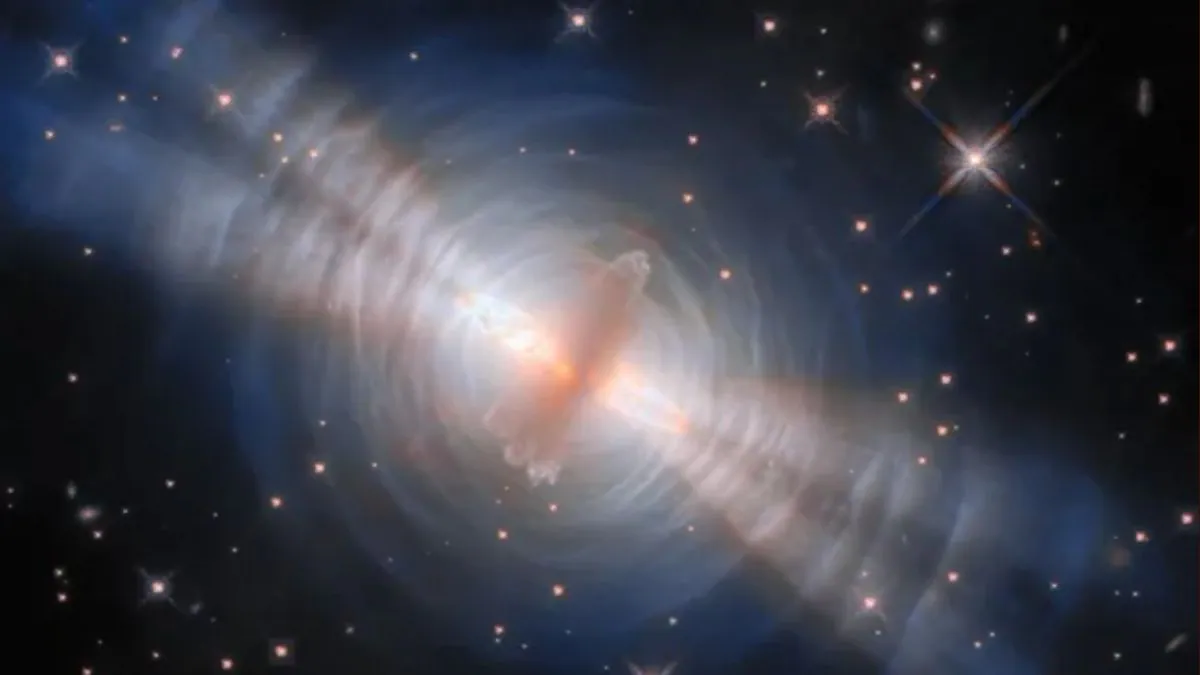
NASA’s Hubble Space Telescope has captured a new and breathtaking image of the Egg Nebula-a glowing shell of gas and dust surrounding a dying, Sun-like star some 1000 light-years from Earth. In this final cosmic drama, the star at the nebula’s centre is then enveloped in a dusty “yolk,” while beams of starlight blast through the surrounding clouds. According to astronomers, this brief but spectacular stage of life provides them with an unusually close-up view into the dying moments of a star.
Egg Nebula’s final act
According to NASA, the latest Hubble image is a stunning snapshot of the complex architecture of the Egg Nebula in unprecedented detail. The star’s light travels through the cavities of its dust and gas shells, making two beams of light illuminate the rings of ejected gas. Such perfect symmetry in its structure is not feasible for a supernova, but it is quite possible due to episodic jets, or ‘sputtering’ offshoots, emanating from the star’s core, according to NASA’s team of scientists. It is a detailed image of the structure of the nebula, thanks to a combination of Hubble’s images of the star
Planetary nebulae and Hubble’s legacy
To explain, planetary nebulae occur when Sun-like stars exhaust their nuclear fuel and subsequently expel their outer shells. The hot core left behind ionises the expelled shells, causing the nebulae to glow. (Note: They have nothing to do with actual planetary formation, by the way.) The Egg Nebula is a ‘pre-planetary’ stage of a dying star’s evolution. As a reminder, the Hubble telescope, deployed way back in 1990, has photographed a slew of planetary nebulae, like the Helix Nebula and Butterfly Nebula, and is still shining a light on stellar evolution after more than three decades in space.