


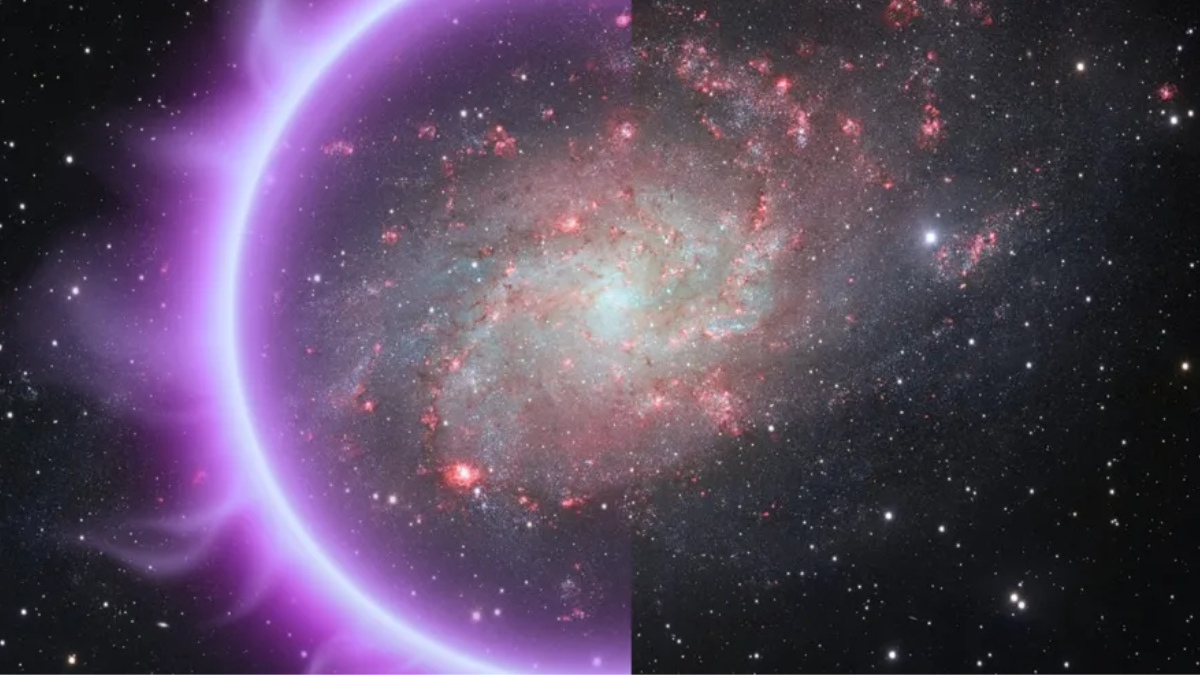
Dark matter, which scientists long have considered the dominant form of matter in the universe, may not exist at all. Rather, the odd twirls of galaxies and bent patterns of light throughout space could be evidence that gravity works very differently over immense distances than researchers understand. The idea challenges decades of cosmology, where invisible matter outweighs normal matter five to one, and could reshape views on galaxy formation, cosmic structure, universe evolution, and gravity’s true nature.
New Study Suggests Changing Gravity Could Explain Galaxy Motion Without Dark Matter
According to a report published on Phys.org, physicist Naman Kumar of the Indian Institute of Technology contends that dark matter might not be needed if gravity varies ever so slightly in strength at galactic scales. Kumar mentioned that dark matter was inferred because galaxies spin too fast and light bends more than visible matter can explain.
Kumar’s work re-examines gravity through the lens of quantum field theory and an infrared running framework, permitting gravity to be strength-modulated over distance. This creates a stronger force, which decays more slowly than anticipated, and appears to explain the way that galaxies rotate — a phenomenon typically attributed to dark matter halos.
New Gravity Model Fits Early Universe Data While Questioning Dark Matter’s Role
The theory also remains consistent with early-universe observations, where gravity changes must be minimal. Any deviations then grow as small corrections noticeable only at large, late-time cosmic scales.
While the model does not yet replace dark matter entirely, it suggests that some cosmic mysteries may reflect gravity’s hidden complexity rather than missing particles. Kumar’s findings were published in Physical Review Letters B.