


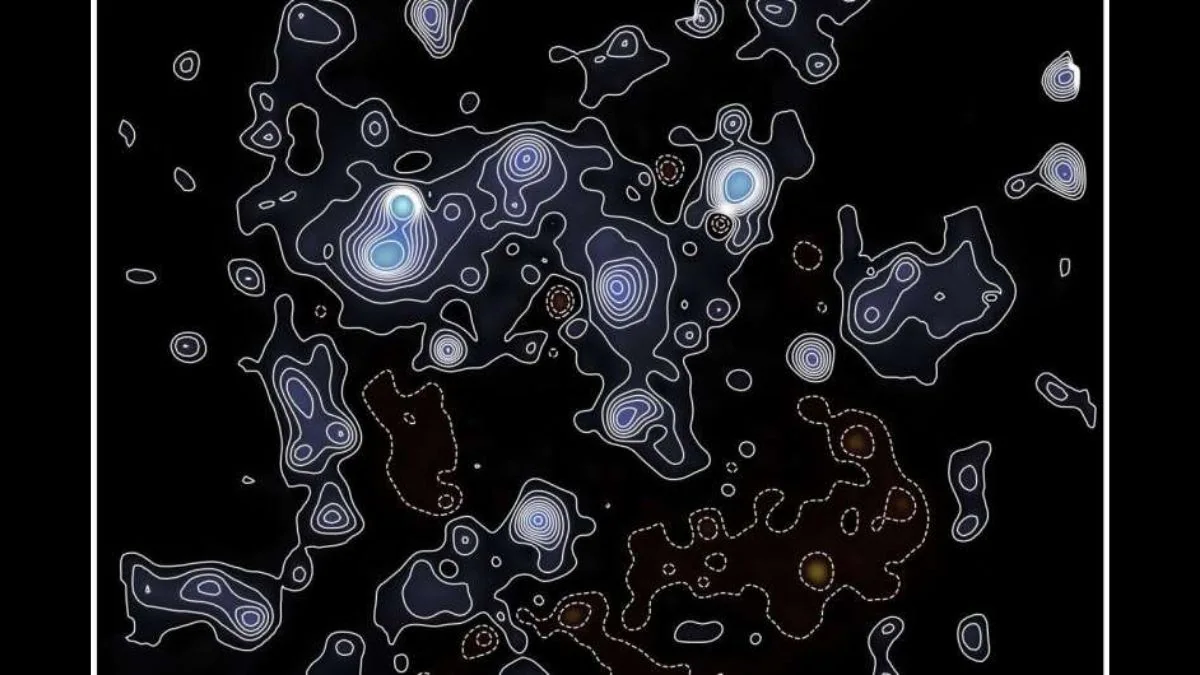
Astronomers have built the most detailed map of dark matter in the Universe, an invisible substance that makes up about 85 percent of all matter. Using deep images from the NASA James Webb Space Telescope, an international team of astronomers from Durham University, NASA’s Jet Propulsion Laboratory (JPL), and the Swiss Federal Institute of Technology in Switzerland have mapped the gravity of dark matter in the sky. The team has published their findings in Nature Astronomy.
Sharper dark-matter map
According to the study, Webb’s observations focused on the COSMOS field in the Sextans constellation, covering about 2.5 times the area of the full Moon. Over 255 hours of imaging, the telescope identified roughly 800,000 galaxies, enabling an ultra-high-resolution dark matter map. “This is the largest dark matter map we’ve made with Webb,” says JPL astrophysicist Diana Scognamiglio, and it is “twice as sharp as any dark matter map made by other observatories”. The Webb map contains about ten times more background galaxies than earlier surveys, revealing smaller clumps of dark matter in finer detail.
Dark matter’s role in galaxy formation
Dark matter does not emit or absorb light; it is invisible to telescopes—but it controls the way regular matter clumps together through gravity. By mapping the distortions of ~250,000 distant galaxies caused by lensing, the team verified that visible galaxy clusters lie within corresponding dark matter halos. As Durham University’s Richard Massey explains, “dark matter and regular matter have always been in the same place.” This supports the idea that dark matter was the first matter to clump together after the Big Bang, followed by gas to form galaxies.